
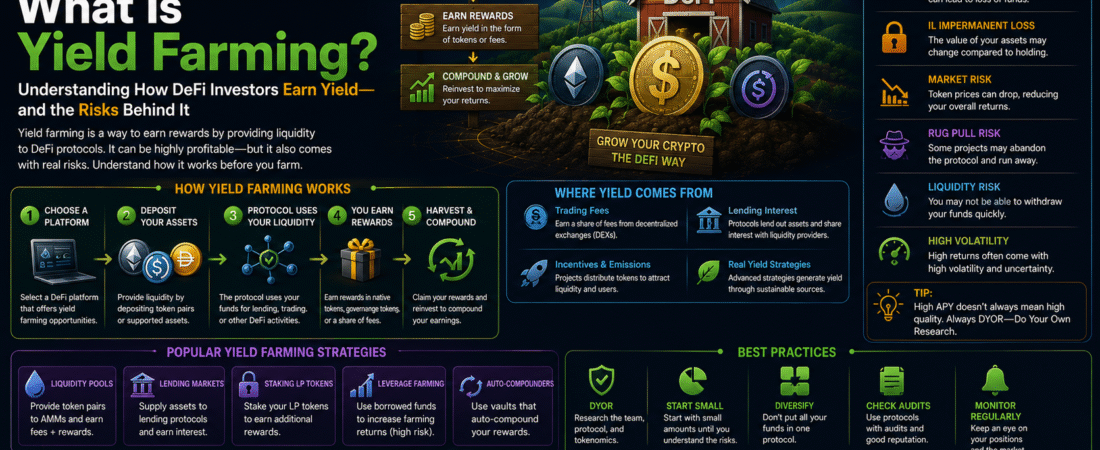

What Is Yield Farming? Understanding How DeFi Investors Earn Yield—and the Risks Behind It
CoinBrain Research Articles | Crypto Investing Basics — Article 04
Updated: August 2026
Crypto investors frequently encounter offers that appear remarkably attractive:
Earn 8% APY
Provide Liquidity and Earn Rewards
Deposit Stablecoins and Earn Yield
Farm Tokens
Boost Your DeFi Returns
These opportunities belong to a broad area of decentralized finance commonly known as yield farming.
At its simplest, yield farming means deploying crypto assets into decentralized finance protocols in an attempt to generate additional returns.
But those returns do not appear from nowhere.
Someone may be borrowing the capital.
Traders may be paying transaction fees.
A protocol may be distributing newly created tokens.
A decentralized exchange may need liquidity.
Or a project may simply be subsidizing users temporarily to attract capital.
Understanding where the yield comes from is therefore much more important than the headline APY.
Yield farming can make otherwise idle crypto assets economically productive. It can also combine several layers of risk—market risk, smart-contract risk, liquidation risk, impermanent loss, token inflation, oracle risk, and protocol failure.
For newcomers, the right question is not:
“Which farm offers the highest APY?”
The better question is:
“What economic activity generates this yield, and what risks am I accepting to receive it?”
Educational Notice: This article is for educational and research purposes only. It does not constitute financial, investment, tax, or legal advice. DeFi and yield farming can involve substantial risk, including complete loss of deposited assets.
1. Executive Summary
Yield farming is the practice of deploying crypto assets into decentralized finance protocols to earn financial rewards.
Those rewards can come from several sources:
- borrower interest
- decentralized exchange trading fees
- protocol incentives
- newly issued governance tokens
- staking rewards
- liquidity incentives
- combinations of these mechanisms
A simplified yield-farming flow might look like:
Crypto Assets → DeFi Protocol → Economic Activity → Rewards
For example, an investor may deposit USDC into a decentralized lending protocol.
Borrowers use that liquidity and pay interest.
Part of that interest is distributed to suppliers.
Alternatively, an investor might provide ETH and USDC to a decentralized exchange liquidity pool.
Traders swap between those assets.
The liquidity provider receives a portion of transaction fees.
A protocol may then add another incentive by distributing governance tokens.
The investor’s return might therefore consist of:
Trading Fees + Token Incentives + Other Protocol Rewards
This sounds attractive, but each additional layer introduces additional risk.
Yield farming differs fundamentally from staking.
Staking
Primarily helps secure a Proof-of-Stake blockchain.
Yield Farming
Primarily provides capital to decentralized financial applications in exchange for economic incentives.
The distinction is important.
Staking is fundamentally connected to blockchain consensus and network security.
Yield farming is fundamentally connected to capital allocation within DeFi markets.
2. Key Takeaways
Before participating in yield farming, understand these principles.
1. Yield must come from somewhere
Sustainable yield generally requires an identifiable economic source.
Examples include:
- borrowers paying interest
- traders paying transaction fees
- users paying protocol fees
If the only source of yield is newly created tokens, the reward may depend heavily on continued demand for those tokens.
2. High APY usually means higher complexity or risk
A 50%, 100%, or 500% APY should never be interpreted as free return.
Ask what economic conditions make such a reward possible.
3. Yield farming is not the same as staking
Staking secures a blockchain.
Yield farming deploys capital into DeFi protocols.
4. Liquidity providers can experience impermanent loss
Providing two assets to an automated market maker can produce a different outcome than simply holding those assets separately.
5. Lending introduces borrower and liquidation economics
DeFi lending protocols generally use collateral and automated liquidation systems to manage credit risk.
6. Smart contracts introduce technology risk
Even a financially sensible strategy can fail if the underlying software contains exploitable vulnerabilities.
7. APY can change rapidly
DeFi yields are frequently dynamic.
A 12% rate today could become 4% tomorrow.
8. Token rewards can hide weak economics
A protocol can temporarily create extremely attractive yields by distributing large quantities of its own token.
If that token loses value, the headline yield may prove meaningless.
9. Complexity compounds risk
Using:
ETH → Liquid Staking → Lending → Borrowing → Liquidity Pool → Yield Farm
may generate multiple sources of return.
It also creates multiple potential failure points.
10. Understand the strategy before depositing funds
If you cannot clearly explain where your yield comes from, you probably do not understand the investment sufficiently.
3. Market Overview
What Is DeFi?
Yield farming exists primarily within Decentralized Finance, or DeFi.
DeFi uses blockchain-based smart contracts to provide financial services without requiring every transaction to be processed by a traditional centralized intermediary.
Examples include:
- lending
- borrowing
- trading
- asset management
- stablecoins
- derivatives
- liquidity provision
- payments
- insurance-like products
Protocols such as Aave allow users to supply assets into blockchain-based liquidity pools from which other participants can borrow.
Aave’s current documentation explains that supplied assets enter smart-contract liquidity pools and begin earning variable interest based partly on borrowing utilization.
Decentralized exchanges such as Uniswap use another model.
Instead of matching every buyer with a seller through a traditional order book, users can provide assets directly into liquidity pools.
Those pools enable other users to trade.
Why Does Yield Farming Exist?
Financial markets need capital.
Banks need deposits to make loans.
Stock exchanges need liquidity.
Money markets need lenders.
Businesses need financing.
DeFi recreates many of these economic relationships through smart contracts.
Yield is the incentive that attracts capital.
Conceptually:
Capital Provider
↓
supplies assets
↓
DeFi Protocol
↓
uses liquidity for trading, lending, or another financial activity
↓
Economic Activity Generates Fees
↓
Capital Provider Receives Rewards
This is the healthy economic foundation of yield farming.
But another mechanism exists.
Incentive-Driven Yield
A new DeFi protocol may have few users and little liquidity.
It needs to attract capital.
The protocol may therefore distribute its own tokens to early participants.
For example:
Deposit $10,000 into Liquidity Pool X
Receive:
- normal trading fees
- plus 1,000 PROJECT tokens per month
This can create a very high advertised APY.
But part of that yield is effectively a customer-acquisition incentive.
If PROJECT tokens decline dramatically in value, the apparent return disappears.
This distinction between:
Organic Yield
and
Subsidized Yield
is one of the most important concepts in DeFi investing.
4. Technology Deep Dive
Yield farming can involve several different financial mechanisms.
Understanding them separately makes the overall concept much easier.
Mechanism 1 — Lending
Suppose you own:
10,000 USDC
You supply it to a decentralized lending protocol.
Other participants want to borrow USDC.
They provide collateral and pay interest.
Part of that interest goes to suppliers.
The economic relationship is:
Depositor → Liquidity Pool → Borrower
and:
Borrower Interest → Liquidity Pool → Depositor Yield
Aave currently operates using this type of overcollateralized lending architecture. Its supply rates respond dynamically to utilization—how much supplied liquidity borrowers are actually using.
If borrowing demand rises relative to available supply:
Interest rates may rise.
If large amounts of capital enter the market while borrowing demand remains weak:
Interest rates may fall.
This is genuine market-driven yield.
Mechanism 2 — Liquidity Providing
Consider a decentralized exchange.
Users want to trade:
ETH ↔ USDC
Where do the assets required for those trades come from?
One model uses a:
Liquidity Pool
Investors contribute assets into the pool.
For example:
ETH + USDC
Traders then swap against this liquidity.
Trading fees can be distributed to liquidity providers.
Conceptually:
Liquidity Provider
↓
ETH + USDC
↓
Liquidity Pool
↓
enables trading
↓
Traders Pay Fees
↓
Liquidity Providers Earn Fees
Automated Market Makers
Many decentralized exchanges use Automated Market Makers, commonly abbreviated:
AMMs
Instead of relying entirely on traditional order books, AMMs use mathematical rules encoded in smart contracts to determine trading relationships.
A classic simplified constant-product model is:
x × y = k
Where:
- x = quantity of Token A
- y = quantity of Token B
- k = pool constant
When traders remove one asset from the pool, they add the other.
The balance between the two assets changes.
This mechanism allows continuous decentralized trading.
Uniswap’s documentation describes this constant-product relationship when explaining how liquidity positions change as token prices move.
Mechanism 3 — Liquidity Mining
Suppose a decentralized exchange wants additional liquidity.
Trading fees alone may not attract enough providers.
The protocol can offer:
Trading Fees + Governance Token Rewards
This additional incentive is commonly associated with:
Liquidity Mining
For example:
Provide ETH/USDC liquidity.
Earn:
- swap fees
- plus protocol tokens
Liquidity mining became one of the foundational mechanisms behind early DeFi yield farming.
Mechanism 4 — Protocol Incentives
Protocols frequently distribute tokens to encourage desired behavior.
They may reward users for:
- depositing assets
- borrowing assets
- providing liquidity
- staking liquidity-provider positions
- participating in governance
- supporting new markets
These rewards can be useful for bootstrapping a network.
However, they should not automatically be considered sustainable revenue.
Mechanism 5 — Leveraged Yield Farming
More sophisticated participants may borrow assets to increase the capital deployed into a yield strategy.
Example:
Initial capital:
$10,000
Borrow additional:
$5,000
Total deployed:
$15,000
If yield exceeds borrowing costs, the strategy may increase returns.
But leverage introduces:
Liquidation Risk
If collateral values move unfavorably, part of the position may be automatically sold.
Aave’s current borrowing documentation emphasizes that collateral must remain above required thresholds; otherwise positions can be liquidated.
For beginners, leveraged yield farming belongs firmly in the advanced category.
Mechanism 6 — Yield Aggregators
DeFi strategies can become complicated.
A yield aggregator attempts to automate parts of the process.
Instead of manually moving assets between protocols, an investor deposits into a strategy that attempts to optimize yield automatically.
Conceptually:
Investor
↓
Yield Aggregator
↓
Strategy A
Strategy B
Strategy C
↓
Optimized Return
Convenience comes with another dependency.
The investor now relies on:
Underlying Protocols + Aggregator Smart Contracts + Strategy Logic
Staking vs Lending vs Liquidity Providing vs Yield Farming
These concepts should not be mixed together.
| Activity | Primary Purpose | Typical Return Source | Important Risk |
|---|---|---|---|
| Staking | Secure blockchain | Protocol rewards + fees | Slashing / asset risk |
| Lending | Provide borrowable capital | Borrower interest | Smart contract / liquidation system |
| Liquidity Providing | Enable trading | Trading fees | Impermanent loss |
| Yield Farming | Optimize/use DeFi capital | Multiple rewards | Multiple combined risks |
Yield farming is therefore best understood as an umbrella strategy that can combine several mechanisms.
5. Current Industry Landscape
Yield farming has changed substantially since the first major DeFi expansion.
Early DeFi markets became famous for extremely high token incentives.
Protocols competed aggressively for liquidity.
Investors moved capital from one opportunity to another looking for the highest yields.
This period introduced terms such as:
Yield Farming
Liquidity Mining
and occasionally:
DeFi Summer
The market has since become considerably more sophisticated.
Lending Protocols
Large lending protocols provide markets where users supply and borrow assets.
Aave, for example, currently operates across Ethereum and numerous additional blockchain and Layer-2 environments. Its current protocol documentation describes non-custodial, overcollateralized lending through publicly accessible smart contracts.
Decentralized Exchanges
DEX liquidity pools remain another major source of DeFi yield.
Users supply assets that enable decentralized trading.
Modern liquidity provision has also become more sophisticated.
Rather than supplying liquidity across every possible price, providers may choose specific trading ranges.
This can improve capital efficiency.
But it also creates management requirements.
For example, Uniswap notes that when a concentrated-liquidity position moves outside its configured range, that position stops earning trading fees until the market returns to the range.
Stablecoin Yield
Stablecoins have become particularly important within DeFi yield markets.
Investors may supply assets such as dollar-linked stablecoins to:
- lending protocols
- liquidity pools
- tokenized financial products
- automated yield strategies
Stablecoins reduce one type of volatility compared with highly volatile crypto assets.
They do not eliminate risk.
Stablecoin holders still face:
- issuer risk
- reserve risk
- smart-contract risk
- depegging risk
- regulatory risk
- protocol risk
Liquid Staking Integration
The rise of liquid staking created another source of DeFi collateral.
A user might:
Stake ETH
↓
receive a liquid staking token
↓
deposit that token into another DeFi protocol
↓
borrow against it
↓
deploy borrowed assets elsewhere
This creates what is often called:
Composability
One DeFi building block can interact with another.
This is one of DeFi’s most powerful characteristics.
It is also one of its greatest sources of systemic complexity.
Regulatory Evolution
The relationship between decentralized applications and financial regulation continues to evolve.
In 2026, discussions around the regulatory treatment of genuinely non-custodial DeFi front ends and decentralized protocols remained active within the SEC’s Crypto Task Force process, illustrating that the legal treatment of DeFi architecture remains an evolving policy area.
Investors should therefore distinguish between:
Technical decentralization
and
Regulatory status.
A protocol calling itself decentralized does not automatically determine how regulators will classify every activity around it.
6. Institutional Activity
Early yield farming was dominated by crypto-native investors.
That is gradually changing.
Institutional engagement with DeFi is developing through several channels.
Institutional Lending
Professional investors increasingly evaluate blockchain-based credit markets.
Potential advantages include:
- transparent collateral
- programmable settlement
- continuous markets
- automated interest calculations
- blockchain-based reporting
Institutional participation generally requires stronger controls around:
- custody
- compliance
- smart-contract risk
- counterparty analysis
- governance
- legal structure
Tokenized Real-World Assets
An important development is the convergence of:
DeFi
and
Traditional Financial Assets
Tokenized:
- government securities
- money-market instruments
- private credit
- funds
can potentially become usable within blockchain-based markets.
This changes the possible sources of DeFi yield.
Instead of all returns depending on crypto-native token incentives, blockchain investors may increasingly access yield ultimately generated by traditional economic assets.
This could become one of the most important transformations in decentralized finance.
Institutional Stablecoin Markets
Stablecoins increasingly serve as digital settlement assets.
Institutions can potentially use blockchain markets for:
- cash management
- settlement
- collateral
- lending
- treasury activity
As institutional stablecoin adoption expands, demand for blockchain-based money markets may expand with it.
Professional Market Making
Professional trading firms provide liquidity across centralized and decentralized markets.
DeFi therefore increasingly intersects with sophisticated:
- arbitrage
- market making
- liquidity management
- derivatives
- cross-market strategies
Yield farming is no longer simply retail investors depositing tokens into promotional pools.
At the professional level, it is becoming part of a broader on-chain capital market.
7. Market Data & Metrics
Understanding yield farming requires looking beyond APY.
Several metrics deserve attention.
Annual Percentage Rate — APR
APR generally expresses annualized return without assuming compounding.
Simplified example:
Deposit:
$10,000
APR:
5%
Approximate annual reward:
$500
before fees, taxes, losses, and rate changes.
Annual Percentage Yield — APY
APY incorporates compounding assumptions.
If rewards are continually reinvested:
Earned Yield → Added to Principal → Generates Additional Yield
This can produce a higher theoretical annual return than simple APR.
However:
APY is not necessarily fixed.
A DeFi interface showing:
12% APY
does not mean the investor will earn exactly 12% during the following year.
Rates may change continuously.
Total Value Locked — TVL
TVL attempts to measure the value of assets deposited into a protocol or broader ecosystem.
For example:
Protocol deposits:
$5 billion
TVL:
approximately $5 billion
depending on methodology.
TVL can provide useful context about protocol size.
But:
High TVL ≠ Safe Protocol
and:
Low TVL ≠ Bad Protocol
TVL should be used together with other metrics.
Utilization Rate
In lending protocols:
Utilization Rate = Borrowed Assets ÷ Supplied Assets
Suppose:
Supplied USDC:
$100 million
Borrowed:
$80 million
Utilization:
80%
Higher utilization can generate stronger lending rates because more capital is being demanded by borrowers.
Aave explicitly uses utilization as a central factor in determining variable supply and borrowing rates.
Protocol Revenue
Investors should ask:
How much actual economic activity does this protocol generate?
Important metrics can include:
- trading fees
- borrowing interest
- protocol fees
- transaction volume
- active users
- revenue retained by protocol
- rewards distributed to participants
Incentive Yield vs Organic Yield
Suppose a farm offers:
20% APY
Breakdown:
Trading fees:
4%
Token incentives:
16%
Then most of the advertised yield depends on token subsidies.
Compare another strategy:
Total yield:
6%
Borrower interest:
6%
Although the headline return is lower, its economics may be easier to understand.
This does not automatically make either strategy better.
But the distinction is essential.
Token Emissions
If rewards are paid in protocol tokens, study:
- emission schedule
- circulating supply
- total supply
- unlocks
- token utility
- market liquidity
- demand
A 100% token-denominated APY may be meaningless if the reward token loses 90% of its value.
Trading Volume
For liquidity providers, trading volume matters because trading activity produces fees.
A liquidity pool with:
High TVL + Very Low Volume
may generate relatively weak fee income.
A more useful metric can therefore be:
Trading Volume ÷ Liquidity
Net Yield
Always focus on what remains after costs.
A simplified framework is:
Net Yield = Gross Rewards + Fees − Losses − Costs
Costs may include:
- gas fees
- protocol fees
- validator or management fees
- impermanent loss
- borrowing interest
- slippage
- taxes
- token depreciation
8. Real-World Use Cases
Yield farming supports several important functions within decentralized finance.
Use Case 1 — Lending Stablecoins
An investor supplies USDC to a lending protocol.
Borrowers pay interest.
The supplier receives part of the resulting yield.
Use Case 2 — Providing Exchange Liquidity
An investor supplies:
ETH + USDC
to a liquidity pool.
Traders use the pool to swap between ETH and USDC.
The liquidity provider earns part of the trading fees.
Use Case 3 — Bootstrapping New Markets
A new protocol needs liquidity.
It distributes governance tokens to early liquidity providers.
This attracts:
- capital
- traders
- market activity
The incentives may decline as the protocol matures.
Use Case 4 — Stablecoin Liquidity
Providing liquidity between assets intended to remain close in value can reduce some volatility relative to volatile asset pairs.
Examples could conceptually include:
Stablecoin A ↔ Stablecoin B
But stablecoin depegging remains a major risk.
Use Case 5 — Automated Yield Optimization
Yield aggregators can move or compound assets according to predefined strategies.
This reduces manual management.
It adds strategy and smart-contract dependencies.
Use Case 6 — Collateral Productivity
An investor may deposit assets as collateral and simultaneously earn some form of supply yield.
The capital can potentially support additional borrowing or other strategies.
Use Case 7 — On-Chain Treasury Management
Businesses, DAOs, funds, and crypto-native organizations can potentially deploy treasury assets into on-chain markets to earn yield rather than leaving assets economically inactive.
Professional treasury management requires significantly stronger risk controls than simply selecting the highest available return.
9. Risks & Challenges
Yield farming can combine more risks than almost any beginner crypto strategy.
Understanding them is essential.
1. Smart-Contract Risk
DeFi protocols operate through software.
Software can contain bugs.
Attackers may exploit vulnerabilities and drain funds.
A project being large, popular, or audited does not guarantee that it cannot fail.
2. Impermanent Loss
This is one of the most misunderstood concepts in DeFi.
Suppose you provide:
ETH + USDC
to an automated market maker.
ETH’s price changes significantly.
The pool automatically rebalances the quantities of ETH and USDC as traders interact with it.
When you eventually withdraw, your asset composition may differ from what you originally deposited.
Your position may be worth less than simply holding the original assets separately.
That difference is commonly called:
Impermanent Loss
Uniswap specifically identifies impermanent loss, market volatility, out-of-range positions, smart-contract vulnerabilities, and untrusted token teams among the risks faced by liquidity providers.
3. Token Price Risk
A farming strategy may earn large quantities of reward tokens while those tokens collapse in value.
For example:
Rewards:
+50% in token units
Reward token price:
-80%
The headline APY becomes economically misleading.
4. Rug Pull Risk
A malicious or irresponsible team may:
- withdraw liquidity
- manipulate token economics
- exploit administrative privileges
- abandon the project
New and unaudited protocols deserve particular caution.
5. Oracle Risk
Lending and trading protocols often depend on external price information.
If those price feeds fail or are manipulated, incorrect liquidations or other protocol failures can occur.
6. Liquidation Risk
Borrowing against collateral introduces liquidation risk.
Suppose:
Collateral:
$10,000 ETH
Borrowed:
$6,000 stablecoins
ETH falls sharply.
The position may violate required collateral thresholds.
Smart contracts may automatically liquidate part of the collateral.
Aave specifically requires borrowers to monitor collateral health because positions can be liquidated when required thresholds are breached.
7. Stablecoin Depeg Risk
A token designed to track:
$1
may temporarily or permanently trade below that value.
Suppose a supposedly stable asset falls to:
$0.70
A 10% yield cannot compensate for a 30% principal loss.
8. Liquidity Risk
You may not always be able to withdraw the full amount immediately.
In lending markets, available withdrawal liquidity can depend on how much of the pool has been borrowed. Aave’s current documentation explicitly notes that withdrawals depend on sufficient unborrowed liquidity being available in the pool.
9. Governance Risk
Protocol rules can change.
Governance may alter:
- collateral requirements
- incentives
- fees
- emissions
- supported assets
- risk parameters
10. Bridge Risk
Yield farmers frequently move assets between blockchain networks.
Blockchain bridges have historically represented an important security risk.
A strategy may therefore depend not only on the destination protocol, but also on the infrastructure used to move assets there.
11. Composability Risk
Consider this strategy:
ETH
↓
Liquid staking protocol
↓
Liquid staking token
↓
Lending protocol
↓
Borrowed stablecoin
↓
Liquidity pool
↓
Yield aggregator
The position may depend on:
five or six separate systems functioning correctly.
One failure can affect the entire chain.
12. APY Illusion
A protocol showing:
1,000% APY
can attract enormous attention.
But extremely high APY may result from:
- tiny liquidity
- rapidly issued tokens
- temporary incentives
- unsustainable economics
- volatile reward tokens
A high APY should trigger more analysis—not less.
10. Future Outlook: 3–5 Years
Yield farming will probably evolve substantially over the next several years.
The early model of:
“Deposit token → receive huge token emissions”
is unlikely to represent the long-term future of sophisticated DeFi.
Several developments are more important.
Shift Toward Sustainable Yield
Investors are increasingly likely to distinguish between:
Yield generated by actual economic activity
and
Yield generated primarily by token inflation.
Sustainable models may increasingly emphasize:
- transaction fees
- borrower interest
- real-world asset income
- protocol revenue
Real-World Assets Meet DeFi
Tokenized:
- treasury securities
- money-market instruments
- private credit
- financial funds
could increasingly interact with DeFi protocols.
This could connect blockchain markets with trillions of dollars of traditional financial assets.
Institutional DeFi
Professional investors may increasingly use blockchain-based:
- lending markets
- liquidity infrastructure
- settlement
- collateral management
- tokenized assets
Institutional adoption will likely demand higher standards in:
- security
- compliance
- identity
- risk management
- reporting
Better Risk Management
Future DeFi interfaces may display much more than APY.
Investors could increasingly see:
- smart-contract risk ratings
- liquidity risk
- collateral exposure
- protocol concentration
- stablecoin exposure
- yield source decomposition
This could make DeFi more understandable to mainstream users.
Automated Strategies
Smart contracts and AI-based systems may increasingly automate:
- liquidity ranges
- collateral management
- yield optimization
- portfolio rebalancing
- risk monitoring
But automation does not eliminate risk.
It simply changes who—or what—is managing it.
Cross-Chain Yield Markets
Capital will likely continue moving across multiple blockchain ecosystems.
Better interoperability could create more integrated DeFi markets.
Security around bridges and cross-chain messaging will remain critical.
DeFi Becomes Financial Infrastructure
Long term, the most important development may be that users stop thinking about:
“yield farming”
as a special crypto activity.
Instead, blockchain protocols may simply become another financial infrastructure layer through which:
Capital seeks return.
That would represent genuine market maturation.
11. Investment & Business Implications
For beginners considering yield farming, the correct decision process should begin with risk—not APY.
Step 1 — Identify the Source of Yield
Ask:
Who is paying me?
Possible answers:
- borrowers
- traders
- protocol treasury
- token inflation
- another protocol
If you cannot identify the source, stop there.
Step 2 — Identify What You Are Depositing
Are you depositing:
- ETH?
- Bitcoin representation?
- stablecoins?
- governance tokens?
- liquidity-provider tokens?
- liquid staking tokens?
Each asset has different risk.
Step 3 — Identify Every Protocol Dependency
Suppose your strategy depends on:
USDC + Ethereum + Lending Protocol + Oracle
You now have at least four different categories of dependency.
Write them down.
Step 4 — Separate Organic and Incentive Yield
Suppose:
Total advertised APY:
15%
Breakdown:
Borrowing interest:
5%
Protocol token incentives:
10%
Now you understand the economics much better.
The 15% should not be treated as one homogeneous return.
Step 5 — Examine Historical Rates
Do not assume today’s APY will continue for one year.
Look at:
- historical utilization
- historical yields
- incentive changes
- governance proposals
- token emissions
Step 6 — Understand Withdrawal Conditions
Ask:
Can I withdraw immediately?
Is sufficient liquidity available?
Does withdrawal depend on another market?
Are there lockups?
What transaction costs apply?
Step 7 — Calculate Net Return
Suppose:
Gross yield:
8%
Protocol fees:
-0.5%
Gas and transaction costs:
-0.5%
Impermanent loss:
-3%
Net:
approximately 4%
The headline APY told only part of the story.
Step 8 — Limit Complexity
A beginner strategy involving one well-understood protocol is easier to evaluate than a five-protocol leveraged farming loop.
Every additional component introduces another potential failure point.
A Beginner Example
Suppose Maria owns:
10,000 USDC
She finds two opportunities.
Farm A
Advertised yield:
6%
Source:
Borrowers pay interest.
Protocol has substantial liquidity and established lending markets.
Farm B
Advertised yield:
80%
Source:
5% trading fees
75% newly issued FARM tokens.
At first glance:
80% > 6%
But Maria investigates further.
FARM token supply is rapidly increasing.
The token has limited utility.
Liquidity is thin.
Most rewards depend on continued token issuance.
The proper comparison is therefore not:
6% vs 80%
It is:
Different economic mechanisms + Different risk structures
This is how a serious investor should evaluate yield.
Business Implications
Yield-generating DeFi is creating businesses around:
- blockchain lending
- liquidity infrastructure
- stablecoins
- automated market making
- tokenized securities
- institutional collateral
- treasury management
- risk analytics
- smart-contract auditing
- DeFi insurance
- compliance infrastructure
- portfolio automation
The long-term opportunity may therefore extend far beyond retail yield farming.
DeFi could become infrastructure for programmable capital markets.
12. Final Analysis
Yield farming introduced a powerful idea to crypto:
Digital assets do not necessarily have to remain economically idle.
They can provide:
- liquidity
- credit
- collateral
- trading infrastructure
and potentially earn compensation for doing so.
But yield farming also demonstrated one of crypto’s most dangerous psychological traps:
The higher the displayed APY, the more attractive the investment appears.
The correct relationship should often be the opposite:
The higher the yield, the more questions an investor should ask.
Start with:
Where does the yield come from?
Then ask:
Who is paying it?
Why are they paying it?
How sustainable is it?
What assets are exposed?
Which smart contracts are involved?
Can the position be liquidated?
Could impermanent loss exceed the fees?
Could the reward token collapse?
Could the stablecoin depeg?
Could the protocol fail?
Only after answering those questions should the headline APY become relevant.
The most important distinction for newcomers is therefore:
Yield is not the same as profit.
And:
APY is not the same as investment return.
A 20% yield strategy that loses 40% of principal is not successful simply because it generated rewards.
As decentralized finance matures, the strongest opportunities are likely to be those supported by understandable and sustainable economic activity.
For CoinBrain investors, the guiding principle remains:
Do not chase yield. Understand it.
13. References & Further Reading
Aave
Introduction to Aave V3
Official introduction to decentralized lending, supplying, borrowing, collateral, utilization rates, and smart-contract-based financial markets.
Supplying Tokens
Explains how supplied assets enter Aave liquidity pools, how suppliers earn interest, and how market utilization influences rates.
Borrowing Tokens
Documentation covering collateralized borrowing, loan-to-value parameters, health factors, borrowing interest, and liquidation risk.
Withdrawing Tokens
Explains withdrawal mechanics and the relationship between withdrawals and available liquidity in lending pools.
Uniswap Labs
What Is Impermanent Loss?
Explains how changing token prices alter automated-market-maker liquidity positions and why liquidity-provider outcomes can differ from simply holding the original assets.
What Are the Risks When Providing Liquidity?
Overview of impermanent loss, market volatility, out-of-range liquidity positions, smart-contract vulnerabilities, and token-related risks.
U.S. Securities and Exchange Commission
DeFi Policy and Regulatory Materials
Ongoing SEC Crypto Task Force materials illustrate the evolving regulatory discussion surrounding decentralized applications, non-custodial interfaces, intermediaries, and DeFi market structure.
Concepts for Further Study
Readers progressing beyond the basics should investigate:
- decentralized finance
- automated market makers
- liquidity pools
- liquidity-provider tokens
- impermanent loss
- concentrated liquidity
- lending utilization
- collateral ratios
- liquidation thresholds
- smart-contract risk
- oracle risk
- stablecoin depegging
- liquidity mining
- governance tokens
- protocol revenue
- token emissions
- total value locked
- real yield
- yield aggregators
- leveraged yield farming
- DeFi composability
CoinBrain Crypto Investing Basics
Article 01 — How to Start Investing in Crypto
Article 02 — Spot vs Futures: Understanding the Difference Before You Trade
Article 03 — What Is Staking? How Crypto Can Earn Rewards While Securing a Blockchain
Article 04 — What Is Yield Farming? Understanding How DeFi Investors Earn Yield—and the Risks Behind It
Next Article
Article 05 — What Is DeFi? Understanding Decentralized Finance and the Future of Financial Services
CoinBrain Research Articles
Research. Understand. Decide.
Leave a Reply
You must be logged in to post a comment.