
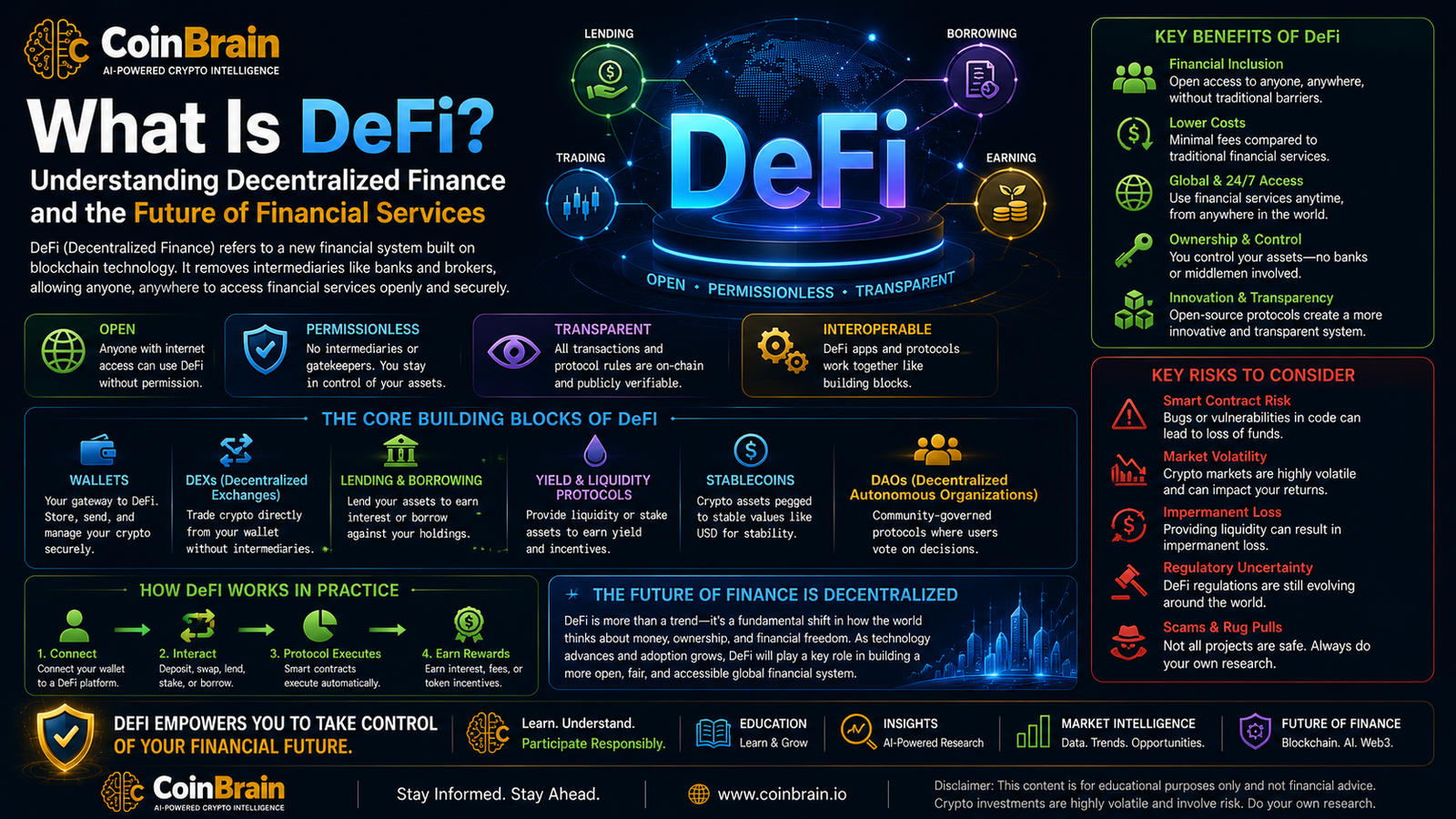

What Is DeFi? Understanding Decentralized Finance and the Future of Financial Services
CoinBrain Research Articles | Crypto Investing Basics — Article 05
Updated: August 2026
Imagine being able to:
- exchange assets
- lend money
- borrow against collateral
- earn yield
- trade derivatives
- move stablecoins
- provide market liquidity
- manage digital assets
without relying on a traditional bank, broker, or centralized exchange to execute every transaction.
That is the fundamental idea behind Decentralized Finance, commonly known as DeFi.
DeFi uses blockchain networks and smart contracts to create financial applications that can operate continuously and, in many cases, be accessed directly through a crypto wallet.
Instead of asking a bank to process a loan, a smart contract can manage collateral and borrowing rules.
Instead of placing an order through a traditional securities exchange, users can exchange tokens through decentralized liquidity pools.
Instead of depositing assets with a financial institution, users may supply them to blockchain-based lending markets.
This does not mean DeFi eliminates financial intermediaries entirely.
Rather, it changes where intermediation occurs.
Some functions traditionally performed by companies, employees, clearing systems, and financial databases can instead be performed by:
Blockchains + Smart Contracts + Digital Assets + Economic Incentives
That creates extraordinary possibilities—but also new forms of risk.
Educational Notice: This article is for educational and research purposes only. It does not constitute financial, investment, tax, or legal advice. DeFi can involve substantial risk, including smart-contract vulnerabilities, liquidation, loss of collateral, stablecoin failure, oracle manipulation, governance risk, bridge exploits, and complete loss of deposited assets.
1. Executive Summary
Decentralized Finance, or DeFi, is an ecosystem of blockchain-based financial applications designed to provide services such as trading, lending, borrowing, liquidity provision, payments, derivatives, and asset management through smart contracts.
Traditional finance generally works through institutions.
For example:
Customer → Bank → Banking Infrastructure → Financial Service
DeFi can instead operate through:
User Wallet → Smart Contract → Blockchain → Financial Service
The smart contract contains rules describing how the financial application functions.
For example:
A lending protocol may automatically determine:
- how much collateral is required
- how much an investor can borrow
- the interest rate
- when a loan becomes undercollateralized
- when liquidation should occur
A decentralized exchange can determine:
- available liquidity
- exchange rates
- transaction fees
- how assets move between liquidity providers and traders
without requiring a traditional centralized exchange to custody every user’s assets.
DeFi has grown into a substantial financial ecosystem. As of August 2026, DefiLlama tracks more than 7,000 protocols across more than 500 blockchain networks, with approximately $75.7 billion in DeFi Total Value Locked (TVL) at the time of this article. Because crypto markets move continuously, these figures should be treated as snapshots rather than fixed values.
The ecosystem increasingly intersects with:
- stablecoins
- tokenized real-world assets
- institutional finance
- Layer-2 networks
- blockchain payments
- derivatives
- decentralized trading
- digital identity
- AI agents
DeFi may therefore prove important not merely as a crypto investment category, but as an experimental architecture for the future of programmable financial services.
2. Key Takeaways
Before using DeFi, understand these fundamental principles.
1. DeFi replaces some institutional processes with software
Smart contracts can automate financial rules that would traditionally require institutions and back-office systems.
2. DeFi is broader than yield farming
Yield farming is one strategy within DeFi.
DeFi itself includes:
- lending
- borrowing
- trading
- stablecoins
- derivatives
- payments
- liquidity provision
- asset management
- tokenization
3. Users can often retain greater control over their assets
Many DeFi applications are non-custodial.
Instead of depositing assets permanently with an intermediary, users interact with smart contracts through their wallets.
But non-custodial does not mean risk-free.
4. Smart contracts are the infrastructure
Software replaces many traditional financial processes.
If the software fails, financial losses can occur.
5. Stablecoins are critical to DeFi
Stablecoins provide blockchain-native units of account and settlement assets.
6. DeFi protocols are composable
Applications can interact with one another.
A token received from one protocol may become collateral inside another.
This is often described as:
Money Legos
7. Transparency is one of DeFi’s strengths
Transactions and smart-contract balances can often be inspected directly on public blockchains.
8. Transparency does not guarantee safety
An open-source smart contract can still contain vulnerabilities.
9. DeFi increasingly overlaps with traditional finance
Tokenized securities, stablecoins, institutional lending, and real-world assets are bringing the two ecosystems closer together.
10. DeFi should be evaluated as financial infrastructure—not merely as a collection of tokens
The most important long-term question is not:
Which DeFi token will rise?
It is:
Which financial activities benefit from moving onto programmable blockchain infrastructure?
3. Market Overview
Traditional Finance vs Decentralized Finance
To understand DeFi, first consider how traditional finance works.
Suppose you want to borrow money.
In traditional finance:
You
↓
Bank
↓
Identity Verification
↓
Credit Assessment
↓
Loan Approval
↓
Bank Database
↓
Funds Released
A centralized institution coordinates the process.
DeFi approaches the same problem differently.
You might:
Connect Wallet
↓
Deposit Crypto Collateral
↓
Smart Contract Checks Collateral
↓
Borrow Digital Asset
↓
Blockchain Records Position
No bank loan officer necessarily approves the transaction.
The protocol enforces predefined rules.
Major DeFi Categories
The DeFi ecosystem can be divided into several broad categories.
Decentralized Exchanges — DEXs
Allow users to trade digital assets directly through smart contracts.
Examples include systems built around liquidity pools and automated market makers.
Lending and Borrowing
Users supply assets into lending markets.
Other users borrow against crypto collateral.
Stablecoins
Digital assets designed to maintain relatively stable value, most commonly against the US dollar.
Liquid Staking
Allows blockchain assets to participate in staking while potentially remaining usable elsewhere through tokenized representations.
Derivatives
Protocols can offer:
- perpetual futures
- options
- synthetic assets
- prediction markets
Asset Management
Smart contracts can implement:
- index products
- automated strategies
- vaults
- yield optimization
Tokenized Real-World Assets
Traditional assets can be represented on blockchain infrastructure.
Examples may include:
- government securities
- funds
- private credit
- commodities
- equities
Payments
Stablecoins and blockchain networks can support programmable domestic and cross-border payments.
The Current Market
DeFi remains highly concentrated around major blockchain ecosystems.
Ethereum continues to be particularly important.
As of August 2026, DefiLlama reports approximately $147.8 billion of stablecoins on Ethereum, alongside roughly $15.2 billion of active tokenized real-world assets tracked on the network. Ethereum decentralized exchanges were also processing approximately $912 million of daily volume at the snapshot observed for this article.
These figures illustrate an important development:
DeFi is no longer just:
crypto tokens trading against other crypto tokens.
Increasingly it involves:
Stablecoins + Tokenized Assets + Lending + Trading + Settlement + Institutional Capital
4. Technology Deep Dive
What Is a Smart Contract?
A smart contract is software deployed on a blockchain.
It contains rules that execute according to predefined conditions.
Imagine a simplified lending contract:
If collateral value remains above the required threshold, allow borrowing.
If collateral value falls below the minimum threshold, allow liquidation.
Instead of an employee manually checking the account, software enforces the rules.
Why Use a Blockchain?
A traditional application could perform similar calculations.
The difference is that blockchain architecture can provide characteristics such as:
- shared state
- transparent transactions
- programmable ownership
- digital settlement
- composability
- permissionless interaction
- cryptographic verification
Multiple applications can potentially interact with the same assets without requiring every company to maintain a separate ownership database.
Wallets as Financial Access Points
A crypto wallet is often the user’s entry point into DeFi.
Conceptually:
Wallet = Identity + Asset Control + Transaction Authorization
The wallet allows the user to sign transactions.
This can include:
- exchanging tokens
- supplying collateral
- borrowing
- repaying loans
- providing liquidity
- voting in governance
The wallet does not necessarily reveal a traditional real-world identity.
However, regulatory requirements may increasingly introduce identity and compliance layers into certain institutional DeFi applications.
Decentralized Exchanges
Traditional exchanges generally maintain order books.
Buyers submit bids.
Sellers submit offers.
The exchange matches them.
Many DeFi exchanges instead use liquidity pools.
Suppose a pool contains:
ETH + USDC
Liquidity providers deposit the assets.
Traders can then exchange:
ETH → USDC
or:
USDC → ETH
against that pool.
Uniswap’s current infrastructure supports multiple approaches to decentralized liquidity, including liquidity provision through v2, v3 and v4 pools and additional market-making mechanisms.
Lending Protocols
A DeFi lending protocol creates markets between:
Suppliers
and
Borrowers
Suppose investors supply:
$100 million USDC
Borrowers use:
$70 million
The protocol can automatically adjust rates according to supply and demand.
Borrowers usually need collateral.
For example:
Deposit:
$15,000 ETH
Borrow:
$8,000 USDC
If ETH falls too far, the collateral may no longer safely support the loan.
The protocol can liquidate part of the collateral.
This creates a financial system in which:
Collateral Management + Interest Rates + Liquidation
can all be implemented through smart contracts.
Oracles
A major technical problem immediately appears.
How does a blockchain lending application know the current market price of ETH?
Blockchains cannot inherently know external market prices.
They therefore rely on:
Oracles
Oracles provide external data to smart contracts.
Potential information includes:
- cryptocurrency prices
- interest rates
- market data
- asset valuations
- event outcomes
Without reliable price data, DeFi lending and derivatives systems could not safely determine collateral values.
Oracle infrastructure is therefore a critical part of DeFi.
Stablecoins
Stablecoins are arguably one of DeFi’s most important building blocks.
Imagine trying to create a lending economy where every asset fluctuates 10% in a day.
Accounting becomes difficult.
Stablecoins provide a relatively stable unit.
Examples typically seek to track:
1 token ≈ US$1
This allows users to:
- borrow dollars digitally
- trade against stable units
- settle transactions
- provide stablecoin liquidity
- transfer value internationally
At the time of this article, DefiLlama tracked approximately $183.1 billion USDT and $72.2 billion USDC in circulation, illustrating the scale stablecoins have achieved within the broader digital-asset economy.
Composability: DeFi’s Superpower
Suppose you:
- stake ETH
- receive a liquid staking token
- deposit it into a lending protocol
- borrow stablecoins
- provide those stablecoins to another market
Each application can interact with assets created by another.
This property is known as:
Composability
Traditional finance also combines financial products.
But integrations frequently require:
- contracts
- APIs
- clearing relationships
- reconciliations
- institutional agreements
On programmable blockchains, composability can occur directly through smart contracts.
This is why DeFi applications are often called:
Money Legos.
Permissionless Protocols
Some DeFi systems allow anyone with:
- internet access
- crypto assets
- a compatible wallet
to interact with the protocol.
This creates a radically different access model compared with many traditional financial services.
However, the distinction between:
permissionless underlying protocol
and
regulated user interface or service provider
will become increasingly important as regulation develops.
5. Current Industry Landscape
The DeFi ecosystem has progressed through several phases.
Phase 1 — Experimentation
Early blockchain applications demonstrated that tokens and smart contracts could create financial primitives.
Phase 2 — DeFi Expansion
Protocols introduced:
- decentralized exchanges
- lending markets
- stablecoins
- liquidity mining
This produced rapid adoption but also excessive speculation and unsustainable incentives.
Phase 3 — Infrastructure Building
The market began emphasizing:
- security
- scalability
- better oracles
- Layer-2 networks
- professional market making
- stablecoin infrastructure
- more sustainable protocol economics
Phase 4 — Institutional Convergence
The industry is increasingly entering a new phase:
DeFi + Traditional Finance
This includes:
- tokenized securities
- institutional stablecoins
- tokenized treasuries
- blockchain settlement
- regulated digital assets
The SEC published a formal statement on tokenized securities in January 2026, distinguishing different tokenization structures and emphasizing that the legal rights attached to a tokenized security depend on its architecture.
In March 2026, the SEC also issued an interpretation clarifying the application of U.S. federal securities laws to multiple categories of crypto assets and crypto transactions, reflecting the broader maturation of the regulatory environment.
Layer-2 DeFi
Ethereum scaling networks have also expanded DeFi.
Layer-2 systems seek to provide:
- lower transaction costs
- greater throughput
- faster user experience
while retaining varying degrees of connection to Ethereum’s settlement and security architecture.
This allows DeFi applications that would be expensive on Layer 1 to become more accessible.
Multi-Chain DeFi
DeFi is no longer concentrated on one blockchain.
Protocols operate across ecosystems including:
- Ethereum
- Solana
- Layer-2 networks
- Avalanche
- BNB Chain
- and many others
DefiLlama now tracks DeFi activity across more than 500 chains, illustrating how fragmented and multi-chain the ecosystem has become.
6. Institutional Activity
Institutional participation may become one of the most important forces shaping DeFi over the next decade.
The institutional version of DeFi is unlikely to look exactly like retail yield farming.
Professional investors require:
- legal certainty
- custody controls
- compliance
- auditability
- counterparty analysis
- risk management
- reporting
- operational resilience
Tokenized Securities
A traditional security could potentially exist in tokenized form.
The SEC described a tokenized security in January 2026 as a security whose ownership is represented wholly or partly through one or more crypto networks.
Imagine:
Traditional Fund
becoming:
Blockchain-Based Fund Token
That token could potentially interact with compatible financial infrastructure.
Tokenized Treasuries
Government securities represent another important opportunity.
Conceptually:
Treasury Security
↓
Tokenized Representation
↓
Blockchain
↓
Potential DeFi Integration
This could eventually allow traditionally regulated financial assets to interact with programmable settlement systems.
Institutional Lending
Blockchain-based credit markets can potentially provide:
- transparent collateral
- automated settlement
- programmable risk controls
- continuous operations
Protocols such as Aave demonstrate that substantial credit markets can operate through smart-contract liquidity pools.
Professional Market Making
DeFi exchanges increasingly attract professional liquidity providers and market makers.
Uniswap’s current developer architecture explicitly identifies market makers, trading firms, asset issuers, and DeFi developers among users of its liquidity infrastructure.
Regulatory Infrastructure
The SEC’s Crypto Task Force is actively working on areas including:
- crypto asset classification
- disclosure
- registration
- custody
- tokenization
- trading infrastructure
Its stated objective includes developing clearer regulatory boundaries while supporting innovation and investor protection.
This matters because large institutional adoption will probably require much clearer integration between:
Public Blockchain Infrastructure
and
Regulated Financial Markets
7. Market Data & Metrics
DeFi investors need to understand several metrics.
Total Value Locked — TVL
TVL measures assets deposited into DeFi smart contracts.
As of August 2026, DefiLlama’s dashboard showed approximately:
$75.7 billion DeFi TVL
across its tracked protocols.
TVL provides a useful indication of capital committed to DeFi.
But:
TVL is not revenue.
TVL is not profit.
TVL is not a safety rating.
Stablecoin Supply
Stablecoins are important indicators of blockchain liquidity.
More stablecoin capital can potentially support:
- trading
- borrowing
- payments
- collateral
- settlement
DEX Trading Volume
This measures the value of assets exchanged through decentralized exchanges.
Higher sustainable volume can generate more fees for liquidity providers and protocols.
Active Loans
For lending protocols, important metrics include:
- supplied assets
- borrowed assets
- utilization
- liquidations
- collateral
For example, DefiLlama currently reports approximately $926 million of active loans for Kamino, illustrating the scale that individual DeFi credit platforms can reach.
Protocol Fees
Fees show how much users are paying to use a protocol.
Examples include:
- trading fees
- borrowing fees
- liquidation fees
Protocol Revenue
Revenue measures the portion of fees captured economically by the protocol or its stakeholders, depending on the methodology.
This is different from gross fees.
Token Incentives
Protocols may distribute tokens to encourage participation.
DefiLlama distinguishes incentives from protocol earnings in its methodology, which is useful because large token rewards can make economic performance appear stronger than it really is.
Active Users
A protocol should ideally have actual users.
Useful measures can include:
- active addresses
- transaction count
- recurring users
- trading activity
Liquidations
Large liquidation activity can indicate:
- excessive leverage
- volatile collateral
- stressed market conditions
A Better DeFi Dashboard
Rather than looking only at token price, consider:
TVL
Trading Volume
Active Loans
Fees
Revenue
Users
Token Incentives
Security Record
Governance
This produces a much stronger picture of protocol health.
8. Real-World Use Cases
DeFi already supports numerous financial activities.
Use Case 1 — Decentralized Trading
A user exchanges:
ETH → USDC
through a decentralized exchange.
The smart contract handles the exchange.
Use Case 2 — Crypto-Backed Borrowing
An investor owns ETH but does not want to sell it.
The investor deposits ETH as collateral and borrows stablecoins.
This maintains ETH exposure while creating liquidity.
But it also introduces liquidation risk.
Use Case 3 — Lending
An investor supplies stablecoins.
Borrowers pay interest.
The supplier earns part of the resulting yield.
Use Case 4 — International Payments
Stablecoins can potentially move across blockchain networks continuously.
This can support:
- cross-border payments
- business settlement
- remittances
Use Case 5 — Market Making
Liquidity providers supply assets to decentralized exchanges and earn trading fees.
Use Case 6 — Derivatives
DeFi protocols can provide markets for:
- perpetual contracts
- synthetic assets
- options
- prediction markets
Some decentralized perpetual markets now process billions of dollars of daily notional volume. DefiLlama’s August 2026 snapshot for Hyperliquid, for example, showed approximately $6.9 billion of 24-hour perpetual volume and more than $5 trillion of cumulative perpetual volume tracked for the platform.
Use Case 7 — Tokenized Real-World Assets
Traditional assets can potentially become blockchain-native financial instruments.
Examples include:
- treasury securities
- funds
- commodities
- private credit
Use Case 8 — Automated Treasury Management
Organizations can use smart contracts for:
- liquidity management
- collateral
- yield
- payments
Use Case 9 — Machine-to-Machine Payments
This could become increasingly important in an AI-driven economy.
Imagine an AI agent that needs to:
- purchase computing power
- pay another agent
- purchase data
- receive payment for a service
Traditional banking systems were primarily designed for humans and companies.
Blockchain and stablecoin infrastructure can potentially support:
Software paying software.
This may become an important point of convergence between:
AI + DeFi + Stablecoins
9. Risks & Challenges
DeFi offers powerful functionality.
It also introduces substantial risks.
1. Smart-Contract Risk
Financial assets may be controlled by software.
A vulnerability can create immediate losses.
2. Oracle Risk
Incorrect price information can cause:
- wrongful liquidation
- bad debt
- market manipulation
3. Liquidation Risk
Borrowing against volatile collateral can lead to automatic liquidation.
4. Stablecoin Risk
A stablecoin can lose its intended peg.
A supposedly stable $1 asset trading at $0.70 represents a major loss.
5. Bridge Risk
Moving assets between blockchain networks may require bridges.
Bridge vulnerabilities have historically produced substantial crypto losses.
6. Governance Risk
Protocol governance may change:
- fees
- collateral rules
- incentives
- supported markets
- upgrades
7. Admin-Key Risk
Some protocols retain privileged administrative capabilities.
These can potentially allow:
- upgrades
- emergency pauses
- parameter changes
Understand who controls them.
8. Composability Risk
A strategy may depend on:
Blockchain A
↓
Bridge
↓
Stablecoin
↓
Lending Protocol
↓
Oracle
↓
Liquidity Protocol
If one component fails, the entire position may be affected.
9. Liquidity Risk
A user may be unable to exit a large position at the expected price.
10. Token Risk
A good protocol does not automatically imply a good investment token.
This distinction is crucial.
A protocol may have:
- substantial usage
- high TVL
- significant revenue
while its token provides weak economic rights.
Always distinguish:
Protocol Quality
from:
Token Investment Thesis
11. User Error
Self-custody creates responsibility.
Mistakes can include:
- signing malicious transactions
- sending assets to wrong addresses
- losing private keys
- interacting with fake websites
Blockchain transactions are often irreversible.
12. Regulatory Risk
Regulators continue developing frameworks around crypto assets, intermediaries, tokenization, and decentralized protocols.
In the U.S., the SEC’s March 2026 interpretation represented a significant regulatory clarification for crypto assets, but broader market-structure and implementation questions remain active.
10. Future Outlook: 3–5 Years
The next stage of DeFi may look very different from the speculative environment that first made the term famous.
Several trends deserve particular attention.
DeFi and Traditional Finance Will Converge
The future may not be:
DeFi vs Banks
Instead:
Traditional Finance + Programmable Blockchain Infrastructure
Banks, asset managers, fintechs, and blockchain protocols may increasingly interact.
Tokenized Assets Will Expand
The SEC’s 2026 work on tokenized securities illustrates how rapidly tokenization has moved from experiment toward regulatory and institutional discussion.
More financial assets may become programmable.
Stablecoins Could Become a Major Settlement Layer
Stablecoin circulation already exceeds hundreds of billions of dollars across leading assets.
Their role could expand in:
- payments
- treasury
- international settlement
- DeFi
- machine commerce
Institutional DeFi Will Grow
Institutional DeFi will likely emphasize:
- identity
- compliant assets
- regulated custody
- verified counterparties
- audited smart contracts
- tokenized securities
rather than anonymous high-risk farming.
Layer-2 Networks Will Improve Accessibility
Lower transaction costs can make DeFi practical for smaller users and higher-volume applications.
AI Agents Could Become DeFi Users
Autonomous agents may eventually:
- manage wallets
- optimize collateral
- exchange assets
- pay for services
- manage treasury positions
This could transform DeFi into a financial layer for autonomous software.
User Interfaces Will Become Simpler
Today’s DeFi experience can require understanding:
- wallets
- gas
- networks
- bridges
- slippage
- approvals
Future applications will likely hide much of this complexity.
Users may interact with:
“Send $500”
while blockchain infrastructure works behind the scenes.
That may be when DeFi becomes truly mainstream.
11. Investment & Business Implications
For investors, DeFi should be evaluated at three different levels.
Level 1 — The Financial Service
Ask:
What does the protocol actually do?
Is it:
- exchange?
- lender?
- derivative market?
- stablecoin?
- asset manager?
Level 2 — The Protocol
Ask:
Is the protocol actually being used?
Evaluate:
- TVL
- volume
- loans
- users
- fees
- revenue
- security
Level 3 — The Token
Ask:
How does the token capture value?
This is frequently ignored.
A token might provide:
- governance
- fee rights
- staking
- collateral utility
- protocol incentives
Or it may have very weak economic linkage to protocol success.
A Beginner Evaluation Framework
Before investing in a DeFi project, ask:
Problem
What financial problem does it solve?
Product
Does the product actually work?
Users
Are people using it?
Revenue
Does genuine economic activity produce fees?
Token
Why does the token need to exist?
Security
Has the protocol been audited?
What is its exploit history?
Governance
Who can change the protocol?
Competition
What alternatives exist?
Valuation
Is the token price reasonable relative to its economics?
Business Opportunities
DeFi is also creating significant business opportunities beyond tokens.
Potential sectors include:
- blockchain payments
- institutional custody
- compliance infrastructure
- tokenization platforms
- DeFi analytics
- risk management
- smart-contract auditing
- institutional lending
- digital identity
- stablecoin infrastructure
- oracle services
- wallet infrastructure
- tokenized asset management
The larger opportunity may therefore be:
infrastructure supporting programmable finance
rather than speculation on individual governance tokens.
12. Final Analysis
DeFi represents one of blockchain technology’s most ambitious experiments:
Can financial infrastructure operate through open, programmable networks rather than relying entirely on centralized institutions?
The answer is increasingly nuanced.
DeFi has already demonstrated that smart contracts can support:
- decentralized trading
- collateralized lending
- borrowing
- stablecoins
- derivatives
- liquidity markets
- tokenized assets
at meaningful scale.
But it has also demonstrated serious weaknesses:
- hacks
- exploits
- unstable token economics
- excessive leverage
- governance failures
- bridge attacks
- unsustainable incentives
The correct conclusion is therefore neither:
“DeFi will replace all banks.”
nor:
“DeFi is just speculation.”
A more realistic possibility is that DeFi technologies become part of the next generation of financial infrastructure.
Traditional finance provides:
Regulation + Legal Rights + Institutional Trust + Risk Management
DeFi provides:
Programmability + Transparency + Composability + Continuous Settlement
The future may combine both.
For investors, this leads to a crucial distinction:
Do not invest in a DeFi token merely because DeFi itself has potential.
A growing industry can contain many unsuccessful companies, protocols, and tokens.
Study:
Usage
Economics
Security
Tokenomics
Regulation
Competition
and most importantly:
real-world value creation.
The long-term significance of DeFi may ultimately be much larger than yield farming.
It may become part of an emerging global financial architecture in which:
money, assets, ownership, lending, trading, and settlement become programmable.
13. References & Further Reading
DeFiLlama
DeFi Market Dashboard
Tracks TVL, protocol fees, revenue, trading volumes, yields, stablecoins, and activity across thousands of protocols and hundreds of blockchain networks. At the August 2026 snapshot used for this article, approximately $75.7 billion of DeFi TVL was tracked.
Blockchain DeFi Rankings
Tracks DeFi activity across more than 500 blockchain networks.
Stablecoin Market Data
Tracks stablecoin circulation, peg stability, blockchain distribution, and market capitalization.
Ethereum DeFi Data
Provides current statistics covering stablecoins, RWAs, DEX trading, perpetual trading, fees, applications, and network activity on Ethereum.
Uniswap
Liquidity Overview
Developer documentation explaining decentralized liquidity provision, market making, Uniswap liquidity pools, and current liquidity infrastructure.
U.S. Securities and Exchange Commission — SEC
Crypto Task Force
The SEC’s ongoing initiative addressing regulatory clarity around digital assets, protocols, custody, disclosure, registration, tokenization, and market infrastructure.
Statement on Tokenized Securities — January 28, 2026
SEC staff guidance discussing structures and legal characteristics of tokenized securities.
Application of Federal Securities Laws to Certain Crypto Assets — March 2026
SEC interpretation addressing the application of federal securities laws to categories of crypto assets and transactions.
Concepts for Further Study
Readers progressing beyond the fundamentals should investigate:
- smart contracts
- decentralized exchanges
- automated market makers
- liquidity pools
- DeFi lending
- overcollateralization
- stablecoins
- blockchain oracles
- liquid staking
- tokenized real-world assets
- Layer-2 networks
- protocol governance
- total value locked
- protocol fees
- protocol revenue
- composability
- cross-chain bridges
- decentralized derivatives
CoinBrain Crypto Investing Basics
Article 01 — How to Start Investing in Crypto
Article 02 — Spot vs Futures: Understanding the Difference Before You Trade
Article 03 — What Is Staking? How Crypto Can Earn Rewards While Securing a Blockchain
Article 04 — What Is Yield Farming? Understanding How DeFi Investors Earn Yield—and the Risks Behind It
Article 05 — What Is DeFi? Understanding Decentralized Finance and the Future of Financial Services
Next Article
Article 06 — What Is Tokenomics? Understanding Supply, Demand, Utility and What Gives a Crypto Token Value
CoinBrain Research Articles
Research. Understand. Decide.
Leave a Reply
You must be logged in to post a comment.