
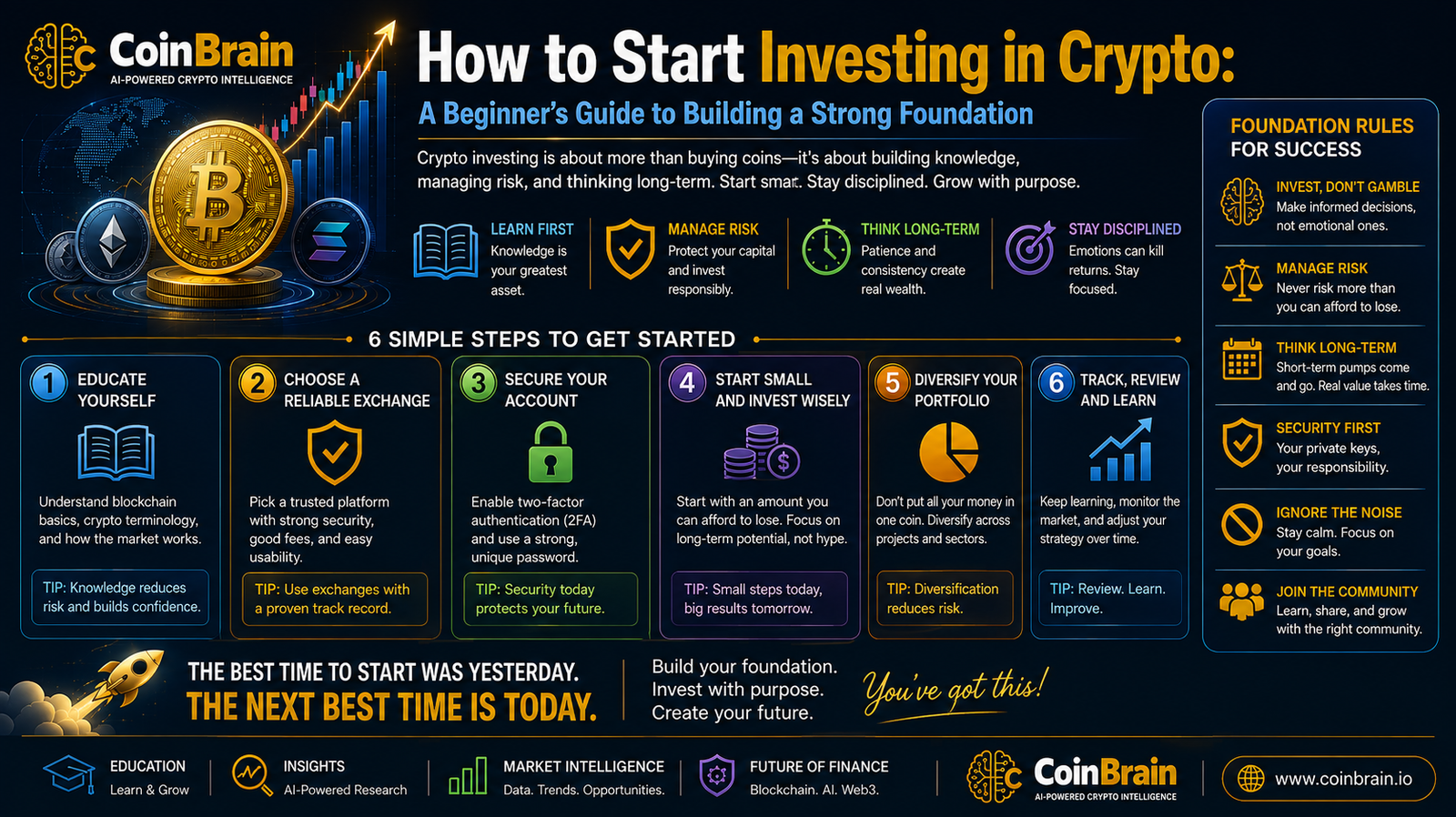

How to Start Investing in Crypto: A Beginner’s Guide to Building a Strong Foundation
CoinBrain Research Reports | Crypto Investing Basics
Updated: August 2026
Cryptocurrency investing can appear deceptively simple: open an account, choose a coin, click “Buy,” and wait.
In reality, responsible crypto investing starts long before the first purchase.
A new investor needs to understand what crypto assets are, why their prices move, how exchanges and wallets work, how assets are secured, how projects should be evaluated, and—most importantly—how much risk should be taken.
This CoinBrain Research Report provides a structured introduction for newcomers who want to enter the crypto market with knowledge rather than speculation.
Educational Notice: This report is for educational and research purposes only. It does not constitute financial, investment, tax, or legal advice. Cryptocurrency investments can involve substantial risk, including the possible loss of the entire amount invested.
1. Executive Summary
Cryptocurrency has evolved from an experimental technology into a significant part of the global digital-asset ecosystem.
Bitcoin introduced the concept of digitally scarce money without a central issuer. Ethereum expanded blockchain technology into programmable smart contracts. Since then, thousands of blockchain networks, tokens, decentralized applications, stablecoins, and financial protocols have emerged.
At the same time, crypto remains a highly volatile and technically complex asset class.
For beginners, the objective should therefore not be:
“Which coin will make me rich?”
A much better starting question is:
“How can I participate in this market while understanding and controlling my risk?”
A sensible beginner framework consists of several stages:
Learn → Plan → Select → Secure → Invest → Monitor → Review
The strongest foundation is built by understanding the asset before buying it, establishing a risk budget, choosing reputable infrastructure, securing accounts and wallets, avoiding unnecessary leverage, and investing according to a predefined strategy rather than emotion.
Crypto can offer exposure to potentially transformative technologies, but opportunity and risk exist together.
2. Key Takeaways
Before investing your first unit of currency into cryptocurrency, understand these principles.
1. Learn before buying
Do not invest merely because an asset is trending, being promoted online, or rising rapidly.
Understand what you are buying.
2. Crypto is a high-risk asset class
Prices can move dramatically in either direction. Some projects will fail completely.
Regulators continue to warn retail investors about volatility, fraud, platform failure, custody risks, and the possibility of substantial losses.
3. Start small
Your first crypto investment should not determine your financial future.
Beginning with a modest allocation provides an opportunity to learn how exchanges, wallets, transfers, fees, and markets work.
4. Avoid leverage when starting
Spot ownership and leveraged speculation are fundamentally different.
Futures and leveraged products can magnify both gains and losses and introduce liquidation risk.
5. Security is part of investing
Owning crypto introduces responsibilities that traditional brokerage investors may not encounter.
Account security, private keys, recovery phrases, wallet management, phishing prevention, and custody all matter.
6. Research the asset—not just its price
Price alone tells you very little.
Study:
- market capitalization
- circulating supply
- maximum supply
- token utility
- network activity
- liquidity
- development
- adoption
- governance
- competition
- token unlocks
7. Think in years, not hours
For investors rather than traders, understanding structural trends can be more useful than attempting to predict every short-term price movement.
3. Market Overview
From Bitcoin to a Digital-Asset Economy
Bitcoin launched in 2009 with a radical proposition: digital value could be transferred through a decentralized network without requiring a central monetary authority.
The industry has since expanded far beyond Bitcoin.
Today’s crypto ecosystem includes several major categories.
Digital Monetary Assets
Bitcoin remains the most prominent example.
Its investment thesis is commonly associated with scarcity, decentralization, censorship resistance, and its potential role as a digital store of value.
Smart-Contract Platforms
Networks such as Ethereum and other Layer-1 blockchains provide infrastructure on which developers can build applications.
These networks support areas such as:
- decentralized finance
- stablecoins
- tokenization
- gaming
- digital identity
- prediction markets
- decentralized infrastructure
Stablecoins
Stablecoins attempt to maintain their value relative to another asset, most commonly the US dollar.
They have become important infrastructure for crypto trading, payments, settlement, remittances, and decentralized finance.
Real-World Asset Tokenization
Traditional assets can increasingly be represented through blockchain-based tokens.
Potential applications include:
- government securities
- private credit
- funds
- commodities
- real estate
- financial instruments
Decentralized Finance
DeFi protocols attempt to provide financial functionality using blockchain networks and smart contracts.
Applications include decentralized exchanges, lending, borrowing, liquidity provision, derivatives, and asset management.
Infrastructure
Another major category consists of projects providing underlying services such as:
- blockchain interoperability
- data availability
- decentralized computing
- oracle networks
- storage
- scaling
- security
The important lesson for beginners is that “crypto” is no longer one homogeneous investment category.
Buying Bitcoin, a stablecoin, a Layer-1 token, a DeFi governance token, and a speculative memecoin can involve radically different economic propositions and risk profiles.
4. Technology Deep Dive
Before investing, it helps to understand what you are actually buying.
What Is a Cryptocurrency?
A cryptocurrency or crypto asset is a digital asset whose ownership and transfers are generally recorded using blockchain or similar distributed-ledger technology.
A blockchain can be thought of as a shared database maintained by a network rather than a single central organization.
Transactions are grouped, validated, and recorded according to the network’s consensus rules.
But not every crypto asset functions in the same way.
Coin vs Token
A coin generally belongs to its own blockchain.
Examples include native assets used by blockchain networks to pay transaction fees or participate in network security.
A token can instead be issued through an existing blockchain’s smart-contract infrastructure.
Tokens may represent:
- governance rights
- access to services
- financial claims
- stable value
- real-world assets
- protocol incentives
- digital collectibles
Understanding the distinction matters because owning a token does not necessarily mean owning equity in the organization that developed the project.
What Gives a Crypto Asset Value?
This is one of the most important questions a beginner can ask.
Potential sources of value include:
Scarcity
A limited or predictable supply can influence an asset’s monetary characteristics.
Utility
The token may be required to use a network or application.
Network Effects
A blockchain used by more developers, users, institutions, applications, and assets may become increasingly valuable.
Security
Highly secure and decentralized networks can command economic value because users trust their settlement properties.
Revenue or Economic Activity
Some protocols generate fees through actual usage.
Governance
Certain tokens allow holders to participate in protocol governance.
Speculation
Unfortunately, price can also rise simply because investors expect other investors to pay more.
That final source of demand can disappear quickly.
5. Current Industry Landscape
Crypto investing has changed considerably from its early years.
Retail investors are no longer the only participants.
The ecosystem now includes:
- traditional asset managers
- hedge funds
- banks
- payment companies
- fintech businesses
- regulated exchanges
- custodians
- blockchain-native companies
- governments and regulators
- corporations
- individual investors
Regulatory frameworks are also becoming increasingly important.
In Europe, the Markets in Crypto-Assets framework has established a regulatory regime for significant parts of the crypto-asset industry. Investors should nevertheless understand that using a regulated provider does not automatically make every product offered by that provider equally regulated or equally protected.
Similarly, Switzerland has developed a substantial digital-asset ecosystem, while FINMA continues to emphasize the technological, operational, legal, and insolvency risks associated with crypto custody.
The direction is clear:
Crypto is becoming more integrated with traditional finance, but it has not become risk-free.
6. Institutional Activity
One of the biggest structural changes in crypto has been the arrival of traditional financial institutions.
Institutional involvement now extends across areas including:
- Bitcoin and Ether investment products
- institutional custody
- tokenized funds
- stablecoin infrastructure
- blockchain settlement
- tokenized securities
- digital-asset trading
- corporate blockchain infrastructure
Exchange-traded products have also created another route through which investors can gain price exposure to major crypto assets without directly managing private keys.
However, investment products do not remove the underlying volatility of the assets they track.
Institutional adoption should therefore be interpreted carefully.
“Institutions are entering crypto” is not itself an investment thesis.
A better question is:
What exactly are institutions adopting, why are they adopting it, and does that activity create sustainable economic demand for the underlying network or asset?
That distinction becomes increasingly important when evaluating individual projects.
7. Market Data & Metrics
Beginners frequently make the mistake of looking primarily at token price.
Suppose:
Token A = $0.10
and
Token B = $10,000
It does not automatically follow that Token A is cheaper.
You need to understand supply.
Market Capitalization
A simplified calculation is:
Market Capitalization = Token Price × Circulating Supply
If a token costs $0.10 but has 100 billion tokens circulating:
$0.10 × 100 billion = $10 billion market capitalization
A low unit price therefore does not necessarily indicate an undervalued asset.
Fully Diluted Valuation
Another important metric is:
FDV = Token Price × Maximum or Fully Diluted Supply
A project might have:
- 1 billion tokens currently circulating
- 10 billion eventual tokens
This can create substantial future dilution.
Investors should therefore investigate:
- circulating supply
- total supply
- maximum supply
- inflation rate
- token unlock schedule
- insider allocations
- investor allocations
Trading Volume
Trading volume indicates how actively an asset is being traded.
Very low liquidity can make it difficult to buy or sell without significantly affecting price.
Network Activity
Depending on the project, useful metrics can include:
- active addresses
- transactions
- transaction fees
- stablecoin supply
- total value locked
- developer activity
- protocol revenue
- validator participation
No single metric proves that a project is a good investment.
The objective is to combine multiple signals.
8. Real-World Use Cases
Crypto assets should ideally be evaluated in the context of what their underlying networks actually enable.
Payments
Blockchain networks can facilitate digital payments and cross-border settlement.
Store of Value
Bitcoin is frequently evaluated as a digitally scarce monetary asset.
Stablecoin Settlement
Stablecoins can facilitate dollar-denominated value transfer across blockchain networks.
Decentralized Finance
Smart contracts enable lending, borrowing, trading, and other financial applications without relying exclusively on traditional intermediaries.
Tokenization
Blockchain infrastructure can represent traditional financial and physical assets digitally.
Digital Ownership
Tokens can establish transferable ownership of digitally native assets.
Decentralized Infrastructure
Blockchain incentives can coordinate distributed computing, storage, connectivity, and other infrastructure.
Machine-to-Machine Economies
Over the longer term, blockchain networks and stablecoins may provide settlement infrastructure for AI agents and autonomous software systems.
These use cases matter because sustainable investment value ultimately requires something stronger than speculation.
9. Risks & Challenges
This is arguably the most important section for a new investor.
Market Risk
Crypto prices can fall rapidly and dramatically.
Large historical drawdowns are not unusual.
Project Risk
A technically impressive project can still fail because of:
- poor adoption
- weak economics
- competition
- governance problems
- insufficient funding
- developer abandonment
Custody Risk
Crypto introduces an important distinction between assets held through an intermediary and assets controlled directly through private keys.
The SEC’s investor education materials emphasize that crypto wallets generally store the private keys used to access crypto assets, rather than the assets themselves.
Self-custody removes certain intermediary risks but creates personal operational responsibility.
Lose the necessary credentials or recovery information under certain wallet arrangements, and recovery may be impossible.
Exchange and Counterparty Risk
A centralized exchange can experience:
- insolvency
- cyberattack
- withdrawal restrictions
- operational failures
- regulatory intervention
An exchange account should not automatically be treated like an insured bank deposit.
Smart-Contract Risk
DeFi applications can contain vulnerabilities that attackers exploit.
Stablecoin Risk
Not every stablecoin has the same reserve structure, redemption mechanism, governance model, or risk profile.
Regulatory Risk
Rules differ across jurisdictions and continue to evolve.
Fraud
Crypto investors are frequent targets of:
- phishing
- impersonation
- fake exchanges
- fake wallets
- fraudulent token launches
- pump-and-dump schemes
- social-media scams
- malicious links
- fake investment groups
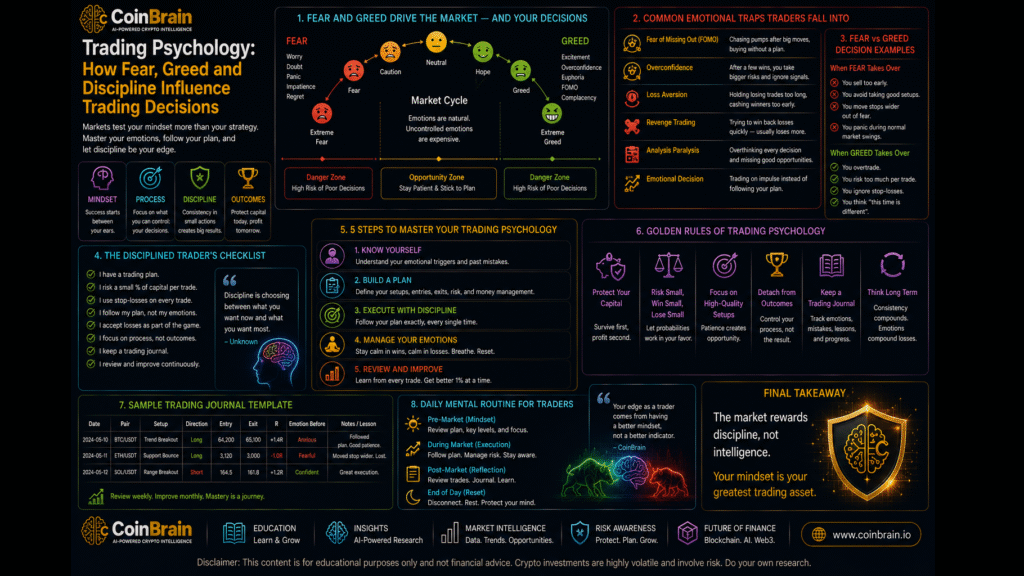
FOMO
Fear of missing out is one of the most dangerous forces in investing.
When an asset has already risen dramatically, investors often feel compelled to enter simply because everyone appears to be making money.
That is precisely when disciplined analysis becomes most important.
10. Future Outlook: 3–5 Years
Over the next several years, CoinBrain expects the distinction between cryptocurrency speculation and digital-asset infrastructure to become increasingly important.
Several structural themes deserve particular attention.
Institutional Integration
Traditional financial institutions are likely to continue developing digital-asset products and infrastructure.
Tokenization
Real-world assets may increasingly move onto blockchain-based infrastructure.
Stablecoins
Stablecoins could become increasingly important for payments, settlement, treasury management, and internet-native commerce.
Blockchain Scalability
Layer-2 networks and other scaling technologies will continue attempting to improve transaction throughput and cost efficiency.
Regulatory Maturation
Clearer frameworks may gradually reduce some regulatory uncertainty while simultaneously imposing higher compliance requirements.
AI and Blockchain Convergence
Autonomous AI agents may eventually require programmable payment, identity, ownership, and settlement infrastructure.
Not every blockchain or token will benefit equally from these developments.
Indeed, maturation could have the opposite effect:
Capital may increasingly concentrate around networks and protocols demonstrating genuine utility, liquidity, security, and sustainable economics.
11. Investment & Business Implications
For a newcomer, the first objective should be building an investment process.
A practical framework could look like this.
Step 1 — Establish Your Financial Foundation
Before considering crypto, understand your:
- emergency reserves
- debts
- income requirements
- investment horizon
- existing portfolio
- ability to absorb losses
Crypto should not substitute for basic financial planning.
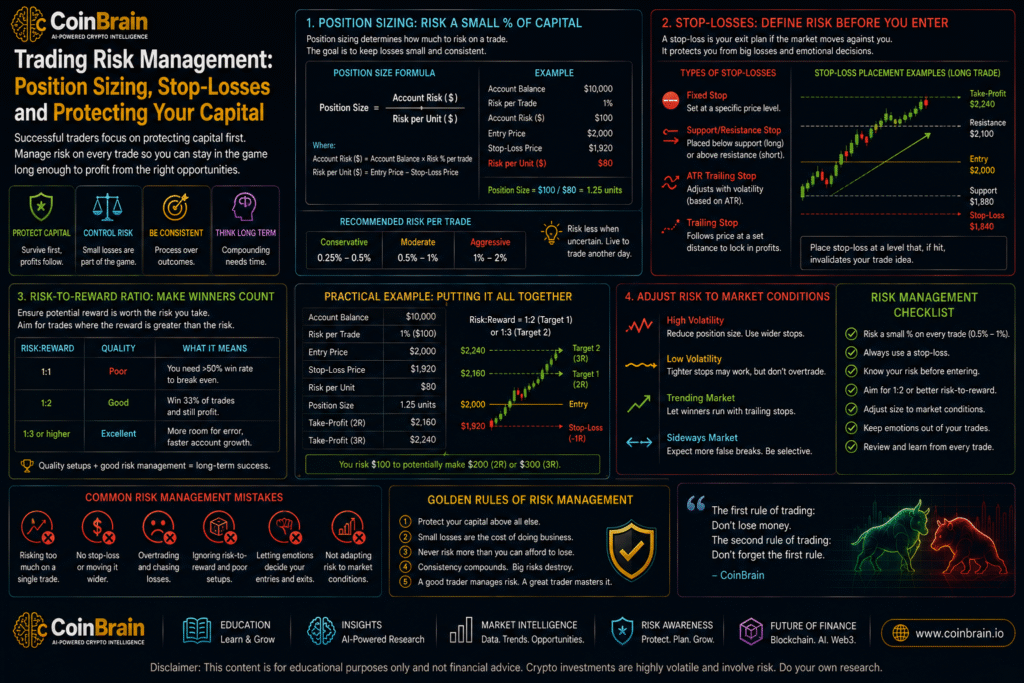
Step 2 — Define Your Risk Budget
Decide beforehand how much capital you are genuinely prepared to expose to a high-risk asset class.
Do not determine this amount after markets begin moving.
Step 3 — Learn the Major Asset Categories
Understand the difference between:
Bitcoin → Stablecoins → Layer-1s → Layer-2s → DeFi → Infrastructure → RWAs → AI-related networks → speculative tokens
They should not be evaluated identically.
Step 4 — Choose Your Access Method
Crypto exposure can potentially be obtained through different structures depending on jurisdiction and availability:
- centralized exchanges
- regulated brokers
- exchange-traded products
- decentralized exchanges
- direct self-custody
Each introduces different risks.
Step 5 — Secure Your Accounts
At minimum:
- use a unique password or strong passphrase
- enable strong multi-factor authentication
- protect recovery credentials
- verify URLs
- distrust unsolicited messages
- never disclose a seed phrase or private key
Step 6 — Begin With Spot Investing
For most beginners seeking investment exposure, spot ownership is conceptually simpler than derivatives.
Futures, options, perpetual contracts, and leverage introduce additional complexity.
Step 7 — Research Before Buying
Ask:
What problem does it solve?
Who uses it?
Why does the token need to exist?
How is supply distributed?
Who controls the project?
What competitors exist?
What could make this investment fail?
That last question is particularly valuable.
Step 8 — Decide How You Will Invest
Instead of trying to predict the perfect entry point, some investors use systematic approaches such as Dollar Cost Averaging.
We will examine this strategy separately later in this series.
Step 9 — Record Your Investment Thesis
For every meaningful position, write down:
Why am I buying this?
What would prove my thesis wrong?
How long am I prepared to hold it?
What risks am I accepting?
This creates discipline.
Step 10 — Review, Don’t Obsess
A long-term investment strategy should not require checking prices every five minutes.
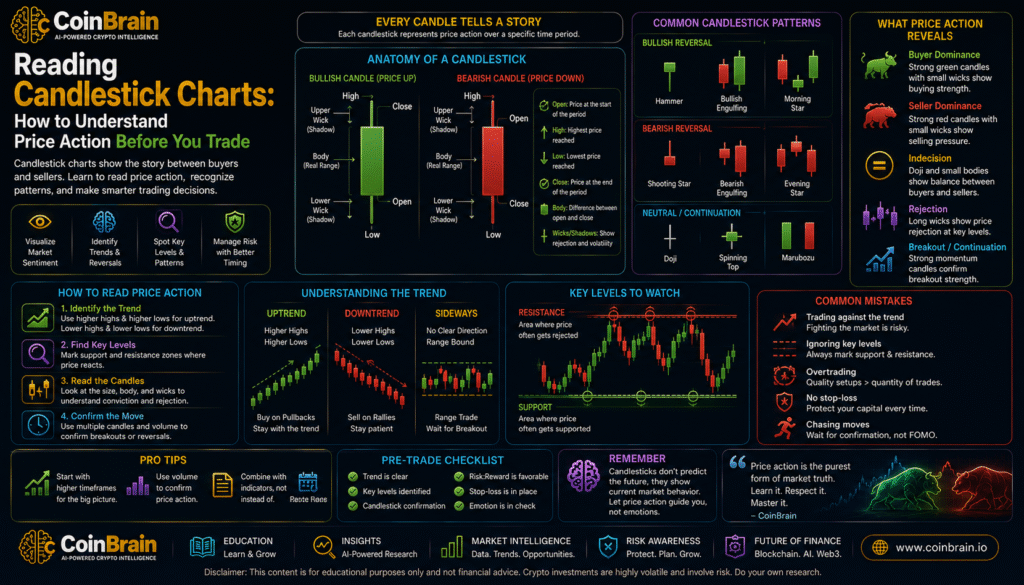
Monitor whether the underlying thesis is changing—not merely whether today’s candle is green or red.
12. Final Analysis
The biggest mistake a new crypto investor can make is believing that investing begins with choosing a coin.
Crypto provides access to an extraordinary technological experiment involving digital money, decentralized computing, programmable financial infrastructure, tokenization, and potentially entirely new forms of digital economic activity.
But innovation does not guarantee investment returns.
Thousands of tokens exist. Many will disappear. Some networks may survive but their tokens may still perform poorly. Others may achieve genuine adoption and become important pieces of future financial infrastructure.
The beginner therefore needs a framework—not predictions.
Remember:
Understand before investing.
Protect capital before chasing returns.
Study fundamentals before following narratives.
Use security as part of your investment strategy.
Avoid investing money you cannot afford to lose.
And perhaps most importantly:
Never confuse a rising price with a good investment.
The objective of CoinBrain’s Crypto Investing Basics series is not to tell readers what to buy.
It is to give them the knowledge required to understand what they are buying.
13. References & Further Reading
U.S. Securities and Exchange Commission — Investor.gov
Crypto Asset Custody Basics for Retail Investors (2025)
Explains crypto custody, wallets, private keys, self-custody, and third-party custody considerations.
Exchange-Traded Products Providing Exposure to Bitcoin and Ether
Provides investor guidance regarding crypto-linked exchange-traded products and associated volatility and investment risks.
Exercise Caution with Crypto Asset Securities
Discusses volatility, platform risk, fraud, liquidity, custody, and other risks associated with crypto investments.
Investor.gov Tips for 2026
General investor education covering diversification, asset allocation, fraud prevention, and investment decision-making.
Swiss Financial Market Supervisory Authority — FINMA
Guidance 01/2026: Custody of Cryptobased Assets
FINMA’s guidance examines technological, operational, legal, custody, and insolvency considerations surrounding crypto assets.
European Securities and Markets Authority — ESMA
Investor Warnings on Crypto-Assets
European investor-protection guidance covering risks associated with crypto assets and crypto service providers.
Risks of Unregulated Products Offered by Regulated Crypto-Asset Entities
Explains why investors should distinguish between a regulated provider and the regulatory status of each individual product or service it offers.
CoinGecko
Cryptocurrency Market Data
Market capitalization, circulating supply, fully diluted valuation, trading volume, historical prices, and other market metrics useful for independent research.
CoinBrain Crypto Investing Basics
How to Start Investing in Crypto
Next in series : Spot vs Futures — Understanding the Difference Before You Trade
CoinBrain Research Article
Research. Understand. Decide.
Leave a Reply
You must be logged in to post a comment.