

Spot vs Futures: Understanding the Difference Before You Trade
CoinBrain Research Articles | Crypto Investing Basics — Article 02
Updated: August 2026
Buying Bitcoin and trading Bitcoin futures may look similar on a trading screen.
Both involve Bitcoin. Both allow someone to potentially profit from changes in Bitcoin’s price. Both may offer buttons labeled Buy, Sell, Long, or Short.
But economically, they are very different activities.
With spot investing, you generally buy the actual crypto asset at its current market price.
With futures, you trade a contract whose value is linked to the price of that asset. Depending on the product, you may never own the underlying cryptocurrency at all.
That distinction becomes particularly important when leverage is introduced.
A spot investor can experience a large decline in the value of an asset and still continue holding it. A leveraged futures trader can potentially have the position forcibly liquidated long before the underlying asset ever recovers.
For newcomers, understanding this distinction is essential before entering crypto markets.
Educational Notice: This article is for educational and research purposes only. It does not constitute financial, investment, tax, or legal advice. Cryptocurrency and derivatives trading can involve substantial losses. Leveraged derivatives can magnify losses and may not be suitable for inexperienced investors.
1. Executive Summary
The simplest distinction between spot and futures is:
Spot = buying or selling the asset itself.
Futures = trading a contract based on the asset’s price.
If an investor buys Bitcoin on the spot market, the investor generally owns Bitcoin after the transaction.
If a trader opens a Bitcoin futures position, the trader owns a derivative contract whose value responds to Bitcoin’s price.
This creates several important differences.
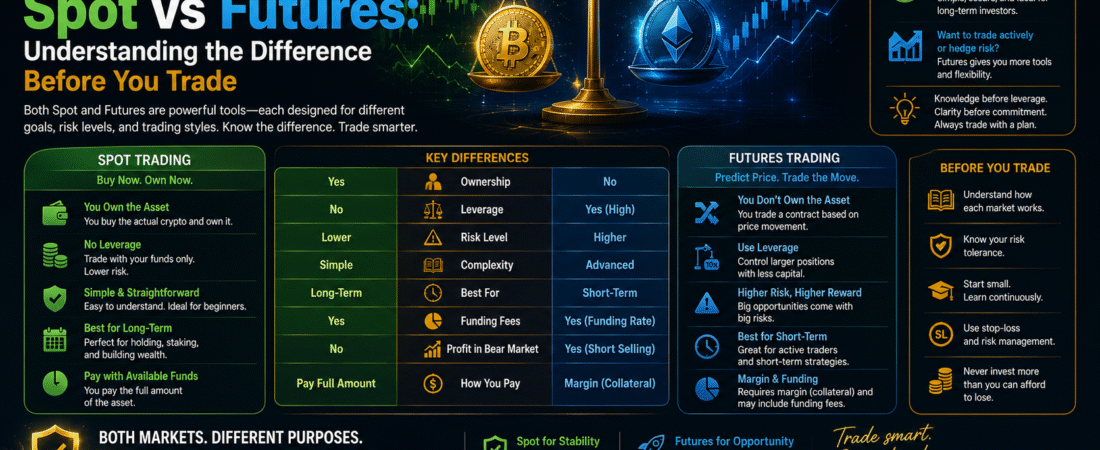
| Feature | Spot | Futures |
|---|---|---|
| Own underlying crypto? | Generally yes | Generally no |
| Can hold indefinitely? | Usually yes | Depends on contract |
| Can easily short? | Less straightforward | Yes |
| Leverage normally involved? | Not necessary | Common |
| Liquidation risk? | No, without borrowing/margin | Yes, when margined |
| Funding payments? | No | Perpetual futures may have them |
| Expiration? | None | Traditional futures may expire |
| Complexity | Lower | Higher |
| Suitable for beginners? | Generally easier to understand | Requires considerably more knowledge |
Neither instrument is inherently “good” or “bad.”
They are designed for different purposes.
Spot markets are commonly used for ownership and investment.
Futures are frequently used for:
- speculation
- hedging
- short exposure
- capital-efficient exposure
- institutional risk management
- relative-value strategies
For beginners, however, the most important difference is risk mechanics.
2. Key Takeaways
Before trading either market, understand these principles.
1. Spot means ownership
When you purchase a crypto asset through a spot transaction, you generally acquire the asset itself.
2. Futures are derivatives
A futures contract derives its value from another asset.
You can therefore gain economic exposure to Bitcoin without actually owning Bitcoin.
3. Futures allow both long and short strategies
A trader can attempt to profit from:
- rising prices through a long
- falling prices through a short
4. Leverage changes the mathematics dramatically
Using leverage allows a trader to control a larger position with less capital.
It also magnifies losses.
5. Futures positions can be liquidated
If losses reduce available margin below required levels, a platform may automatically close the position.
6. Spot investors can normally wait
A spot investor whose asset declines can generally continue holding it, assuming there is no borrowing involved and the underlying project remains viable.
7. Perpetual futures introduce funding rates
Unlike traditional futures, perpetual contracts normally do not expire. Funding payments are commonly used to help keep their prices aligned with spot markets.
8. Futures are tools—not shortcuts to higher returns
They were created partly for price discovery and risk management.
Using them simply to maximize leverage can transform normal market volatility into catastrophic portfolio risk.
3. Market Overview
Crypto markets contain two large trading environments.
The Spot Market
The spot market is where assets are purchased and sold for relatively immediate settlement.
Suppose Bitcoin trades at:
$100,000
You spend:
$1,000
Ignoring fees, you acquire approximately:
0.01 BTC
If Bitcoin subsequently rises to $120,000:
0.01 × $120,000 = $1,200
Your unrealized gain is approximately:
$200 or 20%.
If Bitcoin falls to $80,000:
0.01 × $80,000 = $800
Your position has declined approximately:
20%.
But you still hold approximately 0.01 BTC.
There is no automatic liquidation simply because Bitcoin fell 20%, assuming you bought it outright rather than using margin or borrowed funds.
The Futures Market
Now imagine instead that you use $1,000 as margin to control a larger Bitcoin futures position.
Suppose your effective leverage is:
10×
Your $1,000 margin might provide exposure to roughly:
$10,000 of Bitcoin notional value.
If Bitcoin rises approximately 5%, the theoretical change on that $10,000 exposure is approximately:
+$500
relative to your $1,000 margin.
That represents approximately:
+50%
before fees, funding, margin changes, slippage, and other considerations.
Very attractive.
But leverage works symmetrically.
A 5% decline represents approximately:
-$500
relative to the same $1,000 margin.
That is approximately:
-50%.
A sufficiently large adverse movement can result in liquidation.
This illustrates the central principle of futures:
Leverage does not create additional market return. It creates additional exposure to market movement.
4. Technology Deep Dive
What Is Spot Trading?
“Spot” refers to buying or selling an asset at or near its current market price for direct settlement.
You may place several types of orders.
Market Order
Buy or sell immediately at the best prices currently available.
Limit Order
Specify the maximum price you are prepared to pay or minimum price at which you are prepared to sell.
For example:
Bitcoin market price:
$100,000
Your limit buy:
$95,000
The order executes only if matching liquidity becomes available at your specified price or better.
What Is a Futures Contract?
A futures contract is a derivative.
Its price derives from an underlying reference asset.
In traditional financial markets, futures exist for many assets:
- oil
- gold
- wheat
- stock indices
- interest rates
- currencies
Crypto markets extended the same concept to assets such as:
- Bitcoin
- Ether
- Solana
- other digital assets
The trader therefore trades price exposure, rather than necessarily purchasing the underlying asset.
Traditional Futures
Traditional futures normally have specified expiration dates.
For example:
Bitcoin September Futures
The contract eventually reaches settlement according to predetermined rules.
Some futures contracts in financial markets settle through delivery of the underlying asset.
Others are cash settled.
In cash-settled crypto futures, traders settle differences in value rather than receiving the cryptocurrency itself.
The CFTC specifically notes that futures customers may not receive the underlying virtual currency because many contracts settle financially according to a defined reference price.
Perpetual Futures
Crypto markets popularized another derivative:
Perpetual Futures
Often shortened to:
Perps
A perpetual contract resembles a futures contract but does not have a traditional expiration date.
A trader can theoretically maintain a position as long as:
- sufficient margin remains
- funding obligations are satisfied
- platform requirements are met
- the position is not liquidated
Because there is no expiration mechanism pulling the contract toward spot price, perpetual markets typically use funding rates.
What Is a Funding Rate?
Suppose Bitcoin spot trades at:
$100,000
But aggressive futures buying pushes the perpetual price significantly above spot.
A funding mechanism can create payments between long and short participants to discourage persistent divergence.
In simplified terms:
Positive Funding
Longs commonly pay shorts.
This can happen when perpetual futures are trading strongly relative to spot.
Negative Funding
Shorts commonly pay longs.
The exact calculation varies by trading venue.
Funding is important because a position can lose money from financing costs even when the underlying price has not moved significantly.
Long vs Short
Futures make directional trading particularly straightforward.
Long Position
You expect price to rise.
Example:
Enter long at $100,000.
Exit at $110,000.
The price movement works in your favor.
Short Position
You expect price to fall.
Example:
Enter short at $100,000.
Exit at $90,000.
The decline works in your favor.
This ability makes derivatives valuable for speculation but also for hedging.
What Is Leverage?
Leverage allows traders to control a position larger than the capital committed as margin.
A simplified relationship is:
Leverage = Position Value ÷ Margin
Suppose:
Position value = $10,000
Margin = $2,000
Then:
$10,000 ÷ $2,000 = 5× leverage
You control five dollars of market exposure for every dollar of margin.
This multiplies sensitivity to price movements.
A Simple Leverage Example
Imagine a $1,000 trading account.
No Leverage
Position:
$1,000
Bitcoin rises:
10%
Approximate gain:
$100
5× Leverage
Exposure:
$5,000
Bitcoin rises:
10%
Approximate gain:
$500
But if Bitcoin falls 10%:
Approximate loss:
$500
10× Leverage
Exposure:
$10,000
A 10% favorable move represents approximately:
+$1,000
relative to the $1,000 starting margin.
But a sufficiently large adverse move could exhaust available margin before such a clean 10% decline occurs.
Real liquidation mechanics depend on:
- maintenance margin
- collateral
- trading fees
- unrealized P&L
- mark price
- platform methodology
- other positions
- margin mode
This is why the simplistic statement:
“10× leverage means liquidation exactly after a 10% move”
should not be treated as a universal rule.
Actual liquidation thresholds vary.
5. Current Industry Landscape
Derivatives have become an important component of crypto-market infrastructure.
They exist across two broad environments.
Regulated Traditional Futures Markets
Established derivatives venues provide institutional and professional participants with regulated crypto futures.
CME Group, for example, currently offers futures linked to multiple digital assets, including Bitcoin, Ether and Solana, alongside micro-sized and other contract structures.
These markets support activities such as:
- hedging
- price discovery
- institutional exposure
- portfolio risk management
Crypto-Native Derivatives Markets
Crypto exchanges helped popularize perpetual futures.
These products are particularly attractive to active traders because they:
- have no conventional expiry
- support long and short positions
- can offer substantial leverage
- trade continuously
- cover many crypto assets
The availability of these products, however, differs significantly by jurisdiction.
A product available to a professional trader in one country may be prohibited, restricted, or offered under different conditions elsewhere.
Regulatory treatment is also still evolving.
In May 2026, for example, CFTC staff issued interpretive guidance concerning the categorization of certain crypto-asset perpetual contracts as foreign futures in a specific regulatory context.
For users, the implication is straightforward:
Do not assume that every crypto derivatives product is regulated in the same way simply because it appears on a familiar trading platform.
6. Institutional Activity
Why would sophisticated institutions use futures rather than simply buying crypto?
Because futures solve different problems.
Hedging
Imagine an investment fund owns:
$10 million of Bitcoin
The portfolio manager believes Bitcoin has strong long-term prospects but expects significant downside risk during the next month.
Selling the entire Bitcoin position might:
- create transaction costs
- change portfolio exposure
- have tax consequences
- require repurchasing later
Instead, the fund could potentially short Bitcoin futures.
If Bitcoin falls:
- the physical/spot Bitcoin position loses value
- the short futures position may gain value
The hedge offsets part of the decline.
Price Discovery
Large and transparent futures markets contribute to market price discovery.
Participants express expectations about future prices through trading activity.
Capital Efficiency
Derivatives can provide exposure without requiring an institution to purchase the full notional value of an asset.
CME highlights capital efficiency, price discovery, and risk-management exposure among the functions of its cryptocurrency futures market.
Relative-Value Strategies
Professional traders may also trade relationships between instruments.
For example:
Long Bitcoin spot + Short Bitcoin futures
or strategies involving:
Bitcoin futures vs Ether futures
These strategies can seek to capture pricing differences rather than simply predict whether the entire crypto market rises or falls.
This is very different from a retail trader selecting “20× Long” because Bitcoin appears bullish.
7. Market Data & Metrics
Understanding derivatives requires several additional metrics beyond ordinary price and trading volume.
Open Interest
Open Interest (OI) measures outstanding derivative contracts that have not yet been closed or settled.
Increasing open interest can indicate growing participation and positioning.
But rising open interest does not automatically mean bullishness.
Both:
a long
and
a short
exist within a derivatives market.
Open interest therefore measures activity and exposure—not simply market optimism.
Funding Rate
Funding rates can help show positioning pressure in perpetual markets.
Very positive funding may suggest traders are aggressively positioned long.
Strongly negative funding may suggest heavy short positioning.
Extreme funding can sometimes indicate crowded positioning.
But it should never be interpreted alone.
Basis
The basis describes the difference between futures and spot pricing.
Simplified:
Basis = Futures Price − Spot Price
Suppose:
Bitcoin spot = $100,000
Three-month Bitcoin futures = $103,000
Then the absolute basis is:
$3,000
The futures contract trades at a premium to spot.
When futures trade above spot, the market structure is commonly described as contango.
When futures trade below spot, it may be described as backwardation.
Professional traders monitor these relationships closely.
Liquidation Data
Crypto markets often monitor estimated long and short liquidations.
Large liquidation events can accelerate market movements because forced closures create additional buying or selling pressure.
For example:
A heavily leveraged long market begins falling.
Positions approach liquidation.
Exchanges automatically sell positions.
Those sales create more downward pressure.
More positions are liquidated.
This can create a:
liquidation cascade.
The same mechanism can occur upward when heavily leveraged shorts are forced to buy back positions.
Volume
Derivatives trading volume indicates market activity.
High volume generally provides deeper liquidity, although liquidity can deteriorate sharply during periods of extreme volatility.
8. Real-World Use Cases
Futures are not merely tools for gambling on price movements.
They have legitimate economic applications.
Use Case 1 — Hedging
A Bitcoin holder wants to reduce short-term downside risk without selling Bitcoin.
Potential strategy:
Short Bitcoin futures
Use Case 2 — Short Exposure
An investor expects an asset to decline.
Spot investing naturally favors ownership.
Futures make bearish positioning much easier.
Use Case 3 — Portfolio Management
A professional portfolio manager may temporarily increase or decrease market exposure using futures rather than reorganizing the underlying portfolio.
Use Case 4 — Arbitrage
Suppose Bitcoin spot trades at:
$100,000
while an equivalent futures contract trades unusually high at:
$108,000
A professional trader may investigate whether a market-neutral trade can exploit that difference.
Real-world execution involves costs, financing, settlement mechanics, margin requirements, counterparty risk, and basis risk.
Use Case 5 — Price Discovery
Futures markets aggregate the expectations and positioning of numerous traders.
This provides information about how market participants price risk.
Use Case 6 — Speculation
A trader believes Bitcoin will rise or fall and uses a derivative to express that view.
This is perhaps the most familiar retail use—but also one of the riskiest when combined with aggressive leverage.
9. Risks & Challenges
For beginners, this section deserves particular attention.
1. Liquidation Risk
This is the major distinction from ordinary unleveraged spot investing.
A futures trader must maintain sufficient margin.
When collateral falls below required levels, the position may be automatically closed.
The CFTC warns that leverage amplifies both profits and losses and can force traders to replenish margin or close positions when markets move against them.
2. Leverage Risk
Consider:
2×
5×
10×
20×
50×
As leverage increases, the adverse market movement required to seriously damage the position becomes progressively smaller.
High leverage effectively reduces the amount of normal market volatility a position can tolerate.
3. Psychological Risk
Leverage changes behavior.
A trader may begin thinking:
“If 5× can make $500, why not use 20× and make $2,000?”
This reasoning considers potential return while ignoring survival probability.
Repeated high-leverage trading can transform investing into short-duration speculation.
4. Funding Costs
Perpetual positions can incur ongoing funding payments.
A trade can therefore become expensive to maintain.
5. Margin Risk
Margin requirements can change with market conditions and product rules.
Coinbase, for example, explicitly advises derivatives customers that insufficient margin can lead to automatic liquidation.
6. Slippage
During rapidly moving markets, a position may execute at a worse price than expected.
Liquidation may also occur under unfavorable market conditions.
7. Platform Risk
Derivatives require infrastructure.
Potential issues include:
- exchange failure
- technical outages
- pricing disruptions
- API failures
- collateral problems
- liquidity shortages
- regulatory intervention
8. Counterparty Risk
Depending on the venue and product structure, traders can be exposed to intermediaries and settlement mechanisms.
9. Short-Squeeze Risk
Short positions can experience rapid losses if price moves upward.
Forced short liquidations can accelerate that rise.
10. Complexity Risk
Perhaps the greatest danger is trading a product without understanding it.
Before using futures, a trader should understand at minimum:
- leverage
- margin
- liquidation
- mark price
- position size
- stop-loss mechanics
- funding rate
- open interest
- contract specifications
- settlement
- trading fees
If these concepts are unfamiliar, the trader is probably not ready to use leveraged futures.
10. Future Outlook: 3–5 Years
Crypto derivatives are likely to become increasingly integrated into traditional financial infrastructure.
Several trends appear particularly important.
More Regulated Products
Institutional derivatives markets are likely to continue broadening their digital-asset offerings.
More Sophisticated Hedging
As asset managers, corporations, funds, market makers, and financial institutions increase digital-asset exposure, derivatives can become increasingly important for managing that risk.
Growing Perpetual Markets
Perpetual futures have become a defining crypto-native financial innovation.
They are likely to remain important, although regulatory structures may evolve considerably.
Integration Between Traditional and Crypto Markets
The distinction between:
traditional financial derivatives
and
crypto-native derivatives
may gradually narrow as market infrastructure matures.
Better Risk Infrastructure
Expect improvements in:
- collateral management
- portfolio margining
- institutional custody
- settlement
- clearing
- risk monitoring
- derivatives analytics
This development does not mean derivatives will become safe for inexperienced traders.
Sophisticated infrastructure cannot eliminate leverage risk.
11. Investment & Business Implications
For newcomers, a useful decision framework is remarkably simple.
If Your Objective Is Long-Term Ownership
Spot is generally easier to understand.
You purchase the asset and hold it according to your investment thesis.
There is normally:
- no futures expiration
- no perpetual funding rate
- no forced liquidation from ordinary unleveraged ownership
This does not eliminate crypto risk.
The asset can still decline dramatically or even become worthless.
If Your Objective Is Short-Term Trading
Futures provide additional capabilities but also introduce additional risks.
You must understand:
Direction + Position Size + Leverage + Margin + Liquidation + Funding + Execution
Being correct about market direction is not enough.
You can correctly believe:
“Bitcoin will be higher in three months.”
And still lose a leveraged futures position today because Bitcoin first falls sharply enough to liquidate you.
This principle deserves emphasis:
A correct long-term market thesis can still produce a losing leveraged trade.
Spot vs Futures Decision Framework
Choose Spot When Your Objective Is Primarily:
- ownership
- long-term investing
- accumulation
- portfolio allocation
- learning crypto markets
Consider Futures Only When You Understandably Need:
- hedging
- short exposure
- derivatives strategies
- professional risk management
- active trading
And understand the additional risks.
A Beginner Example
Imagine Sarah believes Bitcoin has strong prospects over five years.
She has:
CHF 2,000
that she has independently decided to allocate to crypto.
Approach A — Spot
Sarah purchases CHF 2,000 worth of Bitcoin.
Bitcoin falls 25%.
Position value:
approximately CHF 1,500
She still owns the Bitcoin and can continue evaluating her five-year thesis.
Approach B — Leveraged Futures
Sarah uses the CHF 2,000 as margin for a highly leveraged Bitcoin position.
Bitcoin experiences a sharp short-term decline.
Even if Bitcoin later recovers and reaches new highs, Sarah’s original position may have been liquidated during the decline.
Her long-term thesis could ultimately prove correct.
Her trade could still fail.
That is the difference between:
investment horizon
and
position survival.
12. Final Analysis
Spot and futures markets allow participants to interact with the same crypto asset in fundamentally different ways.
With spot:
You primarily own the asset.
With futures:
You primarily own a contract representing price exposure.
That distinction creates different opportunities.
Spot can support:
- accumulation
- long-term ownership
- portfolio exposure
Futures can support:
- hedging
- shorting
- speculation
- arbitrage
- institutional risk management
But futures introduce one variable that dramatically changes risk:
leverage.
Leverage can make a small market movement economically large relative to your capital.
That can increase returns when the market moves favorably.
It can also destroy a position before a longer-term investment thesis has time to develop.
For newcomers, the lesson is therefore not:
“Never use futures.”
It is:
“Never use a financial instrument you do not fully understand.”
Futures are professional financial tools.
They should be treated accordingly.
Start by understanding spot markets.
Learn how prices move.
Learn position sizing.
Learn risk management.
Learn market cycles.
Learn how volatility behaves.
Then study derivatives from the perspective of risk first, return second.
In crypto, survival matters more than maximizing the outcome of a single trade.
13. References & Further Reading
Commodity Futures Trading Commission — CFTC
Understand the Risks of Virtual Currency Trading
The CFTC’s investor guidance explains the distinction between virtual-currency cash markets and derivatives and warns that leverage can amplify underlying price movements and losses.
Use Caution When Buying Digital Coins or Tokens
Investor guidance emphasizing due diligence, liquidity considerations, technological risk, fraud, and speculation.
CME Group
Cryptocurrency Futures
Information covering regulated futures markets for major crypto assets, including Bitcoin, Ether, Solana, and other digital-asset derivatives.
Bitcoin Futures Overview
Information on futures-based exposure, price discovery, risk management, reference pricing, and capital efficiency.
Coinbase Derivatives
Margin Ratio and Liquidation Risk Management
Documentation explaining initial margin, maintenance margin, margin ratios, liquidation thresholds, and risk management.
International Derivatives — Liquidation Management
Information explaining how leveraged perpetual positions can be automatically liquidated when collateral becomes insufficient.
Additional Concepts to Study
Readers interested in progressing beyond the fundamentals should research:
- margin
- maintenance margin
- mark price
- liquidation price
- open interest
- funding rates
- futures basis
- contango
- backwardation
- perpetual futures
- hedging
- position sizing
CoinBrain Crypto Investing Basics
Article 01 — How to Start Investing in Crypto
Article 02 — Spot vs Futures: Understanding the Difference Before You Trade
Next Article
Article 03 — What Is Staking? How Crypto Can Earn Rewards While Securing a Blockchain
CoinBrain Research Articles
Research. Understand. Decide.
Leave a Reply
You must be logged in to post a comment.