
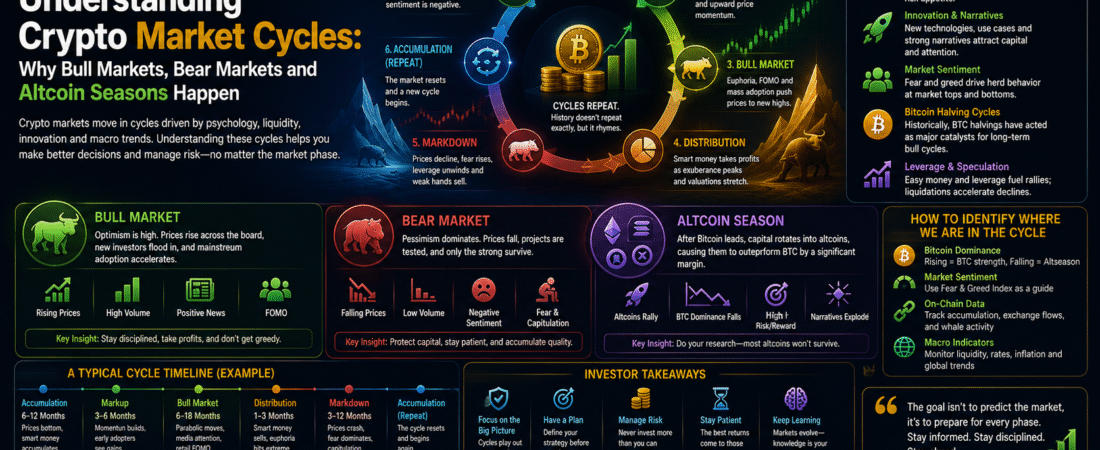

Understanding Crypto Market Cycles
Why Bull Markets, Bear Markets and Altcoin Seasons Happen
CoinBrain Research Articles | Crypto Investing Basics — Article 07
Updated: August 2026
Crypto markets rarely move in a straight line.
Bitcoin may rise dramatically for months, then fall sharply.
After Bitcoin rallies, Ethereum and other large cryptocurrencies may begin outperforming.
Later, capital can rotate into smaller altcoins.
Excitement builds.
Social-media activity increases.
New investors enter.
Leverage expands.
Valuations become increasingly difficult to justify.
Then something changes.
Liquidity weakens.
Expectations shift.
Prices begin falling.
Highly leveraged positions are liquidated.
Speculative tokens collapse.
Investors who believed prices could only rise suddenly discover that crypto markets operate in cycles.
Understanding these cycles is one of the most valuable skills a new crypto investor can develop.
It does not allow anyone to predict the exact market top or bottom.
But it can help investors recognize whether markets are dominated by:
Accumulation → Expansion → Euphoria → Distribution → Decline → Recovery
Crypto cycles are influenced by many forces:
- global liquidity
- interest rates
- Bitcoin’s monetary cycle
- institutional flows
- leverage
- regulation
- technological narratives
- investor psychology
- Bitcoin dominance
- stablecoin liquidity
- token supply
- macroeconomic conditions
The important lesson is that market cycles are not caused by one indicator.
They emerge from the interaction between capital, expectations, technology, incentives and human behavior.
Educational Notice: This article is for educational and research purposes only. It does not constitute financial, investment, tax, or legal advice. Historical market cycles do not guarantee future market behavior. Cryptocurrency markets can experience severe and prolonged losses.
1. Executive Summary
A crypto market cycle is a recurring pattern in which market sentiment, capital flows, valuations and investor behavior move through periods of expansion and contraction.
A simplified cycle can be represented as:
Accumulation
↓
Early Bull Market
↓
Expansion
↓
Euphoria
↓
Distribution
↓
Bear Market
↓
Capitulation
↓
Accumulation Again
These phases are not perfectly defined.
Markets can:
- pause
- reverse temporarily
- experience multiple corrections
- behave differently from previous cycles
Historically, Bitcoin’s approximately four-year halving schedule has often been discussed as one influence on crypto cycles because the block subsidy—and therefore the flow of newly issued BTC to miners—is periodically reduced.
But investors should avoid assuming:
Bitcoin Halving = Guaranteed Bull Market
Crypto is now a much larger and more institutional market.
By 2026, regulated derivatives, ETFs, institutional custody, tokenized assets and sophisticated trading strategies have become increasingly important.
CME reported that its crypto futures and options generated a record $3 trillion of notional volume during 2025, and in 2026 expanded regulated crypto derivatives into additional assets, volatility products and broad-market crypto index exposure.
That suggests future market cycles may become increasingly influenced by:
Macro Liquidity + Institutional Flows + Derivatives + Regulation + Blockchain Adoption
rather than following a simple four-year formula.
2. Key Takeaways
1. Crypto markets move through cycles
Periods of optimism and rising prices are usually followed eventually by periods of declining prices and reduced speculation.
2. Bull markets are not simply rising prices
A sustainable bull market typically involves expanding:
- capital
- demand
- liquidity
- participation
- network activity
- investor confidence
3. Bear markets are part of market structure
Bear markets remove excessive leverage, expose weak projects and reset valuations.
They can be painful but also economically important.
4. Bitcoin often leads crypto market cycles
Capital frequently enters Bitcoin before rotating toward increasingly speculative assets.
But this pattern is not guaranteed.
5. Bitcoin dominance helps measure capital rotation
Bitcoin dominance measures Bitcoin’s market capitalization relative to the broader cryptocurrency market.
Rising dominance can indicate Bitcoin outperforming the broader market.
Falling dominance can indicate stronger relative performance from altcoins.
6. Altcoin season is not simply “altcoins are rising”
CoinMarketCap’s current Altcoin Season Index defines an altcoin season when 75% of the top 100 eligible cryptocurrencies outperform Bitcoin over the previous 90 days.
7. Liquidity matters enormously
When capital becomes abundant and investors seek risk, crypto can perform strongly.
When financing conditions tighten, speculative assets can suffer disproportionately.
8. Leverage amplifies cycles
Borrowing can accelerate bull markets.
Liquidation can accelerate bear markets.
9. Narratives change every cycle
One cycle may focus on:
- ICOs
another on:
- DeFi
- NFTs
- Layer 1s
future cycles may focus on:
- tokenization
- stablecoins
- AI
- DePIN
- institutional blockchain infrastructure
10. Not every altcoin returns after a bear market
This is critical.
A market recovery does not mean every previous-cycle token will recover.
Many disappear permanently.
11. Market timing is extremely difficult
Recognizing broad market phases is useful.
Predicting exact tops and bottoms consistently is far harder.
12. Risk management matters more than cycle prediction
A portfolio capable of surviving the entire cycle is more valuable than a strategy requiring perfect timing.
3. Market Overview
What Is a Bull Market?
A bull market is a sustained period in which asset prices generally rise and investor confidence strengthens.
In crypto, bull markets are often characterized by:
- increasing Bitcoin prices
- higher trading volumes
- rising institutional flows
- expanding stablecoin liquidity
- stronger altcoin performance
- increased leverage
- new project launches
- growing retail participation
- more media attention
But bull markets typically develop progressively.
They do not begin with everyone feeling optimistic.
Often the opposite is true.
Early bull markets can begin while many investors remain pessimistic following a previous decline.
What Is a Bear Market?
A bear market is a prolonged period of falling prices, weak sentiment and declining risk appetite.
Crypto bear markets frequently involve:
- large price declines
- collapsing altcoin valuations
- reduced trading volume
- project failures
- declining venture investment
- layoffs
- bankruptcies
- lower retail interest
- deleveraging
The strongest assets may survive.
Weak projects may disappear.
This creates what could be described as:
creative destruction within the crypto economy.
What Is a Market Cycle?
A market cycle describes the transition between these states.
A useful simplified model is:
Phase 1 — Accumulation
Prices are relatively depressed.
Public enthusiasm is low.
Long-term investors begin accumulating.
Phase 2 — Early Expansion
Prices begin recovering.
Fundamentals improve.
Institutional or sophisticated capital may increase participation.
Phase 3 — Bull Market
Momentum strengthens.
More investors enter.
Prices rise broadly.
Phase 4 — Euphoria
Speculation becomes extreme.
Investors begin believing:
“This time is different.”
Risk discipline weakens.
Phase 5 — Distribution
Early investors begin reducing exposure.
Prices may remain high, but market leadership becomes less consistent.
Phase 6 — Decline
Prices begin falling.
Investors initially interpret declines as temporary buying opportunities.
Phase 7 — Capitulation
Confidence breaks.
Forced selling increases.
Many investors exit.
Phase 8 — Recovery and Accumulation
Markets stabilize.
Weak projects disappear.
Development continues.
A new cycle gradually begins.
4. Technology Deep Dive
Why Does Bitcoin Influence Crypto Cycles?
Bitcoin remains the largest and most established crypto asset.
Its market behavior influences:
- investor confidence
- trading liquidity
- collateral markets
- institutional exposure
- altcoin valuations
Bitcoin is therefore often treated as the crypto market’s primary risk benchmark.
The Bitcoin Halving
Bitcoin’s issuance system periodically reduces the mining subsidy.
Approximately every:
210,000 blocks
the block subsidy is cut in half.
This process is known as:
the Bitcoin Halving.
The mechanism gradually reduces the rate at which new BTC enters circulation until issuance approaches Bitcoin’s approximately 21-million supply limit.
The economic logic is straightforward.
Suppose miners previously received:
6.25 BTC per block
and after a halving receive:
3.125 BTC per block.
All else equal, the flow of newly created BTC available to the market decreases.
The April 2024 halving reduced Bitcoin’s block subsidy from:
6.25 BTC
to:
3.125 BTC.
However, this does not automatically mean Bitcoin’s price must rise.
Price still depends on:
Supply + Demand + Liquidity + Expectations
The halving changes one part of the supply equation.
Why Markets Anticipate Events
Financial markets are forward-looking.
If investors know a Bitcoin halving will happen months in advance, they can position before it occurs.
This means the market may partially price the event beforehand.
Therefore:
Event Happens
does not necessarily mean:
Price Immediately Rises
This applies not only to halvings but also to:
- ETF approvals
- upgrades
- token unlocks
- regulatory changes
- interest-rate decisions
Markets respond to differences between:
expectation
and:
reality.
Liquidity Cycles
Crypto does not operate independently from the global financial system.
Investors allocate capital across:
- bonds
- equities
- commodities
- currencies
- real estate
- crypto
When financial conditions make risk-taking attractive, speculative assets can benefit.
When capital becomes expensive or scarce, risk assets may suffer.
Important macro variables include:
- interest rates
- inflation
- credit conditions
- money supply
- dollar strength
- economic growth
- investor risk appetite
Interest Rates
Imagine safe government bonds offer:
1%
Investors may be more willing to seek higher returns elsewhere.
Now imagine safe yields rise to:
5%
The opportunity cost of holding highly speculative assets increases.
This does not mean:
Higher Rates = Crypto Always Falls
Markets are more complicated.
But interest rates influence how investors price risk.
Leverage Cycles
Crypto markets contain substantial derivative activity.
A trader deposits:
$10,000
and controls:
$50,000
of exposure.
That represents:
5× leverage.
When many traders use leverage during rising markets:
Price Rises
↓
Profits Increase
↓
Confidence Increases
↓
More Leverage Enters
↓
Price Can Rise Further
This is a positive feedback loop.
But the same mechanism works in reverse.
Price Falls
↓
Positions Lose Margin
↓
Liquidations Occur
↓
Forced Selling
↓
Price Falls Further
↓
More Liquidations
This creates:
Liquidation Cascades
and helps explain why crypto crashes can occur extraordinarily quickly.
5. Current Industry Landscape
Crypto cycles are changing.
Early cycles were largely dominated by:
- Bitcoin enthusiasts
- miners
- retail traders
- crypto-native exchanges
Today’s ecosystem contains:
- global asset managers
- regulated derivatives
- exchange-traded products
- professional market makers
- hedge funds
- family offices
- corporations
- tokenized financial products
This structural change matters.
Institutional Derivatives
CME’s cryptocurrency derivatives markets continue to expand.
In February 2026, CME announced continuous 24/7 trading for its regulated crypto futures and options, citing record $3 trillion notional trading volume during 2025.
In April 2026, CME announced Avalanche and Sui futures, reporting nearly $8 billion in average daily crypto derivatives notional value during March.
In May 2026, it announced Bitcoin Volatility futures and a Nasdaq-CME crypto index futures contract designed to provide broad market exposure.
This suggests the market’s structure is becoming more sophisticated.
Current Market Structure
As of the current August 2026 market snapshot available from CoinMarketCap, Bitcoin dominance was approximately:
58.8%
with Ethereum representing approximately:
10.5%
of total tracked crypto market capitalization.
These figures change continuously and should not be treated as permanent.
But they demonstrate that Bitcoin continues to represent a very large portion of crypto’s aggregate valuation.
A More Selective Altcoin Market
An important structural change may also be occurring.
Historically, investors often expected almost every major altcoin to rise dramatically during a broad bull market.
That assumption deserves increasing caution.
CoinMarketCap’s 2026 analysis has highlighted that recent altcoin performance has been much more selective than some earlier cycles, with Bitcoin retaining relatively high dominance and many major altcoins significantly underperforming previous expectations.
This suggests future cycles may favor:
Selective Sector Rotation
rather than:
Everything Goes Up.
6. Institutional Activity
Institutional participation can affect market cycles in several ways.
ETF and Investment Product Flows
Traditional investment vehicles allow capital to enter crypto without every investor managing wallets and private keys.
Large inflows can increase demand.
Large outflows can create selling pressure.
Institutional flows may therefore become increasingly important cycle indicators.
Futures Positioning
Professional investors can use derivatives to:
- hedge
- speculate
- short
- arbitrage
- manage volatility
The expansion of regulated derivatives means crypto cycle analysis increasingly needs to consider not merely:
Spot Buying
but also:
Futures + Options + Basis + Volatility + Hedging
CME’s launch of Bitcoin volatility futures in June 2026 illustrates how professional participants can increasingly trade crypto volatility independently from directional price exposure.
Institutional Rotation
Institutions may allocate between:
Bitcoin
↓
Ethereum
↓
Other Large Crypto Assets
↓
Sector-Specific Exposure
But unlike retail investors chasing small speculative tokens, institutions may prioritize:
- liquidity
- custody
- regulation
- risk management
This can change traditional altcoin-cycle behavior.
Treasury and Corporate Participation
Corporations holding crypto assets can introduce another form of demand.
But corporate adoption can also become procyclical.
When prices rise:
balance sheets strengthen
and additional purchases may appear attractive.
When prices fall:
risk controls tighten
and additional financing becomes more difficult.
7. Market Data & Metrics
Market-cycle analysis should rely on multiple indicators.
No single metric is sufficient.
1. Bitcoin Price Trend
Start with the market leader.
Consider:
- higher highs
- higher lows
- long-term moving averages
- market structure
But price alone is insufficient.
2. Total Crypto Market Capitalization
This estimates the aggregate valuation of tracked crypto assets.
Rising total market cap indicates capital appreciation across the ecosystem.
3. Bitcoin Dominance
A simplified formula is:
BTC Dominance = Bitcoin Market Cap ÷ Total Crypto Market Cap × 100
CoinMarketCap defines Bitcoin dominance as Bitcoin’s market capitalization relative to the broader cryptocurrency market.
Example:
Bitcoin market cap:
$1.5 trillion
Total crypto market:
$2.5 trillion
Then:
BTC Dominance = 60%
4. Ethereum Relative Strength
Ethereum often acts as an important bridge between:
Bitcoin-led markets
and:
broader altcoin participation.
Investors may monitor:
ETH/BTC
to evaluate whether Ethereum is outperforming Bitcoin.
5. Altcoin Season Index
CoinMarketCap currently defines Altcoin Season when:
75% of the top 100 eligible cryptocurrencies outperform Bitcoin over 90 days.
If only:
25% or fewer
outperform Bitcoin, CoinMarketCap categorizes the environment as Bitcoin Season.
This provides a more rigorous definition than:
“Some altcoins are pumping.”
6. Stablecoin Supply
Stablecoins represent deployable crypto-native liquidity.
Growing stablecoin supply can potentially indicate additional capital available for:
- trading
- lending
- settlement
- investment
But it should not be interpreted in isolation.
7. Trading Volume
Healthy price expansion is often stronger when supported by meaningful market participation.
Watch:
- spot volume
- futures volume
- DEX volume
8. Open Interest
Derivative open interest measures outstanding positions.
Rapidly rising open interest can indicate:
increasing leverage.
This becomes particularly important during euphoric phases.
9. Funding Rates
Highly positive perpetual funding can indicate crowded long positioning.
Extremely negative funding can indicate crowded shorts.
Neither predicts price by itself.
But extremes can signal vulnerability.
10. Liquidations
Large liquidation events can identify deleveraging.
During extreme market stress, liquidation cascades may accelerate price movements.
11. On-Chain Activity
Depending on the blockchain, investors can monitor:
- active addresses
- transaction volume
- fees
- staking
- exchange flows
- stablecoin activity
12. Search and Social Activity
Retail interest often rises dramatically late in bull markets.
Indicators can include:
- search trends
- social-media activity
- exchange app rankings
- new user growth
When people previously uninterested in crypto suddenly ask:
“Which coin can 100×?”
the market may be entering a very different psychological phase from early accumulation.
13. Valuations
Cycle analysis should also incorporate:
- market cap
- FDV
- token unlocks
- protocol revenue
- network activity
A bull market can temporarily make weak tokenomics appear irrelevant.
Eventually they matter again.
8. Real-World Use Cases
Understanding market cycles has practical value for different participants.
Use Case 1 — Long-Term Investors
A long-term investor can use market-cycle awareness to avoid making emotionally driven decisions during extreme optimism or fear.
Use Case 2 — Dollar Cost Averaging
Investors who cannot reliably time market cycles may use systematic purchasing strategies.
We will examine Dollar Cost Averaging separately later in this series.
Use Case 3 — Portfolio Rebalancing
Suppose Bitcoin rises dramatically and becomes:
80% of an investor’s crypto portfolio
despite an original target of:
60%.
Rebalancing can restore the intended risk structure.
Use Case 4 — Altcoin Allocation
An investor may monitor:
- Bitcoin dominance
- ETH/BTC
- altcoin relative strength
before increasing exposure to higher-risk assets.
Use Case 5 — Risk Reduction During Euphoria
When markets become extremely speculative, an investor might:
- reduce leverage
- rebalance
- take partial profits
- increase cash or stablecoin reserves
rather than assuming the trend will continue forever.
Use Case 6 — Institutional Hedging
Professional investors can use futures and options to reduce downside exposure without completely exiting underlying holdings.
Use Case 7 — Business Planning
Crypto companies also experience market cycles.
During bull markets:
- user growth increases
- funding becomes easier
- trading activity expands
During bear markets:
- revenue may collapse
- fundraising becomes difficult
- weaker businesses fail
Companies that understand cycle risk can maintain stronger reserves and avoid expanding unsustainably during booms.
9. Risks & Challenges
Market-cycle analysis can itself create dangerous misconceptions.
1. Assuming History Must Repeat
The fact that previous Bitcoin cycles followed certain patterns does not guarantee future cycles will behave identically.
Markets evolve.
2. Treating the Halving as a Trading Signal
The halving changes Bitcoin issuance.
It does not guarantee a specific price or timing outcome.
3. Waiting for the Exact Bottom
Imagine Bitcoin falls:
70%
An investor says:
“I will buy when it falls another 10%.”
It instead recovers 40%.
The investor remains uninvested.
Perfect timing is extremely difficult.
4. Refusing to Accept a Bear Market
During early declines, investors often say:
“It’s just a correction.”
Repeatedly.
Risk management requires updating beliefs when evidence changes.
5. FOMO Near Market Tops
Consider:
Asset rises:
+50%
then:
+100%
then:
+300%
A newcomer finally buys because:
“Everyone is making money.”
Market risk may be highest exactly when psychological confidence is strongest.
6. Selling During Capitulation
The opposite happens near market lows.
After enormous losses, investors may conclude:
“Crypto is dead.”
Extreme pessimism can occur after much of the decline has already happened.
7. Believing Every Altcoin Will Recover
Suppose a token falls:
$10 → $0.50
An investor says:
“It was $10 before. It will eventually return.”
That is anchoring.
The relevant question is:
Does the project still deserve a $10 valuation?
Many tokens never return to previous highs.
8. Excessive Leverage
Leverage can destroy a good long-term thesis.
A trader can correctly predict that Bitcoin will rise over two years and still be liquidated during a 20% interim decline.
9. Narrative Chasing
Every cycle produces popular themes.
Investors often enter only after:
Narrative → Price Increase → Media Attention → FOMO
By then, risk/reward may have deteriorated dramatically.
10. Survivorship Bias
Looking only at successful cryptocurrencies creates a distorted picture.
For every project that survived multiple cycles, many others failed.
11. Bitcoin Dominance Misinterpretation
Bitcoin dominance is useful but imperfect.
CoinMarketCap itself notes that dominance should not be treated as a definitive investment signal and that market-cap methodology has limitations.
12. Macroeconomic Shock
Unexpected events can overwhelm normal crypto-cycle expectations.
Examples include:
- financial crises
- geopolitical shocks
- inflation surprises
- regulatory actions
- liquidity crises
10. Future Outlook: 3–5 Years
Crypto cycles are unlikely to disappear.
But their structure may change significantly.
Institutional Capital Could Reduce Some Inefficiencies
Professional participants may create:
- deeper liquidity
- better arbitrage
- stronger derivatives markets
This could reduce some extreme pricing inefficiencies.
But institutional participation does not eliminate volatility.
Cycles May Become Less Halving-Centric
Bitcoin’s halving will remain an important monetary event.
But as the newly issued share of total Bitcoin supply becomes progressively smaller, other factors may become relatively more important:
- ETF flows
- macro liquidity
- institutional allocation
- regulation
- global adoption
Sector Cycles May Become More Important
Instead of one massive:
Bitcoin → Ethereum → Everything
rotation, future markets could contain distinct cycles around:
- stablecoins
- RWA tokenization
- DeFi
- AI infrastructure
- decentralized compute
- payments
- Layer 2
- institutional settlement
This would resemble traditional equity markets, where sectors rotate independently.
Altcoin Selection Will Become More Important
The current market already shows signs that broad altcoin performance may be more selective than in previous speculative cycles.
That increases the importance of:
- tokenomics
- revenue
- usage
- liquidity
- institutional accessibility
Crypto Could Become More Macro-Sensitive
As institutions increase participation, crypto may interact even more strongly with:
- global liquidity
- interest rates
- equities
- dollar conditions
Derivatives Will Become More Sophisticated
CME’s 2026 expansion into 24/7 trading, Bitcoin volatility futures and market-cap-weighted crypto index futures illustrates this maturation.
Future cycles may therefore increasingly involve professional:
- volatility trading
- hedging
- index exposure
- basis strategies
Real Adoption Could Matter More Than Narratives
As crypto matures, markets may increasingly differentiate between:
speculative tokens
and:
assets supporting genuine economic activity.
That would be a healthy development.
11. Investment & Business Implications
Understanding cycles should improve decision-making—not encourage constant market timing.
A practical framework follows.
Step 1 — Identify Your Time Horizon
Are you:
- trading for days?
- investing for months?
- investing for years?
A five-year investor and a five-day trader should not respond identically to market volatility.
Step 2 — Separate Market Price from Fundamentals
Ask two different questions:
What is the market doing?
and:
What is the asset doing fundamentally?
A strong project can fall during a bear market.
A weak project can rise during a bull market.
Do not confuse the two.
Step 3 — Watch Bitcoin Leadership
Monitor:
- Bitcoin trend
- Bitcoin dominance
- institutional flows
Bitcoin often provides important information about overall crypto risk appetite.
Step 4 — Watch Ethereum and Large-Cap Rotation
If Bitcoin stabilizes after a strong rally while Ethereum and other high-quality assets begin outperforming, broader risk appetite may be strengthening.
This is not guaranteed.
Treat it as evidence—not certainty.
Step 5 — Watch Speculative Expansion
Later-cycle behavior may include:
- rapidly rising small-cap tokens
- memecoin mania
- extremely high leverage
- unrealistic price targets
- widespread FOMO
These are reasons to increase risk awareness.
Step 6 — Watch Leverage
Excessive:
- open interest
- funding
- borrowing
can make the market fragile.
Step 7 — Maintain Liquidity
Investors often become fully invested during bull markets.
Then corrections arrive and they have no capital available.
Liquidity provides optionality.
Step 8 — Rebalance
Suppose your portfolio target is:
Bitcoin: 50%
Ethereum: 25%
Altcoins: 15%
Stablecoins/Cash: 10%
After an altcoin rally:
Bitcoin: 35%
Ethereum: 20%
Altcoins: 40%
Cash: 5%
Your portfolio now carries much more risk than originally intended.
Rebalancing restores discipline.
Step 9 — Develop Exit Rules Before Euphoria
Investors often plan entries carefully but never plan exits.
Possible approaches include:
- target allocations
- partial profit-taking
- periodic rebalancing
- thesis-based exits
Do not create the plan while emotions are at their strongest.
Step 10 — Do Not Assume Altseason
CoinMarketCap’s formal methodology requires 75% of the top 100 eligible cryptocurrencies to outperform Bitcoin over 90 days before labeling the environment Altcoin Season.
A few rising tokens do not constitute an altcoin cycle.
A Beginner Example
Imagine Ali begins investing during a bear market.
Phase 1 — Accumulation
Bitcoin:
$40,000
Sentiment:
Extremely negative.
Ali invests gradually rather than all at once.
Phase 2 — Recovery
Bitcoin:
$60,000
Media coverage improves.
Ali continues his strategy.
Phase 3 — Bull Market
Bitcoin:
$100,000
Altcoins begin rising.
Ali’s portfolio has appreciated strongly.
Instead of suddenly doubling risk, he rebalances.
Phase 4 — Euphoria
A speculative token rises:
500%
Friends tell Ali:
“Bitcoin is too slow. Put everything into small caps.”
Ali remembers that risk typically increases—not decreases—after enormous price appreciation.
Phase 5 — Correction
Crypto falls sharply.
Because Ali:
- avoided excessive leverage
- maintained diversification
- held liquidity
he does not need to sell under pressure.
This example illustrates a critical principle:
Understanding cycles is less about predicting the market and more about managing your behavior throughout the market.
A CoinBrain Market-Cycle Dashboard
Rather than attempting to find one magical indicator, monitor several dimensions:
Market Leadership
- Bitcoin trend
- Bitcoin dominance
- ETH/BTC
Liquidity
- stablecoin supply
- trading volume
- institutional flows
Risk
- funding rates
- open interest
- liquidations
- leverage
Fundamentals
- network activity
- fees
- protocol revenue
Sentiment
- search activity
- social activity
- retail participation
Valuation
- market caps
- FDVs
- token unlocks
Macro
- interest rates
- financial conditions
- economic growth
Think in terms of:
Weight of Evidence
rather than:
One Indicator Predicts Everything.
Business Implications
Crypto businesses should also plan around cycles.
During bull markets:
Do not assume current revenue will continue forever.
During bear markets:
Do not assume current weakness will continue forever.
Sustainable businesses should:
- maintain reserves
- control fixed costs
- diversify revenue
- build throughout downturns
- avoid excessive bull-market hiring
- focus on real user demand
Historically, bear markets have often been periods when serious blockchain infrastructure continues developing while speculative attention disappears.
12. Final Analysis
Crypto markets are driven by more than technology.
They are driven by:
Money
Liquidity
Psychology
Leverage
Narratives
Supply
Demand
Macroeconomics
and increasingly:
Institutional Capital.
This interaction produces market cycles.
During bull markets, investors frequently believe:
the market has permanently changed.
During bear markets, they often believe:
the industry is permanently finished.
Both conclusions can be dangerous.
The strongest investors attempt to remain disciplined during both extremes.
Market cycles should therefore not be understood as a formula:
Halving → Bitcoin Rises → Altcoins Rise → Market Crashes
Reality is more complicated.
A more useful framework is:
Liquidity Expands
↓
Risk Appetite Improves
↓
Strong Assets Attract Capital
↓
Performance Attracts More Capital
↓
Risk Taking Expands
↓
Speculation Increases
↓
Valuations Become Extreme
↓
Catalyst or Liquidity Shift
↓
Deleveraging
↓
Prices Decline
↓
Weak Projects Fail
↓
Valuations Reset
↓
Capital Accumulates Again
The timing varies.
The catalyst varies.
The dominant narrative varies.
But human behavior remains surprisingly persistent.
For CoinBrain investors, the central lesson is:
Do not try to become perfect at predicting cycles. Become better at surviving them.
A good investment process should work during:
optimism
and:
fear.
It should protect against the two most destructive emotions in crypto:
FOMO at the top
and:
panic at the bottom.
Understanding market cycles does not tell you exactly when to buy or sell.
It gives you something more valuable:
context for making better decisions.
13. References & Further Reading
CoinMarketCap
Bitcoin Dominance
Defines Bitcoin dominance as Bitcoin’s share of the overall crypto market capitalization and provides historical market-share data.
What Is Bitcoin Dominance?
Explains how BTC dominance is calculated and how market participants use it to analyze relative Bitcoin and altcoin strength.
Altcoin Season Index
CoinMarketCap’s methodology compares the top 100 eligible cryptocurrencies against Bitcoin over 90 days. Seventy-five percent must outperform Bitcoin for the market to qualify as Altcoin Season under the index.
Crypto Market Overview
Tracks Bitcoin dominance, broader crypto-market conditions, ETF flows and market sentiment.
CME Group
24/7 Cryptocurrency Futures and Options Trading — 2026
CME reported record $3 trillion notional cryptocurrency derivatives volume during 2025 while announcing continuous trading for its regulated crypto derivatives markets.
Avalanche and Sui Futures — 2026
Documents further expansion of regulated institutional cryptocurrency derivatives and reported nearly $8 billion of average daily notional crypto derivatives activity during March 2026.
Bitcoin Volatility Futures — 2026
Introduced a regulated instrument allowing market participants to isolate and manage Bitcoin volatility exposure separately from directional price exposure.
Nasdaq CME Crypto Index Futures — 2026
Introduced a market-cap-weighted regulated futures product providing broad cryptocurrency market exposure through one contract.
Concepts for Further Study
Readers progressing beyond the fundamentals should investigate:
- Bitcoin halving
- bull markets
- bear markets
- accumulation
- distribution
- capitulation
- Bitcoin dominance
- altcoin season
- ETH/BTC
- market liquidity
- stablecoin liquidity
- open interest
- funding rates
- liquidation cascades
- market sentiment
- institutional flows
- crypto ETFs
- macro liquidity
- monetary policy
- risk-on and risk-off markets
- portfolio rebalancing
CoinBrain Crypto Investing Basics
Article 01 — How to Start Investing in Crypto
Article 02 — Spot vs Futures: Understanding the Difference Before You Trade
Article 03 — What Is Staking? How Crypto Can Earn Rewards While Securing a Blockchain
Article 04 — What Is Yield Farming? Understanding How DeFi Investors Earn Yield—and the Risks Behind It
Article 05 — What Is DeFi? Understanding Decentralized Finance and the Future of Financial Services
Article 06 — What Is Tokenomics? Understanding Supply, Demand, Utility and What Gives a Crypto Token Value
Article 07 — Understanding Crypto Market Cycles: Why Bull Markets, Bear Markets and Altcoin Seasons Happen
Next Article
Article 08 — Crypto Risk Management: How to Protect Your Capital Before Chasing Returns
CoinBrain Research Articles
Research. Understand. Decide.
Leave a Reply
You must be logged in to post a comment.