
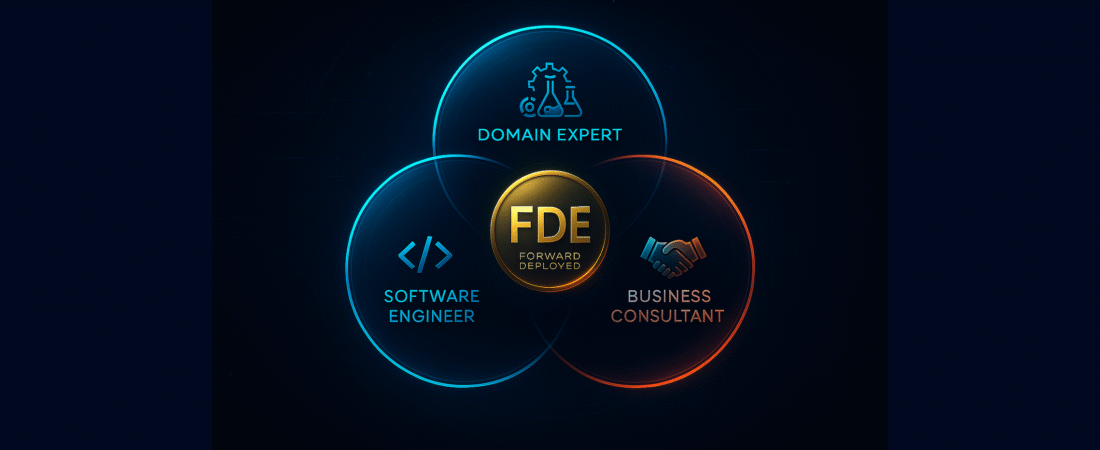

Forward Deployed Engineer vs Software Engineer vs AI Engineer vs Solution Architect
Understanding the Roles Building the Next Generation of Enterprise Technology
Article Group: The Future of Engineering
“Modern technology is built by specialists, integrators, architects, and problem solvers. The most effective professionals understand both their own role and how it connects with others.”
Introduction
Technology careers are becoming increasingly difficult to understand.
A student exploring the industry may encounter titles such as:
- Software Engineer
- AI Engineer
- Machine Learning Engineer
- Solution Architect
- Cloud Engineer
- Data Engineer
- Product Engineer
- Forward Deployed Engineer
At first glance, many of these roles appear similar.
They all involve technology.
They may use the same programming languages.
They often work with databases, APIs, cloud platforms, and Artificial Intelligence.
However, their responsibilities, working styles, success criteria, and relationships with customers can be very different.
Understanding these differences is important for several reasons.
It helps students choose an appropriate career direction.
It helps professionals identify which skills they need to develop next.
It also helps organizations assemble balanced teams for complex Enterprise AI projects.
This article compares four influential roles:
- Software Engineer
- AI Engineer
- Solution Architect
- Forward Deployed Engineer
The goal is not to declare one role better than another.
Each solves a different part of the technology problem.
The Four Roles at a Glance
Before examining each role in detail, consider this simplified distinction.
Software Engineer
Builds reliable software products and features.
AI Engineer
Builds software systems that use Artificial Intelligence.
Solution Architect
Designs how systems, technologies, data, and infrastructure should fit together.
Forward Deployed Engineer
Works closely with customers to understand problems, build solutions, integrate systems, and deliver measurable outcomes.
These roles frequently overlap.
The difference is often found in where each person spends most of their time and what they are ultimately responsible for delivering.
The Software Engineer
A Software Engineer designs, builds, tests, deploys, and maintains software systems.
This is one of the broadest roles in technology.
Software Engineers may work on:
- Web applications
- Mobile applications
- Backend services
- APIs
- Databases
- Operating systems
- Developer tools
- Enterprise platforms
- Embedded systems
- Cloud services
Their primary responsibility is usually to create reliable and maintainable software.
Typical Responsibilities
A Software Engineer may:
- Translate requirements into code.
- Build application features.
- Design APIs.
- Write automated tests.
- Fix bugs.
- Review code.
- Improve performance.
- Maintain existing systems.
- Participate in architecture discussions.
- Monitor production applications.
Typical Skills
Common technical skills include:
- Programming languages
- Data structures
- Algorithms
- Databases
- APIs
- Testing
- Version control
- Debugging
- System design
- Deployment practices
How Success Is Measured
Software Engineers are often evaluated through:
- Software quality
- Reliability
- Maintainability
- Delivery speed
- Performance
- Test coverage
- Production stability
- Contribution to team objectives
Typical Working Style
Software Engineers usually work within a product or platform team.
They may receive priorities from:
- Product managers
- Engineering managers
- Architects
- Customers
- Internal business teams
Their focus is often on building reusable software rather than customizing a complete solution for one customer.
The AI Engineer
An AI Engineer builds applications and platforms that use machine learning models, Large Language Models, computer vision, natural language processing, or other forms of Artificial Intelligence.
The role sits between software engineering, data engineering, and applied AI.
An AI Engineer is usually not focused exclusively on conducting theoretical research.
Instead, the role is concerned with turning AI capabilities into working products.
Typical Responsibilities
An AI Engineer may:
- Integrate AI models into applications.
- Build prompt workflows.
- Develop Retrieval-Augmented Generation systems.
- Create AI Agents.
- Design structured model outputs.
- Build model evaluation pipelines.
- Implement guardrails.
- Optimize cost and latency.
- Connect AI systems with databases and APIs.
- Monitor model performance.
- Compare models and providers.
Typical Skills
Common skills include:
- Python
- APIs
- Data processing
- Machine learning fundamentals
- Large Language Models
- Embeddings
- Vector databases
- Prompt design
- RAG
- Agent architecture
- Evaluation
- Cloud deployment
AI Engineers also need strong software engineering skills.
A model demonstration is not the same as a production system.
The engineer must consider:
- Security
- Reliability
- Scalability
- Monitoring
- Failure handling
- Data privacy
- Cost control
How Success Is Measured
AI Engineers may be evaluated through:
- Model or workflow accuracy
- Retrieval quality
- Response relevance
- Latency
- Cost
- Safety
- Reliability
- User adoption
- Business impact
Typical Working Style
AI Engineers often work within:
- AI product teams
- Data science teams
- Innovation teams
- Platform teams
- Enterprise transformation programs
Their focus is usually deeper on AI behavior than that of a general Software Engineer.
The Solution Architect
A Solution Architect designs the overall technical solution required to meet a business objective.
The role is less focused on implementing every individual feature and more focused on ensuring that all parts of the system work together.
A Solution Architect may design how the following components interact:
- Applications
- Databases
- APIs
- Cloud services
- Security systems
- Identity providers
- Data pipelines
- AI models
- External platforms
- Monitoring tools
Typical Responsibilities
A Solution Architect may:
- Analyze business and technical requirements.
- Design system architecture.
- Select technologies.
- Define integration patterns.
- Identify risks.
- Design security controls.
- Estimate infrastructure needs.
- Review scalability.
- Document architecture decisions.
- Align multiple engineering teams.
- Present solutions to stakeholders.
Typical Skills
A strong Solution Architect needs breadth across:
- Software architecture
- Cloud computing
- Networking
- Databases
- Security
- APIs
- Enterprise integration
- Data architecture
- Identity management
- Scalability
- Governance
Communication is particularly important.
The architect must explain technical decisions to different audiences.
These may include:
- Engineers
- Executives
- Security teams
- Vendors
- Product managers
- Customers
How Success Is Measured
Solution Architects are often evaluated through:
- Architectural quality
- Alignment with business requirements
- Security
- Scalability
- Cost efficiency
- Technical feasibility
- Long-term maintainability
- Reduction of implementation risk
Typical Working Style
Solution Architects usually work across multiple teams.
They may not write production code every day, but they should understand implementation deeply enough to make realistic decisions.
A weak architect produces attractive diagrams that cannot be built.
A strong architect understands both design and engineering reality.
The Forward Deployed Engineer
A Forward Deployed Engineer combines hands-on engineering with customer engagement and solution delivery.
The role exists because many enterprise problems cannot be solved by shipping a generic product and expecting customers to adapt.
Every organization has:
- Different data
- Different workflows
- Different systems
- Different regulations
- Different risks
- Different users
The FDE works closely with the customer to understand this environment and adapt technology to produce a working outcome.
Typical Responsibilities
A Forward Deployed Engineer may:
- Conduct customer discovery.
- Analyze business processes.
- Map enterprise systems.
- Identify valuable use cases.
- Design solution architecture.
- Build prototypes.
- Develop integrations.
- Configure AI workflows.
- Deploy solutions.
- Train users.
- Gather feedback.
- Improve the system after deployment.
- Communicate results to stakeholders.
Typical Skills
The role requires breadth across:
- Software engineering
- AI engineering
- Data engineering
- Cloud infrastructure
- APIs
- Security
- System design
- Business analysis
- Consulting
- Communication
- Project delivery
The FDE does not need to be the deepest expert in every discipline.
However, they must understand enough to connect the disciplines effectively.
How Success Is Measured
Forward Deployed Engineers are often evaluated through:
- Customer outcomes
- Speed to value
- User adoption
- Reliability
- Business impact
- Successful deployment
- Stakeholder trust
- Expansion of the solution
- Reduction of operational problems
Typical Working Style
FDEs work much closer to customers than many traditional engineers.
They may work:
- At customer sites
- Remotely with customer teams
- Across product and customer environments
- In high-pressure pilot projects
- During production deployments
- In ambiguous situations with incomplete requirements
This requires adaptability.
The customer may not know exactly what solution is needed.
The FDE helps discover it.
A Practical Comparison
The following comparison highlights the primary emphasis of each role.
| Area | Software Engineer | AI Engineer | Solution Architect | Forward Deployed Engineer |
|---|---|---|---|---|
| Main focus | Building software | Building AI-powered systems | Designing complete solutions | Solving customer problems |
| Coding involvement | High | High | Medium to low | Medium to high |
| Customer interaction | Usually limited | Varies | High | Very high |
| AI depth | Optional | High | Moderate | Moderate to high |
| Architecture responsibility | Varies by seniority | Moderate | Very high | High |
| Business process understanding | Useful | Useful | Important | Essential |
| Deployment responsibility | Shared | Shared | Oversees design | Often directly involved |
| Custom integration work | Moderate | High | Designs integrations | Very high |
| Success measure | Product quality | AI system performance | Architectural success | Customer outcome |
| Ambiguity level | Moderate | High | High | Very high |
This table represents general patterns.
In smaller companies, one person may perform several of these roles simultaneously.
How the Roles Work Together
Consider a company building an AI assistant for an insurance provider.
The team may include all four roles.
Software Engineer
Builds:
- User interface
- Backend services
- Authentication
- APIs
- Audit logging
- Administrative tools
AI Engineer
Builds:
- Document ingestion
- Retrieval pipeline
- Prompt workflows
- Model integration
- Evaluation framework
- Safety controls
Solution Architect
Designs:
- Overall architecture
- Cloud infrastructure
- Security model
- Integration strategy
- Scalability
- Data flow
- Disaster recovery
Forward Deployed Engineer
Works with the insurance company to:
- Understand claims workflows
- Discover relevant data sources
- Identify user roles
- Map regulatory constraints
- Configure the solution
- Build customer-specific integrations
- Conduct pilots
- Train users
- Measure results
The solution succeeds because each role contributes a different form of expertise.
Product Building vs Customer Delivery
One of the clearest distinctions is between building a product and deploying it successfully with a customer.
A product team may build a powerful AI platform.
However, the customer may still struggle because:
- Their data is poorly organized.
- Their systems use legacy interfaces.
- Their security policies block integrations.
- Their users do not trust AI responses.
- Their business process is unclear.
- Their documents contain inconsistent information.
The FDE addresses the last mile between product capability and real-world adoption.
This last mile is often where enterprise projects succeed or fail.
Technical Depth vs Technical Breadth
Different roles require different skill profiles.
Software Engineer
Often develops deep expertise in:
- Application development
- Backend systems
- Frontend systems
- Databases
- Performance
- Testing
AI Engineer
Often develops deep expertise in:
- Models
- Retrieval
- Evaluation
- Prompting
- AI workflows
- Data preparation
Solution Architect
Develops broad understanding across:
- Applications
- Infrastructure
- Security
- Integration
- Cloud
- Governance
Forward Deployed Engineer
Needs broad technical understanding combined with enough depth to build, troubleshoot, and deploy under real customer conditions.
The FDE profile is often described as T-shaped.
The horizontal line represents broad knowledge.
The vertical line represents deeper expertise in one or more technical areas.
Which Role Requires the Most Communication?
All engineering roles benefit from strong communication.
However, the communication context differs.
Software Engineer
Communicates mainly with:
- Engineering peers
- Product managers
- Designers
- Technical leads
AI Engineer
Communicates with:
- Data scientists
- Software engineers
- Product teams
- Domain specialists
Solution Architect
Communicates with:
- Technical teams
- Security
- Management
- Vendors
- Executives
Forward Deployed Engineer
Communicates with nearly everyone:
- End users
- Business managers
- Engineers
- Executives
- Security teams
- Legal teams
- Operations teams
- Product teams
This makes communication one of the FDE’s core engineering tools.
Which Role Is Closest to the Customer?
The Forward Deployed Engineer is generally the closest to the customer.
A Solution Architect may also work extensively with customers, especially during design and sales engagements.
The difference is that an FDE is commonly involved beyond architecture.
They may write code, build integrations, configure workflows, troubleshoot deployments, and remain engaged during user adoption.
The Solution Architect answers:
“How should this solution be designed?”
The Forward Deployed Engineer answers:
“How do we make this solution work successfully in this customer’s real environment?”
Is a Forward Deployed Engineer a Consultant?
Partly.
An FDE uses consulting skills such as:
- Discovery
- Workshop facilitation
- Requirement analysis
- Stakeholder communication
- Process mapping
- Presentation
However, the role is much more technically hands-on than many traditional consulting positions.
An FDE is expected to build.
They should be able to move from a stakeholder discussion to:
- Architecture
- Code
- Integration
- Deployment
- Testing
- Troubleshooting
This combination is what makes the role distinctive.
Is a Forward Deployed Engineer a Solution Architect?
Not exactly.
There is significant overlap.
Both roles:
- Understand requirements
- Design systems
- Work with stakeholders
- Consider security and scalability
- Coordinate across technologies
However, a Forward Deployed Engineer is usually more deeply involved in implementation and day-to-day customer delivery.
A Solution Architect may define the blueprint.
The FDE may help turn that blueprint into a functioning system.
In practice, experienced FDEs often perform architecture work, and experienced Solution Architects may also contribute to implementation.
Job titles vary between organizations.
Responsibilities matter more than labels.
Is a Forward Deployed Engineer an AI Engineer?
An FDE working for an AI company may perform substantial AI engineering.
They may build:
- RAG pipelines
- Agent workflows
- Prompt systems
- Model integrations
- Evaluation tools
- Knowledge retrieval
- AI-powered automations
However, their scope extends beyond AI.
They must also understand:
- Customer processes
- Existing applications
- Security
- Data access
- Change management
- Deployment
- Adoption
The AI Engineer optimizes the intelligent component.
The FDE ensures the entire solution creates value in the customer’s environment.
Which Role Should a Student Choose?
There is no universally correct answer.
The best choice depends on interests, strengths, and preferred working style.
Consider Software Engineering If You Enjoy
- Building products
- Writing code
- Solving technical problems
- Improving performance
- Designing reliable systems
- Working deeply within engineering teams
Consider AI Engineering If You Enjoy
- Artificial Intelligence
- Experimentation
- Data
- Language models
- Evaluation
- Building intelligent product features
Consider Solution Architecture If You Enjoy
- Big-picture design
- Technical strategy
- Comparing technologies
- Cloud platforms
- Security
- Communicating across teams
Consider Forward Deployed Engineering If You Enjoy
- Technology and business
- Customer interaction
- Ambiguous problems
- Building prototypes
- System integration
- Fast-paced delivery
- Explaining technology
- Seeing direct real-world impact
Students do not need to decide permanently at the beginning of their careers.
These paths are connected.
A Software Engineer may later become an AI Engineer.
An AI Engineer may move into architecture.
A Solution Architect may transition into customer delivery.
An experienced engineer may become an FDE after developing broader business and communication skills.
Career Mobility Between the Roles
Technology careers are rarely linear.
Common transitions include:
Software Engineer to AI Engineer
Requires developing knowledge of:
- Machine learning
- LLMs
- RAG
- Evaluation
- AI deployment
Software Engineer to Solution Architect
Requires developing:
- Architectural breadth
- Cloud knowledge
- Security understanding
- Stakeholder communication
- Strategic thinking
AI Engineer to Forward Deployed Engineer
Requires developing:
- Customer discovery
- Enterprise integration
- Consulting skills
- Business understanding
- Delivery leadership
Solution Architect to Forward Deployed Engineer
Requires becoming more hands-on with:
- Coding
- Prototyping
- Deployment
- Troubleshooting
- AI implementation
The strongest FDEs often emerge from experienced professionals who have worked across several of these areas.
The Rise of Hybrid Roles
Modern organizations increasingly create hybrid titles.
Examples may include:
- AI Product Engineer
- Applied AI Engineer
- Customer Engineer
- Field Engineer
- Deployment Strategist
- Technical Solutions Engineer
- AI Solutions Architect
- Forward Deployed AI Engineer
These titles reflect a broader trend.
Companies want engineers who can operate across traditional boundaries.
They value people who can:
- Understand a problem
- Design the solution
- Build the system
- Deploy it
- Improve it through feedback
The exact title may change.
The underlying capabilities remain valuable.
Generalist or Specialist?
Students often worry that becoming a generalist means lacking expertise.
That is not necessarily true.
The strongest professionals usually combine:
- One or two areas of technical depth
- Broad understanding across related disciplines
- Strong communication
- Business awareness
A specialist may know one area extremely deeply.
A generalist may connect several areas effectively.
Complex Enterprise AI projects need both.
The FDE often acts as the bridge between specialists.
The Importance of Engineering Judgment
Tools alone do not define any of these roles.
Professional value comes from judgment.
For example:
- Should the system use AI at all?
- Should data be processed in real time?
- Should the application use microservices?
- Which information should the model access?
- When must a human approve an action?
- How much automation is safe?
- What happens when the model is wrong?
- How should the system recover from failure?
- Is the proposed solution worth its cost?
These are not syntax questions.
They are engineering decisions.
The more senior the role, the more important such judgment becomes.
A Shared Foundation
Despite their differences, all four roles benefit from a common foundation.
This includes:
- Programming
- Databases
- APIs
- Git
- Testing
- Cloud fundamentals
- Security
- System design
- Documentation
- Communication
- Problem solving
Students should build this foundation first.
Specialization can follow.
A strong foundation creates flexibility.
It allows professionals to move between roles as interests and market needs evolve.
Final Comparison
The four roles can be summarized through four questions.
Software Engineer
How do we build this software correctly?
AI Engineer
How do we make this system intelligent, reliable, and measurable?
Solution Architect
How should all the technical components fit together?
Forward Deployed Engineer
How do we make the complete solution succeed for this customer?
All four questions matter.
Enterprise transformation requires all four perspectives.
Final Thoughts
Technology careers are no longer separated by rigid boundaries.
Software Engineers increasingly use AI.
AI Engineers need production software skills.
Solution Architects must understand data and AI.
Forward Deployed Engineers combine engineering, architecture, business understanding, and customer delivery.
The title matters less than the capability.
Students should avoid choosing a role based only on popularity or salary.
They should consider:
- What kind of problems they enjoy solving
- Whether they prefer depth or breadth
- How much customer interaction they want
- Whether they enjoy building, designing, or deploying
- How comfortable they are with ambiguity
- Which skills they want to strengthen over time
The future will belong to collaborative professionals who understand their own discipline while appreciating how others contribute.
No single role builds the future alone.
Teams do.
What’s Next?
Now that we understand how Forward Deployed Engineers differ from Software Engineers, AI Engineers, and Solution Architects, the next article will explore the complete lifecycle of an FDE engagement:
From Customer Problem to Production AI Solution
We will follow a realistic project from the first discovery meeting through architecture, prototyping, integration, security review, deployment, user adoption, and measurable business results.
This will move the series from career understanding into the practical operating model of Forward Deployed Engineering.

Leave a Reply
You must be logged in to post a comment.