
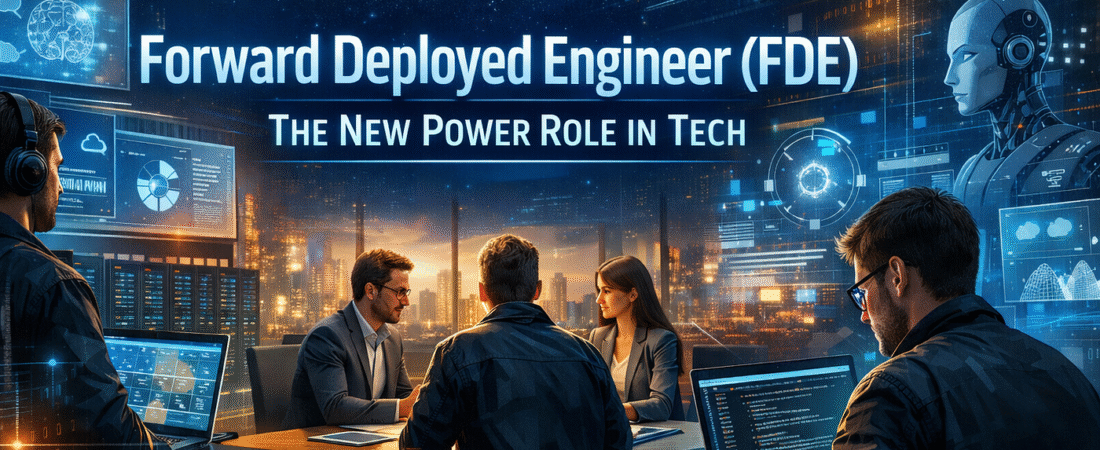

Enterprise AI & Forward Deployed Engineers
Why This Could Be the Most Important Technology Career of the Next Decade
The future won’t belong to those who simply know how to code. It will belong to those who understand problems, connect technology with business, and build intelligent solutions that create real impact.
Welcome to the Future of Engineering
Technology is evolving at an unprecedented pace.
A decade ago, learning a programming language was enough to secure a successful software engineering career. Today, companies expect much more. Modern organizations need professionals who understand software, data, artificial intelligence, cloud computing, business processes, and customer needs—all at the same time.
Artificial Intelligence is transforming every industry. Banks are deploying AI assistants. Hospitals are using AI to support medical decisions. Manufacturers are optimizing production through predictive analytics. Retailers are personalizing customer experiences with intelligent recommendation systems. Governments are modernizing citizen services using AI-powered platforms.
Behind each successful AI deployment is a team of engineers who bridge the gap between technology and business.
Among these emerging professionals, one role is rapidly becoming one of the most influential in enterprise technology:
The Forward Deployed Engineer (FDE).
This series explores that role, the technologies behind it, and the mindset required to become one of tomorrow’s technology leaders.
The World Has Changed
For many years, software development followed a familiar pattern.
A customer requested software.
Developers wrote code.
The software was delivered.
The customer adapted their business to fit the software.
Today, the opposite is happening.
Businesses expect technology to adapt to them.
They want AI systems that understand their documents, connect with existing applications, automate repetitive work, analyze data, and support employees in making better decisions.
This shift has created a completely new generation of engineering roles.
What Is Enterprise AI?
When many people hear the term Artificial Intelligence, they immediately think about chatbots or tools like ChatGPT.
Enterprise AI is much broader.
Enterprise AI refers to the application of Artificial Intelligence within organizations to improve business operations, automate processes, assist employees, generate insights, and support decision-making while integrating securely with enterprise systems.
Rather than replacing people, Enterprise AI enhances productivity.
Examples include:
- AI assistants that answer employee questions using company knowledge.
- Financial analysis powered by intelligent data processing.
- Intelligent customer support systems.
- Contract analysis and compliance verification.
- Supply chain optimization.
- Fraud detection.
- Predictive maintenance.
- Intelligent document processing.
- Executive reporting and analytics.
- Business process automation.
Enterprise AI combines multiple disciplines:
- Artificial Intelligence
- Data Engineering
- Software Engineering
- Cloud Computing
- Cybersecurity
- Business Analysis
- Enterprise Architecture
It is no longer enough to know only one technology.
Modern engineers must understand how these technologies work together.
The Rise of the Forward Deployed Engineer
Imagine a global bank that wants to build an AI assistant capable of answering thousands of internal policy questions.
The information exists across:
- SharePoint
- PostgreSQL databases
- Email archives
- PDF documents
- Internal APIs
- CRM systems
- ERP platforms
The bank doesn’t simply need another software developer.
It needs someone who can:
- Understand business requirements.
- Analyze existing systems.
- Design the architecture.
- Connect multiple technologies.
- Build AI workflows.
- Deploy secure enterprise solutions.
- Train business users.
- Continuously improve the system.
That professional is commonly known as a Forward Deployed Engineer.
Rather than sitting behind a desk building generic software, Forward Deployed Engineers work close to customers, solving real business problems.
They become trusted technical advisors while also remaining hands-on engineers.
Why “Forward Deployed”?
The term originated from organizations that embedded engineers directly with customers to accelerate solution delivery.
Instead of waiting for customers to adapt to software, engineers work alongside them to understand real-world challenges.
They observe workflows.
They identify bottlenecks.
They design intelligent solutions.
They build integrations.
They deploy AI safely.
They continuously improve outcomes based on customer feedback.
The engineer becomes part consultant, part architect, part developer, and part problem solver.
Enterprise AI Is Never Just About AI
Many beginners believe building AI applications is simply calling an AI model through an API.
Reality is much more complex.
An enterprise AI solution often involves:
- Authentication and authorization
- APIs
- Cloud infrastructure
- Databases
- Data governance
- Vector databases
- Retrieval-Augmented Generation (RAG)
- Monitoring
- Security
- Logging
- Business rules
- Human approvals
- Compliance
- Performance optimization
The AI model is only one component within a much larger system.
Understanding the complete ecosystem is what distinguishes professional AI engineers from hobbyists.
The Skills Modern Engineers Need
Technology careers are becoming increasingly multidisciplinary.
Future engineers should gradually develop expertise across several areas.
Software Engineering
- Programming fundamentals
- APIs
- System design
- Testing
- Design patterns
- Scalable architecture
Data Engineering
- SQL
- Data modeling
- ETL pipelines
- Warehousing
- Data quality
- Analytics
Cloud Engineering
- Containers
- Kubernetes
- AWS
- Azure
- Google Cloud
- CI/CD
Artificial Intelligence
- Large Language Models
- Prompt Engineering
- AI Agents
- Embeddings
- Retrieval-Augmented Generation
- Model evaluation
- Responsible AI
Enterprise Systems
- ERP
- CRM
- Identity Management
- Business Processes
- Security
- Governance
Human Skills
Perhaps surprisingly, technical knowledge alone is not enough.
Forward Deployed Engineers must also become excellent communicators.
They need to:
- Listen carefully.
- Ask the right questions.
- Understand business objectives.
- Explain complex technology simply.
- Collaborate across departments.
- Build trust with customers.
These skills often determine the success of AI projects.
The Engineering Mindset
One of the biggest differences between traditional software development and Enterprise AI is the way engineers think.
Instead of asking:
Which programming language should I learn?
Successful engineers ask:
What business problem am I trying to solve?
Instead of asking:
Which AI model is the newest?
They ask:
Which solution creates the greatest value for the customer?
Technology is a tool.
Problems come first.
Solutions come second.
Why This Career Matters
Artificial Intelligence is no longer limited to technology companies.
Every industry is becoming an AI industry.
Healthcare.
Education.
Finance.
Manufacturing.
Retail.
Transportation.
Agriculture.
Energy.
Government.
Every organization is beginning its AI transformation.
This creates enormous demand for professionals capable of leading these initiatives responsibly.
Forward Deployed Engineers are uniquely positioned to bridge technology and business during this transformation.
The Future Belongs to Builders
The coming decade will not simply reward people who know the latest programming framework.
It will reward individuals who understand systems.
People who can integrate technologies.
People who understand customers.
People who build solutions rather than features.
Artificial Intelligence will undoubtedly automate many repetitive programming tasks.
What AI cannot easily replace is human judgment.
Creativity.
Leadership.
Problem solving.
Ethical decision-making.
Systems thinking.
These qualities define tomorrow’s engineers.
About This Series
This article marks the beginning of the Enterprise AI & Forward Deployed Engineer series on IthinkAs.
Throughout this journey, we will move far beyond theoretical concepts.
Together, we will explore:
- Enterprise AI architecture
- Modern software engineering
- Large Language Models
- AI Agents
- Retrieval-Augmented Generation (RAG)
- Multi-Agent Systems
- Cloud platforms
- Enterprise integrations
- Databases
- APIs
- System design
- Security
- DevOps
- Customer discovery
- Industry case studies
- Real-world projects
- Career guidance
- Technology leadership
Each article will build upon the previous one, gradually transforming complex topics into practical knowledge through explanations, architecture diagrams, hands-on examples, and real business scenarios.
Whether you are a student, software engineer, data professional, or aspiring technology leader, this series is designed to help you develop the mindset and skills required to build intelligent systems that solve meaningful problems.
Final Thoughts
Technology has entered a new era.
The future will not be shaped solely by software developers, nor solely by AI researchers.
It will be shaped by engineers who can combine business understanding, systems thinking, software engineering, data, cloud technologies, and Artificial Intelligence into practical solutions that improve how organizations operate.
Forward Deployed Engineering represents far more than a job title.
It represents a new philosophy of engineering.
A philosophy centered on understanding people before technology.
Solving problems before writing code.
Building systems that create measurable impact.
At IthinkAs, our mission is to help prepare the next generation of engineers not simply to follow technological change—but to lead it.
Welcome to the journey.


Leave a Reply
You must be logged in to post a comment.