
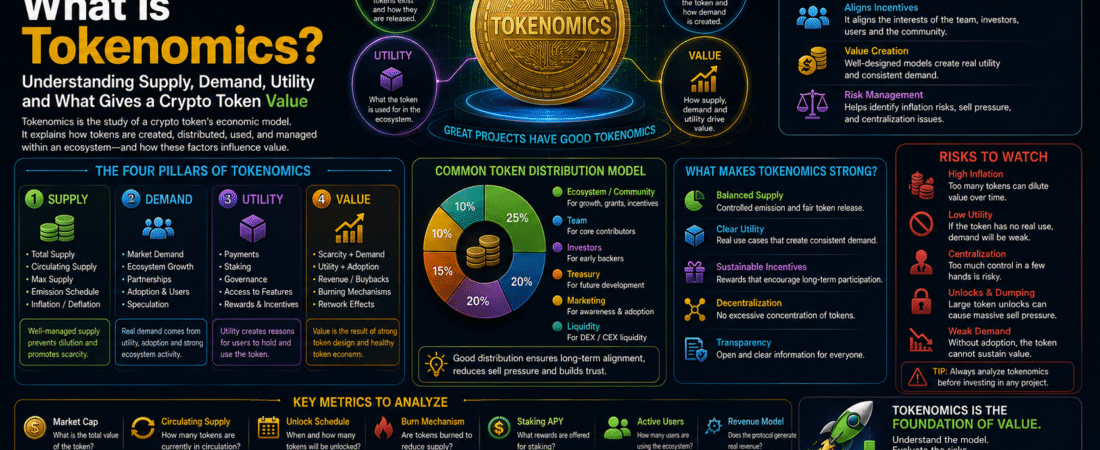

What Is Tokenomics? Understanding Supply, Demand, Utility and What Gives a Crypto Token Value
CoinBrain Research Articles | Crypto Investing Basics — Article 06
Updated: August 2026
Imagine two cryptocurrencies.
Token A
Price: $0.20
Token B
Price: $2,000
At first glance, a newcomer might conclude:
“Token A is cheap. If it ever reaches $100, I could make a fortune.”
That is one of the most common mistakes in crypto investing.
A token’s individual price tells you very little by itself.
You also need to know:
- how many tokens exist
- how many are currently circulating
- how many more can be created
- who owns them
- when locked tokens will become tradable
- what the token is actually used for
- whether users need to buy it
- whether tokens are burned
- whether holders receive any economic benefit
- whether insiders control a large percentage
- whether future supply could dilute existing holders
Together, these characteristics form a project’s tokenomics.
Tokenomics combines the words:
Token + Economics
It describes the economic system surrounding a cryptocurrency or digital token.
For investors, understanding tokenomics can be just as important as understanding the underlying blockchain technology.
A project can have:
excellent technology
but:
poor token economics.
And a growing protocol does not automatically mean that its token will become more valuable.
Educational Notice: This article is for educational and research purposes only. It does not constitute financial, investment, tax, or legal advice. Cryptocurrency investments involve substantial risk, including loss of principal. Token supply schedules, governance rules, token utility, emissions and economic structures can change over time.
1. Executive Summary
Tokenomics describes the economic design of a cryptocurrency or token, including its supply, issuance, distribution, utility, incentives, demand drivers, unlock schedule, burning mechanisms and governance.
A useful simplified framework is:
Token Value = Supply Dynamics + Demand Dynamics + Utility + Incentives + Market Expectations
But each component contains important details.
On the supply side, investors should understand:
- circulating supply
- total supply
- maximum supply
- issuance
- inflation
- token burns
- vesting
- unlock schedules
On the demand side, investors should ask:
- Why would anyone need the token?
- Is it required to use the network?
- Is it used as collateral?
- Does it secure a blockchain?
- Does it provide governance rights?
- Are fees paid with it?
- Is it useful beyond speculation?
Distribution also matters.
A token with:
80% of supply owned by insiders
has very different economics from one distributed broadly among users, miners, validators and market participants.
Valuation matters as well.
Two essential calculations are:
Market Capitalization = Token Price × Circulating Supply
and:
Fully Diluted Valuation = Token Price × Total or Maximum Relevant Supply
CoinGecko describes FDV as the theoretical valuation of a cryptocurrency assuming its full relevant supply were circulating at the current token price.
Tokenomics therefore helps answer a much more sophisticated question than:
“Is this coin cheap?”
The correct question is:
“What economic conditions would need to exist for this token to justify its current—and future—valuation?”
2. Key Takeaways
Before investing in any cryptocurrency, understand these principles.
1. Token price alone is almost meaningless
A $0.10 token can be more highly valued than a $10,000 token.
You need to consider supply.
2. Market capitalization matters more than unit price
Market capitalization helps estimate the current aggregate market valuation of circulating tokens.
Market Cap = Price × Circulating Supply
3. Fully Diluted Valuation can reveal future dilution
If only a small percentage of tokens are currently circulating, today’s market capitalization can make a project appear much smaller than its eventual supply implies.
4. Circulating supply is not the same as maximum supply
A project might have:
1 billion tokens circulating
but:
10 billion maximum tokens
The remaining 9 billion matter.
5. Token unlocks can create future selling pressure
Tokens allocated to:
- founders
- employees
- venture investors
- foundations
- ecosystem funds
may initially be locked.
When they unlock, they can become available for sale.
6. High inflation can dilute holders
If token supply grows rapidly while demand does not grow proportionally, existing holders can experience economic dilution.
7. Burns can reduce supply—but do not automatically create value
Destroying tokens may reduce supply.
Value still requires demand.
8. Utility matters
A strong token should ideally have a clear economic role within its network or application.
9. Protocol success and token success are different
A protocol can generate enormous usage while its token captures little economic value.
10. Distribution matters
Who owns the tokens can influence:
- market liquidity
- governance
- decentralization
- selling pressure
- manipulation risk
11. High staking yield can hide inflation
A token offering 15% staking rewards while supply increases 18% annually may not be as attractive as the headline yield suggests.
12. Tokenomics must be studied dynamically
Token economics can evolve through:
- governance changes
- burns
- new emissions
- token migrations
- protocol upgrades
Tokenomics is not always permanently fixed.
3. Market Overview
Why Tokenomics Matters
Traditional investors evaluate companies using metrics such as:
- revenue
- profit
- cash flow
- debt
- shares outstanding
- earnings per share
- valuation multiples
Crypto investors need additional tools because tokens can represent very different economic structures.
A token might function as:
- digital money
- blockchain gas
- staking collateral
- governance rights
- application utility
- protocol incentives
- collateral
- a claim on tokenized assets
- access to services
These are not economically equivalent.
Bitcoin: A Simple Supply Model
Bitcoin provides one of the clearest examples of monetary tokenomics.
The Bitcoin protocol has a predictable issuance schedule.
New BTC enters circulation through mining rewards.
Approximately every 210,000 blocks, the block subsidy is reduced by half.
Eventually issuance approaches zero.
Bitcoin’s protocol is designed around a maximum supply of:
21 million BTC.
Bitcoin.org confirms that issuance declines over time until total Bitcoin supply reaches approximately 21 million.
This creates a relatively straightforward monetary proposition:
Predictable Issuance + Fixed Ultimate Supply + Market Demand
Bitcoin does not need:
- venture unlocks
- founder allocations
- governance-token emissions
to operate its monetary model.
Its tokenomics are therefore comparatively simple.
Ethereum: Dynamic Monetary Economics
Ethereum provides a different model.
ETH does not use Bitcoin’s fixed 21-million maximum supply.
Its supply changes dynamically.
Two major forces influence it:
Issuance
New ETH is issued to Proof-of-Stake validators who secure Ethereum.
Burning
A portion of transaction fees is permanently destroyed through the mechanism introduced by EIP-1559.
Ethereum therefore has:
New ETH Issuance
minus:
ETH Burned
equals:
Net Supply Change
Ethereum’s official documentation confirms that ETH supply is dynamic and that Proof-of-Stake issuance and EIP-1559 burning jointly determine whether total supply expands or contracts over a given period.
This demonstrates an important principle:
Good tokenomics does not require a fixed maximum supply.
What matters is understanding the relationship between:
issuance, usage, demand and supply reduction.
Application Tokens
Now consider a DeFi protocol.
Its token might be distributed to:
- founders
- investors
- employees
- users
- liquidity providers
- treasury
- community programs
The token might provide:
- governance
- staking
- fee discounts
- collateral
- rewards
This tokenomics structure is much more complex.
4. Technology Deep Dive
The Four Types of Token Supply
Understanding supply terminology is essential.
Circulating Supply
The number of tokens considered available in the market and circulating among participants.
CoinGecko defines circulating supply broadly as tokens currently in the hands of the public, excluding categories such as locked team or foundation allocations under its methodology.
Total Supply
Generally:
Tokens Created − Tokens Permanently Burned
This can include both circulating and locked tokens.
Maximum Supply
The theoretical maximum number of tokens that can ever exist under the protocol’s current rules.
Not every cryptocurrency has a maximum supply.
Fully Diluted Supply
The supply assumption used when estimating what valuation might look like after future issuance or unlocks.
Exact definitions can vary by data provider, so investors should understand the methodology being used.
Market Capitalization
Suppose Token X trades at:
$2
and circulating supply is:
500 million tokens
Then:
Market Cap = $2 × 500 million
Market Cap = $1 billion
Now suppose Token Y costs:
$200
but only:
1 million tokens
are circulating.
Then:
Market Cap = $200 million
Although Token Y costs 100 times more per token, its total circulating market valuation is much smaller.
This is why statements such as:
“It is only $0.20, so it is cheap”
are fundamentally flawed.
Fully Diluted Valuation — FDV
Now suppose Token X has:
Circulating supply:
500 million
Maximum supply:
5 billion
Price:
$2
Current market capitalization:
$1 billion
But its theoretical fully diluted valuation is:
$2 × 5 billion = $10 billion
That means only:
10%
of maximum supply is currently circulating.
Investors need to ask:
When will the other 90% enter circulation?
CoinGecko emphasizes that FDV can be particularly important when projects launch with only a small percentage of supply circulating because future token releases can materially change supply dynamics.
The Low-Float, High-FDV Problem
This has become an important crypto-market concept.
Consider:
Token price:
$1
Circulating supply:
100 million
Maximum supply:
10 billion
Market capitalization:
$100 million
FDV:
$10 billion
A newcomer sees:
“Only $100 million market cap!”
and assumes enormous upside.
But the fully diluted valuation already implies:
$10 billion
at the same token price.
Future supply is therefore critical.
This structure is sometimes referred to as:
Low Float + High FDV
where:
Float = Current Tradable Supply
A small circulating supply can make price easier to support initially.
But later unlocks may introduce significant supply.
Token Allocation
Projects typically divide supply among groups.
Example:
| Allocation | Percentage |
|---|---|
| Community | 35% |
| Ecosystem Incentives | 20% |
| Team | 15% |
| Private Investors | 15% |
| Foundation | 10% |
| Public Sale | 5% |
This allocation immediately raises important questions.
Who controls the foundation?
What are the team’s vesting terms?
At what prices did private investors buy?
When can they sell?
How is the ecosystem allocation distributed?
Vesting
Vesting prevents allocated tokens from becoming fully tradable immediately.
For example:
Team allocation:
200 million tokens
Vesting:
4 years
with:
1-year cliff
A cliff means no tokens may become available during the initial period.
After the cliff, tokens begin unlocking according to a schedule.
Token Unlocks
Suppose circulating supply is:
500 million tokens
Next month:
100 million tokens unlock
Potential supply increases by:
20%
relative to the previous circulating amount.
This does not guarantee a 20% price decline.
Unlocked holders may:
- hold
- stake
- use
- sell
But investors should recognize the change in potential market supply.
Emissions
Protocols may continuously distribute new tokens to:
- validators
- stakers
- miners
- liquidity providers
- users
These are:
Token Emissions
Emissions can serve useful purposes.
They can:
- secure the network
- reward participation
- bootstrap liquidity
- attract users
But emissions also increase supply.
Token Burns
A burn permanently removes tokens from usable supply.
Imagine:
Initial supply:
1 billion tokens
Protocol burns:
10 million
New supply:
990 million
Burning can occur through:
- transaction fees
- protocol revenue
- scheduled mechanisms
- governance decisions
But a token burn does not guarantee price appreciation.
Remember:
Price = Interaction Between Supply and Demand
Reducing supply helps only within a broader economic context.
Inflationary vs Deflationary Tokens
Inflationary
Supply grows over time.
This can be completely rational if new tokens are necessary to:
- secure a network
- reward contributors
- expand an ecosystem
Deflationary
Supply declines over time through burns or other mechanisms.
This sounds attractive, but:
deflation alone does not create demand.
A token nobody wants remains economically weak even if supply is shrinking.
5. Current Industry Landscape
Tokenomics has evolved substantially since early cryptocurrency markets.
The industry has moved through several token-design models.
Monetary Tokens
Bitcoin pioneered the digitally scarce monetary model.
The primary thesis centers around:
- scarcity
- predictable issuance
- decentralization
- network security
Utility Tokens
The ICO era popularized tokens intended to provide access to applications or services.
Unfortunately, many projects created tokens without a compelling economic reason for them to exist.
The question:
“Why does this product need a token?”
became increasingly important.
Governance Tokens
DeFi protocols popularized tokens that allow holders to influence:
- fees
- incentives
- treasury spending
- collateral parameters
- protocol upgrades
Governance rights can be meaningful.
But governance alone does not necessarily create strong investment value.
Staking Tokens
Proof-of-Stake networks created tokens with direct security utility.
The token is required as economic collateral to participate in consensus.
Examples include ETH and many other network-native assets.
Fee-Bearing and Revenue-Linked Models
More protocols have explored mechanisms that connect token ownership or staking to protocol economics.
Depending on structure and jurisdiction, this can create regulatory considerations.
Investors must distinguish between:
protocol revenue
and:
economic value actually accruing to token holders.
These are not automatically the same.
Real-World Asset Tokens
Tokenization is introducing entirely different tokenomics.
A blockchain token might represent or reference:
- treasury securities
- funds
- credit
- commodities
- real estate
- equity-like interests
In these cases, analysis increasingly resembles traditional financial analysis combined with blockchain infrastructure analysis.
Outstanding Token Value
Even market-data providers are developing new ways to represent crypto valuation.
CoinGecko introduced an Outstanding Token Value (OTV) metric in January 2026 as an additional framework for analyzing token value, alongside established measures including circulating supply, market capitalization, total supply and FDV.
This development reflects a broader problem:
Crypto token structures have become sufficiently complex that a single valuation metric rarely tells the entire story.
6. Institutional Activity
Institutional investors typically approach tokenomics differently from speculative retail traders.
A professional investor is unlikely to stop at:
“Great project.”
Instead, the analysis may include:
- supply schedule
- insider ownership
- token unlocks
- liquidity
- governance concentration
- treasury holdings
- protocol revenues
- token utility
- regulatory classification
- custody
- valuation
Why Institutions Care About Unlocks
Imagine a fund evaluates a token with:
Current market cap:
$2 billion
FDV:
$20 billion
Only:
10% of eventual supply
is circulating.
Large allocations will unlock during the next two years.
The fund must evaluate:
Who owns those tokens?
At what cost basis?
When can they sell?
Can market demand absorb future supply?
This is similar in principle to analyzing:
- restricted stock
- employee options
- venture investor lockups
in traditional markets.
Institutional Preference for Transparent Economics
Institutional capital generally benefits from predictable structures.
Important characteristics can include:
- transparent issuance
- documented vesting
- measurable protocol usage
- reliable custody
- clear governance
- deep liquidity
Complex and highly discretionary tokenomics can make valuation more difficult.
Tokenized Traditional Assets
Institutional tokenization could also change what “tokenomics” means.
Consider a token representing a government bond.
Its economics may depend on:
Bond Interest + Legal Ownership + Custody + Redemption Mechanics + Blockchain Settlement
rather than speculative governance-token demand.
Tokenomics will therefore increasingly overlap with:
traditional asset economics.
Institutional Staking
Proof-of-Stake assets introduce another dimension.
An institution holding ETH may evaluate:
Asset Price Return
Staking Rewards
Dilution
Operational Costs
Risk
This is more sophisticated than simply asking for the advertised staking APY.
7. Market Data & Metrics
This section should become part of every investor’s crypto research process.
1. Token Price
Useful—but never sufficient.
2. Circulating Supply
Ask:
How many tokens can currently circulate in the market?
CoinGecko identifies circulating supply, total supply and maximum supply as three core supply metrics for tokenomics analysis.
3. Total Supply
Ask:
How many tokens currently exist, including locked or non-circulating supply?
4. Maximum Supply
Ask:
Can more tokens ever be created beyond the current amount?
Some assets have fixed maximum supplies.
Others do not.
5. Market Capitalization
Market Cap = Price × Circulating Supply
Use it to compare assets more intelligently than token price alone.
6. Fully Diluted Valuation
FDV = Price × Fully Diluted Supply
Use it to evaluate the valuation implied by future supply.
7. Market Cap / FDV Ratio
A useful simplified measure is:
Circulating Market Cap ÷ FDV
Suppose:
Market cap:
$1 billion
FDV:
$5 billion
Ratio:
20%
This signals that a substantial amount of supply may not yet be circulating.
It does not tell you when that supply arrives.
For that, you need:
the unlock schedule.
8. Unlock Schedule
Study:
- next unlock date
- quantity unlocked
- percentage of supply
- recipient categories
- vesting duration
Unlocks should be compared against:
daily trading volume
and:
market liquidity.
A $500 million unlock in a highly liquid asset can have very different implications from the same unlock in a thinly traded market.
9. Inflation Rate
Estimate how quickly circulating supply is increasing.
Suppose:
Current supply:
1 billion
New annual emissions:
100 million
Simplified annual supply inflation:
10%
Demand must absorb the new supply if price is to remain stable, all else equal.
10. Burn Rate
Measure how many tokens are permanently removed.
Ethereum provides a useful example of why both issuance and burn matter: its official supply documentation explains that validator issuance creates ETH while EIP-1559 removes part of transaction fees through burning.
11. Holder Concentration
Ask:
What percentage is held by:
- top 10 wallets?
- team?
- foundation?
- venture investors?
- exchanges?
Concentration can affect:
- governance
- liquidity
- market manipulation
- sell pressure
Be careful: wallet concentration data can be misleading because large addresses may represent exchanges, bridges, staking contracts or smart contracts rather than individual investors.
12. Treasury Holdings
Many protocols maintain token treasuries.
Ask:
- How large is the treasury?
- What assets does it contain?
- Who controls spending?
- How quickly is it being depleted?
A treasury containing only the protocol’s own token is economically very different from one containing substantial stablecoins or productive assets.
13. Protocol Revenue
If the project is an application, investigate whether users actually pay to use it.
But always ask:
Does the token capture any of that economic activity?
14. Token Velocity
A token might be used extensively but immediately sold after every transaction.
If users do not need to hold it, high activity may not generate persistent demand.
This is why:
usage does not automatically equal token appreciation.
8. Real-World Use Cases
Token utility can take many forms.
Use Case 1 — Digital Money
Bitcoin is used as a digitally scarce monetary asset.
Its tokenomics emphasize:
- predictable issuance
- scarcity
- transferability
Use Case 2 — Blockchain Gas
ETH is required to pay for computation and transactions on Ethereum.
This creates demand linked to network usage.
Use Case 3 — Network Security
Proof-of-Stake assets can be staked as economic collateral.
This can create demand from validators and delegators.
Use Case 4 — Governance
Protocol tokens can allow holders to vote on:
- upgrades
- treasury spending
- risk parameters
- incentives
Use Case 5 — Collateral
Some tokens can be deposited as collateral for borrowing.
This creates another source of utility.
Use Case 6 — Fee Discounts
Trading platforms or applications may provide reduced fees to users holding particular tokens.
Use Case 7 — Access
A token might be required to access:
- computing resources
- storage
- data
- applications
- network services
Use Case 8 — Liquidity Incentives
Protocols may distribute tokens to attract capital.
This can help bootstrap the network.
But it can also create temporary speculative demand.
Use Case 9 — Real-World Asset Representation
Tokens can represent economic claims tied to:
- securities
- funds
- commodities
- credit
In these cases, token value may connect directly to the underlying asset.
Use Case 10 — AI and Machine Economies
Future AI systems may use tokens or stablecoins to:
- purchase computing power
- purchase data
- compensate other agents
- access decentralized networks
- make autonomous payments
If such systems develop at scale, some token utilities could emerge from machine-generated rather than human-generated demand.
9. Risks & Challenges
Poor tokenomics can destroy an otherwise promising investment thesis.
1. Dilution Risk
Suppose you own:
1% of circulating supply
Massive new issuance occurs.
Unless your holdings grow proportionally, your relative economic position can decline.
2. Unlock Risk
Large founder or investor unlocks can create potential selling pressure.
Particularly important factors include:
- cost basis
- unlock size
- market liquidity
- investor incentives
3. Insider Concentration
If founders and early investors own a large percentage of supply, they can potentially influence:
- governance
- market liquidity
- price
4. High FDV Risk
A small circulating market capitalization can create the appearance of low valuation while enormous future supply remains locked.
Always compare:
Market Cap vs FDV.
5. Inflation Risk
Large token emissions may continuously introduce new sell pressure.
This is particularly important when recipients need to sell rewards to cover operating costs.
6. Unsustainable Incentives
Suppose a protocol pays users:
100% APY
in newly created tokens.
Users earn tokens.
Users sell rewards.
New users must continue buying.
Without underlying demand, the model can deteriorate rapidly.
7. Weak Utility
Some tokens exist largely because the project wanted a token.
Ask:
Would the product still work perfectly well without this token?
If yes, investigate carefully why token demand should persist.
8. Governance Without Economics
Governance rights may sound valuable.
But voting rights alone do not guarantee financial value.
A governance token needs a convincing reason why investors should want to acquire and retain it.
9. Burn Marketing
Projects sometimes advertise:
“We burned 1 billion tokens!”
But if those tokens were never economically relevant to market supply, the burn may have little practical effect.
Always examine the context.
10. Hidden Supply
Investors should verify:
- team wallets
- foundation reserves
- vesting contracts
- token minting authority
Data providers increasingly require projects to document locked and vested wallets when supply information is updated, reflecting how important transparent supply accounting has become.
11. Governance Changes
Token holders or protocol administrators may be able to change:
- issuance
- fees
- staking
- emissions
Today’s tokenomics may not be permanent.
12. Regulatory Risk
Token design can affect regulatory treatment.
A token promising economic rights, revenue participation or other financial characteristics may face different legal considerations from a decentralized network asset.
Jurisdiction matters significantly.
13. Narrative Risk
Tokens often rise because of narratives:
- AI
- RWA
- gaming
- DeFi
- Layer 2
- DePIN
A strong narrative can temporarily overwhelm weak tokenomics.
Eventually supply and demand still matter.
10. Future Outlook: 3–5 Years
Tokenomics is likely to become much more sophisticated during the next several years.
Greater Focus on Value Capture
Investors will increasingly ask:
How does successful protocol activity benefit the token?
Projects unable to answer this clearly may struggle to maintain long-term valuations.
Less Dependence on Unsustainable Emissions
The early crypto model frequently involved:
Create Tokens → Distribute Rewards → Attract Liquidity
Mature protocols will increasingly need sustainable economics based on:
- fees
- services
- network demand
- real financial activity
More Transparent Unlocks
Market participants will increasingly monitor:
- vesting
- insider allocations
- emissions
- treasury activity
in real time.
Token supply analytics will become a standard component of professional crypto research.
Real-World Assets Will Change Token Design
As tokenization grows, more tokens may represent enforceable economic rights connected to traditional assets.
Tokenomics will increasingly need to answer:
What does the token legally represent?
not merely:
What is the token used for?
Institutional Standards Will Improve
Institutional investors will demand better:
- disclosures
- supply accounting
- treasury transparency
- governance
- risk reporting
This could pressure projects toward more professional token design.
Dynamic Monetary Policies
Some networks will continue using dynamic mechanisms in which:
Network Activity
affects:
Fees
which affects:
Burns
while:
Network Security
affects:
Issuance.
Ethereum already illustrates this dynamic relationship between issuance and burn.
AI-Driven Token Economies
AI agents could eventually create new forms of token demand.
Autonomous systems may need:
- payments
- computing
- storage
- identity
- data
- network resources
Tokens that provide economically necessary machine infrastructure could develop very different demand patterns from today’s retail-driven crypto markets.
11. Investment & Business Implications
For beginners, tokenomics research can follow a repeatable process.
Step 1 — Understand What the Token Does
Ask:
Why does this token exist?
Possible answers:
- money
- gas
- staking
- governance
- collateral
- access
- asset representation
If the answer is unclear, that itself is information.
Step 2 — Check Circulating Supply
How many tokens are currently tradable?
Do not stop here.
Step 3 — Check Total and Maximum Supply
Compare:
Circulating Supply
with:
Total Supply
and:
Maximum Supply
This reveals potential future dilution.
Step 4 — Compare Market Cap and FDV
Suppose:
Market Cap:
$800 million
FDV:
$8 billion
That deserves investigation.
Why are 90% of tokens not circulating?
When will they enter the market?
Step 5 — Study the Unlock Schedule
Identify:
- next unlock
- annual unlocks
- team vesting
- investor vesting
- ecosystem emissions
Step 6 — Study Allocation
A useful allocation might look broadly distributed.
A concerning structure might resemble:
Team: 30%
Private Investors: 35%
Foundation: 20%
Public: 5%
Community: 10%
That does not automatically make the project bad.
But insiders control:
85%
of supply in this hypothetical example.
That deserves careful scrutiny.
Step 7 — Understand Insider Cost Basis
Suppose you buy at:
$5
while early venture investors acquired tokens economically equivalent to:
$0.10
If a large unlock occurs, those investors can sell at:
$1
and still make substantial profits.
Your incentives are different.
Step 8 — Analyze Emissions
Ask:
How many new tokens enter circulation each year?
Then compare emissions against:
- trading volume
- staking
- demand growth
- protocol usage
Step 9 — Analyze Burns
Do burns occur?
If yes:
Why?
Are they linked to:
- network fees?
- protocol revenue?
- arbitrary announcements?
A systematic burn tied to actual economic usage is different from an occasional marketing burn.
Step 10 — Understand Demand
List actual reasons someone must acquire or hold the token.
For example:
Pay Fees
Stake
Provide Collateral
Access Service
Govern
Then ask which activities create recurring demand.
Step 11 — Analyze Value Capture
Imagine a DeFi protocol earns:
$500 million annual fees
Impressive.
But suppose the token:
- receives no fees
- is not required for usage
- has limited staking utility
- exists mainly for governance
Then:
Successful Protocol ≠ Automatically Successful Token
This is one of the most important lessons in crypto investing.
Step 12 — Compare Competitors
Suppose two Layer-1 networks provide similar functionality.
Compare:
| Metric | Network A | Network B |
|---|---|---|
| Market Cap | $10B | $5B |
| FDV | $12B | $25B |
| Circulating % | 83% | 20% |
| Inflation | Low | High |
| Usage | High | Moderate |
| Token Utility | Strong | Strong |
Token B appears cheaper by market capitalization.
But its future dilution is much larger.
Tokenomics changes the comparison.
A Beginner Example
Imagine CoinBrain Token—CBT—for illustration only.
Current price:
$1
Circulating supply:
100 million
Maximum supply:
1 billion
Therefore:
Market Cap = $100 million
and:
FDV = $1 billion
Now imagine:
Team:
250 million
Private investors:
250 million
Foundation:
150 million
Community and ecosystem:
350 million
Only 100 million tokens currently circulate.
Next year:
200 million additional tokens unlock.
A beginner might say:
“It only has a $100 million market cap. It could easily reach $1 billion.”
But at today’s price, its fully diluted valuation is already $1 billion.
If circulating supply eventually reaches 1 billion tokens and the market capitalization remains only $100 million, the theoretical token price would become approximately:
$0.10
This simplified example demonstrates why supply analysis is essential.
The CoinBrain Tokenomics Checklist
Before purchasing any token, answer:
Supply
- What is circulating supply?
- What is total supply?
- What is maximum supply?
Valuation
- What is market cap?
- What is FDV?
- What percentage is circulating?
Distribution
- How much belongs to the team?
- How much belongs to investors?
- How much belongs to the community?
Unlocks
- When do locked tokens become liquid?
- How large are upcoming unlocks?
Emissions
- How quickly is supply increasing?
Burns
- Are tokens removed from supply?
- Why?
Utility
- Why does anyone need the token?
Demand
- What creates recurring buying or holding demand?
Value Capture
- Does protocol success economically benefit holders?
Governance
- Who controls changes?
If several answers are unclear:
Do more research before investing.
Business Implications
Tokenomics is not only an investor issue.
Projects designing digital economies must balance:
Users
Developers
Validators
Investors
Founders
Treasuries
Liquidity Providers
Poor incentive design can destroy a network.
Strong tokenomics can align different participants around the long-term success of an ecosystem.
This creates professional opportunities around:
- token-economic modeling
- treasury design
- governance
- incentive engineering
- market making
- token analytics
- vesting infrastructure
- compliance
- on-chain financial modeling
Tokenomics is increasingly becoming a specialized discipline combining:
Economics + Finance + Game Theory + Blockchain Engineering.
12. Final Analysis
Tokenomics answers one of the most important questions in crypto investing:
What actually determines the economic value of this token?
Technology matters.
Adoption matters.
Community matters.
Narratives matter.
But none of these eliminate:
Supply and Demand.
A blockchain project can build excellent technology while issuing tokens faster than demand grows.
A protocol can attract millions of users while its token captures very little value.
A token can trade at only:
$0.10
while already carrying an enormous valuation.
A project can advertise:
20% staking APY
while token supply expands even faster.
And a seemingly small:
$500 million market-cap token
may actually carry a:
$10 billion fully diluted valuation
once future supply is considered.
This is why serious crypto analysis should never begin and end with price.
Instead, investigate:
Circulating Supply
↓
Total Supply
↓
Maximum Supply
↓
Market Capitalization
↓
Fully Diluted Valuation
↓
Allocation
↓
Vesting
↓
Unlocks
↓
Emissions
↓
Burns
↓
Utility
↓
Demand
↓
Value Capture
Once these pieces are understood, the token becomes much easier to evaluate.
The most important principle is simple:
A low token price does not mean a cheap investment.
And the second is equally important:
A successful project does not automatically create a successful token.
Tokenomics is the bridge between:
a project’s technology
and:
the economics of owning its token.
Understanding that bridge is fundamental to becoming a more disciplined crypto investor.
13. References & Further Reading
Bitcoin.org
Bitcoin FAQ — Bitcoin Creation and Supply
Bitcoin.org explains that new BTC is issued through mining at a decreasing and predictable rate, with issuance eventually ending around the 21-million-BTC supply limit.
Bitcoin Vocabulary — Halving
Explains Bitcoin’s approximately four-year block subsidy reduction cycle and its relationship to Bitcoin’s predictable issuance and 21-million supply cap.
Ethereum.org
Understanding ETH Supply and Issuance
Ethereum’s official documentation explains that ETH’s total supply changes dynamically through two major forces: Proof-of-Stake issuance and the burning of transaction fees under EIP-1559.
How The Merge Impacted ETH Supply
Explains how Ethereum’s move from Proof-of-Work to Proof-of-Stake materially changed ETH issuance and describes the relationship between issuance and burning.
CoinGecko
What Is Tokenomics?
A current overview of token economics covering circulating, total and maximum supply, allocation, vesting, market capitalization, FDV and token utility.
What Is Fully Diluted Valuation?
Explains FDV, supply dilution, vesting and why investors should consider future token releases rather than relying solely on current market capitalization.
Circulating Supply
Defines circulating supply and distinguishes publicly circulating tokens from locked or otherwise non-circulating allocations.
Outstanding Token Value — 2026
CoinGecko introduced Outstanding Token Value as another analytical framework alongside maximum supply, total supply, circulating supply, market capitalization and FDV.
Concepts for Further Study
Readers progressing beyond the fundamentals should investigate:
- circulating supply
- total supply
- maximum supply
- market capitalization
- fully diluted valuation
- low-float/high-FDV tokens
- token vesting
- cliff periods
- token unlocks
- emissions
- token inflation
- token burns
- token utility
- token velocity
- treasury management
- governance
- protocol revenue
- value accrual
- holder concentration
- staking dilution
- monetary policy
- incentive design
CoinBrain Crypto Investing Basics
Article 01 — How to Start Investing in Crypto
Article 02 — Spot vs Futures: Understanding the Difference Before You Trade
Article 03 — What Is Staking? How Crypto Can Earn Rewards While Securing a Blockchain
Article 04 — What Is Yield Farming? Understanding How DeFi Investors Earn Yield—and the Risks Behind It
Article 05 — What Is DeFi? Understanding Decentralized Finance and the Future of Financial Services
Article 06 — What Is Tokenomics? Understanding Supply, Demand, Utility and What Gives a Crypto Token Value
Next Article
Article 07 — Understanding Crypto Market Cycles: Why Bull Markets, Bear Markets and Altcoin Seasons Happen
CoinBrain Research Articles
Research. Understand. Decide.
Leave a Reply
You must be logged in to post a comment.