
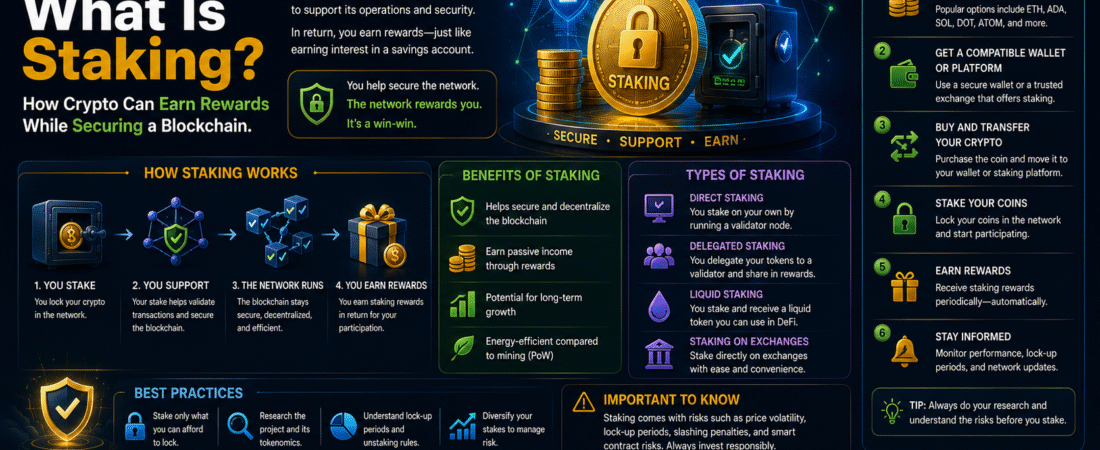

What Is Staking? How Crypto Can Earn Rewards While Securing a Blockchain
CoinBrain Research Articles | Crypto Investing Basics — Article 03
Updated: August 2026
One of the first concepts newcomers encounter after buying cryptocurrency is staking.
An exchange may display:
Stake ETH — Earn Rewards
A wallet may offer:
Stake SOL
A decentralized finance application may advertise:
Liquid Staking
At first glance, staking can look similar to placing money in a savings account and earning interest.
That comparison is convenient—but incomplete.
Crypto staking has a fundamentally different purpose.
In a Proof-of-Stake blockchain, participants commit cryptocurrency to help secure the network, validate transactions, and maintain agreement about the blockchain’s state. In return for performing those responsibilities correctly, the protocol can reward participants with additional tokens.
Staking therefore connects three important ideas:
Network Security → Economic Incentives → Investor Rewards
Understanding that relationship is essential before deciding whether staking belongs in a crypto investment strategy.
Educational Notice: This article is for educational and research purposes only. It does not constitute financial, investment, tax, or legal advice. Staking involves cryptocurrency risk and may introduce additional risks including slashing, validator failure, liquidity restrictions, smart-contract vulnerabilities, counterparty exposure, regulatory uncertainty, and loss of principal.
1. Executive Summary
Staking is the process of committing crypto assets to a Proof-of-Stake blockchain so that validators can participate in securing and operating the network.
In return, participating validators can earn staking rewards.
The basic economic relationship is:
Stake Assets → Help Secure Network → Perform Validation Duties → Earn Protocol Rewards
However, staking exists in several different forms.
An investor might:
- operate a validator directly
- delegate tokens to a validator
- use a staking service
- participate through a staking pool
- hold a liquid staking token
- gain exposure through certain institutional investment products
These approaches do not carry identical risks.
Ethereum provides an important example.
Ethereum transitioned from Proof-of-Work to Proof-of-Stake in September 2022. Under its current consensus system, validators commit ETH as collateral, verify proposed blocks, submit attestations, and can occasionally be selected to propose blocks themselves. Dishonest validator behavior can result in penalties or slashing, meaning that some of the validator’s stake can be destroyed.
Ethereum’s staking system has also continued evolving. Traditional Ethereum validators historically operated around a 32 ETH effective balance, while newer compounding validator credentials can now accumulate an effective balance up to 2,048 ETH.
The most important lesson for beginners is:
Staking rewards are not free money.
The investor remains exposed to the underlying crypto asset and may also assume operational, liquidity, protocol, smart-contract, counterparty, or regulatory risks depending on how staking is performed.
2. Key Takeaways
Before staking any cryptocurrency, understand these principles.
1. Staking helps secure Proof-of-Stake networks
Validators place economic value at risk so the network has a mechanism for encouraging honest behavior.
2. Staking is different from simply holding crypto
A token sitting in a wallet does not necessarily participate in network consensus.
Staking puts the asset into a network-specific validation or delegation process.
3. Rewards are not guaranteed investment returns
Staking rewards depend on factors such as:
- blockchain protocol rules
- total amount staked
- validator performance
- network activity
- inflation or token issuance
- transaction fees
- commissions
- penalties
4. Yield and total investment return are different
You might earn 4% more tokens through staking while the token itself falls 40% in market value.
Your token balance increased.
Your portfolio value still declined.
5. Different staking methods create different risks
Solo staking, delegated staking, exchange staking, pooled staking, and liquid staking should not be treated as equivalent.
6. Validators can be penalized
Poor performance can reduce rewards.
Certain serious protocol violations may lead to slashing.
7. Liquid staking adds another financial layer
Liquid staking can provide a transferable token representing a staked position.
This creates additional flexibility—but also additional smart-contract, liquidity, and protocol risk.
8. Staking has become increasingly institutional
By 2026, staking exposure has moved beyond crypto-native platforms. U.S.-listed products including the iShares Staked Ethereum Trust ETF and Grayscale Ethereum Staking ETF incorporate staking into their structures. The iShares product reported its first staking-related cash distribution in June 2026, while Grayscale filed in July 2026 for a framework involving regular distributions of net staking proceeds.
3. Market Overview
From Mining to Staking
To understand staking, we first need to understand why blockchains require consensus mechanisms.
A decentralized blockchain does not have one central database administrator.
Instead, many independent computers maintain copies of the network’s state.
They must somehow agree on questions such as:
- Which transactions are valid?
- Who owns which assets?
- Which block should come next?
- Which version of the blockchain is legitimate?
This process is called consensus.
Bitcoin primarily solves this through:
Proof-of-Work
Ethereum and many newer blockchain networks use variants of:
Proof-of-Stake
Proof-of-Work
In Proof-of-Work networks such as Bitcoin, miners compete using computational resources.
They expend:
- computing power
- electricity
- hardware resources
The economic cost of mining helps protect the network against manipulation.
Proof-of-Stake
Proof-of-Stake uses a different economic mechanism.
Instead of committing enormous amounts of computational work, validators commit cryptocurrency as economic collateral.
If they behave honestly:
They can receive rewards.
If they violate certain protocol rules:
They can lose money.
The security principle becomes:
Attacking the network should create significant economic consequences for the attacker.
Major Staking Ecosystems
Staking is now fundamental to many blockchain networks, though each protocol operates differently.
Examples include:
- Ethereum
- Solana
- Cardano
- Avalanche
- Polkadot
- Cosmos-based networks
- numerous other Proof-of-Stake ecosystems
The word staking therefore describes a broad category rather than one universal mechanism.
An investor should always research the rules of the specific blockchain.
4. Technology Deep Dive
How Does Proof-of-Stake Actually Work?
Let’s use Ethereum as the primary example.
Ethereum’s Proof-of-Stake system uses validators to participate in consensus.
A validator:
- commits ETH to the staking system
- runs validator software
- receives information about proposed blocks
- verifies network activity
- submits votes known as attestations
- may occasionally be selected to propose a block
- earns rewards for correct participation
Ethereum operates in approximately 12-second slots, with validators selected to perform consensus duties within this structure.
Why Must Validators Stake Assets?
Imagine validators could participate without risking anything.
A malicious participant might try to:
- approve invalid transactions
- support conflicting versions of the blockchain
- attack network consensus
without suffering an economic consequence.
Proof-of-Stake changes that incentive.
Validators must have something valuable at risk.
Ethereum describes this explicitly: validators stake ETH so dishonest behavior can have financial consequences, including destruction of part of their stake.
This is why staking is important.
The crypto is not simply being “locked to earn interest.”
It is serving as:
economic collateral for honest network participation.
What Does a Validator Do?
A validator is a participant in the blockchain’s consensus system.
On Ethereum, validators may:
Attest to Blocks
Validators verify whether proposed blocks appear valid and vote accordingly.
Propose Blocks
A validator can periodically be selected to create and propose a new block.
Participate in Consensus
Collectively, validator votes allow Ethereum to determine the canonical blockchain history.
Ethereum’s 32 ETH Requirement
Ethereum’s traditional validator model requires at least:
32 ETH
to activate an individual validator.
Ethereum’s official staking documentation confirms that users can operate their own validator by depositing 32 ETH and maintaining the necessary node infrastructure.
However, this does not mean someone needs 32 ETH to gain staking exposure.
Other methods exist.
Four Common Ways to Stake
Method 1 — Solo Staking
You operate your own validator.
Typically you:
- provide the necessary ETH
- operate hardware
- maintain internet connectivity
- manage validator software
- maintain keys
- perform operational responsibilities
Ethereum describes home staking as the method providing the greatest direct contribution to network decentralization and allowing the participant to receive protocol rewards without relying on an intermediary.
Advantages
- direct network participation
- greater control
- no third-party validator operator
- full protocol-level rewards before operating costs
- contributes directly to decentralization
Challenges
- technical responsibility
- hardware requirements
- uptime requirements
- key management
- validator maintenance
Method 2 — Staking as a Service
Suppose you have enough ETH for a validator but do not want to operate the technical infrastructure.
A staking provider may operate the validator on your behalf.
Ethereum’s official documentation describes this model as maintaining the user’s validator while delegating node operation to a third-party provider, generally for a fee.
Advantage
Less technical complexity.
Additional Risk
You now depend on:
a service provider.
Method 3 — Pooled Staking
Many investors do not have 32 ETH.
Pooling allows multiple investors to combine their assets.
For example:
Investor A → 2 ETH
Investor B → 5 ETH
Investor C → 1 ETH
Many others → additional ETH
The pool collectively provides enough capital to operate validators.
Ethereum’s official documentation notes that pooled staking lowers the entry barrier but introduces third-party and potentially smart-contract risks because staking pools are not themselves a native Ethereum protocol feature.
Method 4 — Delegated Staking
Some Proof-of-Stake networks allow token holders to delegate their stake to an existing validator.
The validator performs the technical work.
The delegator participates economically and receives a portion of rewards, typically after validator commissions and according to protocol rules.
Solana, for example, supports delegation and stake pools as mechanisms for distributing stake across validators.
What Is Liquid Staking?
Traditional staking can reduce liquidity because assets participate in validation rather than remaining immediately available for other purposes.
Liquid staking attempts to solve this problem.
Suppose you stake:
10 ETH
A liquid staking protocol might issue a token representing your economic claim on that staked ETH and its accumulated rewards.
Conceptually:
ETH → Staking Protocol → Staked ETH
and you receive:
Liquid Staking Token
That token may then potentially be:
- held
- transferred
- traded
- used as collateral
- deployed in DeFi
Ethereum’s documentation notes that pooled staking systems commonly issue tokens representing staked ETH and accumulated rewards, allowing holders to use those representations elsewhere.
Why Is Liquid Staking Important?
Without liquid staking:
Capital is staked → Capital is less flexible
With liquid staking:
Capital is staked → Network receives security → Investor receives liquid representation
This can increase capital efficiency.
But it creates another layer of risk.
Instead of simply holding ETH, you may now depend on:
Ethereum + Validators + Liquid Staking Protocol + Smart Contracts + Token Liquidity
Additional efficiency frequently comes with additional complexity.
5. Current Industry Landscape
Staking has evolved from a relatively specialized blockchain activity into an important part of the digital-asset economy.
There are now several major staking segments.
Native Protocol Staking
Users participate directly through blockchain mechanisms.
This is the closest form to the underlying consensus process.
Delegated Staking
Token holders delegate assets to validators while retaining economic exposure.
This model is common across multiple Proof-of-Stake networks.
Centralized Exchange Staking
Some crypto exchanges allow customers to stake assets through their platforms.
This simplifies participation but creates additional counterparty considerations.
The user must understand:
- who controls the assets
- who selects validators
- what fees are charged
- how withdrawals work
- whether rewards are guaranteed or variable
- what happens if the provider fails
Liquid Staking
Liquid staking has developed into a major piece of decentralized finance infrastructure.
It transforms staked positions into transferable crypto assets.
This allows staking positions to interact with:
- lending protocols
- decentralized exchanges
- collateral systems
- liquidity markets
- structured DeFi products
Restaking
Another development is restaking.
In simplified terms, restaking attempts to reuse already staked economic security to help secure additional protocols or services.
Conceptually:
Original Stake → Secures Blockchain
then:
Staked Position → Additional Security Commitments
This may increase potential economic opportunities.
It also increases complexity and correlated risk.
For beginners, staking and restaking should therefore be viewed as distinct levels of sophistication.
Regulatory Development
The regulatory treatment of staking has also evolved.
In May 2025, the SEC Division of Corporation Finance published a statement addressing certain protocol staking activities, describing staking within Proof-of-Stake networks as a mechanism connected to network operation and security.
By 2026, the institutional landscape had moved further: staking had become incorporated into multiple publicly traded digital-asset products in the United States.
This is an important development.
Staking is increasingly becoming part of mainstream digital-asset financial infrastructure rather than remaining exclusively a crypto-native activity.
6. Institutional Activity
Institutional staking deserves special attention because it illustrates how crypto markets are evolving.
Traditionally, an investor wanting Ethereum staking rewards needed to:
- acquire ETH
- arrange custody
- operate or select validators
- handle staking mechanics
- understand withdrawal procedures
- manage operational risks
Investment products can package parts of that infrastructure.
Staking Through Exchange-Traded Products
By 2026, the U.S. market included investment products explicitly incorporating Ethereum staking.
For example, SEC filings show that the iShares Staked Ethereum Trust ETF declared its first staking-related cash distribution in June 2026.
Grayscale’s Ethereum Staking ETF has similarly incorporated staking exposure, with an April 2026 filing stating that approximately 71% of the product’s assets were staked as of March 31, 2026.
In July 2026, Grayscale disclosed plans for the fund to regularly convert net staking rewards into cash and distribute proceeds to shareholders at least quarterly under its proposed amended framework.
This represents an important structural development:
Traditional Investment Product + Crypto Asset Exposure + Native Blockchain Yield
Why Institutions Care About Staking
Institutions may view staking differently from speculative retail traders.
Potential motivations include:
Incremental Asset Yield
If an institution already plans to hold a Proof-of-Stake asset, staking can potentially generate additional units of that asset.
Network Participation
Staking directly participates in the economic security of the blockchain.
Improving Capital Productivity
Instead of holding an otherwise idle PoS asset, staking may produce protocol rewards.
Institutional Product Design
Asset managers can potentially incorporate staking economics into regulated or exchange-traded structures.
But Institutional Adoption Does Not Remove Risk
A professional custodian, ETF structure, or institutional validator does not eliminate:
- crypto price volatility
- protocol risk
- staking penalties
- liquidity constraints
- regulatory risk
- tax implications
- operational dependencies
Institutionalization changes the method of access.
It does not change the fundamental economics of the underlying asset.
7. Market Data & Metrics
Investors evaluating staking should understand several important metrics.
Staking Ratio
The staking ratio measures the proportion of an eligible cryptocurrency supply committed to staking.
Simplified:
Staking Ratio = Staked Tokens ÷ Eligible or Relevant Token Supply
A higher staking ratio can indicate substantial participation in network security.
But interpretation requires context.
Staking APR
APR generally represents an annualized reward rate without assuming compounding.
For example:
Stake:
100 tokens
APR:
5%
Simplified annual rewards:
5 tokens
before:
- validator fees
- commissions
- penalties
- taxes
- protocol changes
- other costs
APY
APY attempts to account for compounding.
If rewards are continually reinvested:
rewards can themselves generate additional rewards.
This can make APY higher than an equivalent simple APR.
However, advertised APY should never be confused with guaranteed fiat-denominated investment returns.
Nominal Yield vs Real Yield
This distinction is extremely important.
Suppose a network increases token supply by:
7% annually
and staking provides:
8% token rewards.
The nominal staking reward is:
8%.
But if supply is expanding materially, the investor should consider how much of that reward represents genuine economic income versus compensation for monetary dilution.
A sophisticated staking analysis therefore asks:
Where do the rewards actually come from?
Potential sources include:
- newly issued tokens
- transaction fees
- protocol fees
- MEV
- combinations of these sources
Validator Commission
Delegated staking frequently involves validator fees.
Suppose gross staking rewards are:
7%
and a validator takes a portion as commission.
The delegator receives less than the gross protocol reward.
Always distinguish:
Gross Staking Yield
from:
Net Staking Yield
Validator Uptime
Validators need to perform their assigned duties correctly.
Poor uptime may reduce rewards.
Persistent operational problems can further damage returns.
Total Value Staked
This measures how much economic value participates in securing a network.
A large stake can make certain economic attacks more expensive.
But absolute value alone does not fully describe decentralization or security.
Validator Distribution
Consider two networks.
Network A
1,000 validators controlled by:
5 organizations
Network B
1,000 validators controlled by:
hundreds of independent operators
The validator count is identical.
The decentralization profile is not.
Investors should therefore investigate:
- validator concentration
- staking provider concentration
- geographic distribution
- infrastructure concentration
- client diversity
Price-Adjusted Return
Perhaps the most important investor metric is total return.
Suppose you begin with:
100 SOL
and earn:
7 SOL
through staking.
You finish with:
107 SOL
Your token-denominated return is positive.
But suppose SOL’s market price falls 50%.
Your fiat-denominated portfolio value can still be significantly lower.
Therefore:
Staking Yield ≠ Investment Return
A better mental model is:
Total Return ≈ Asset Price Change + Staking Rewards − Costs − Penalties
with the understanding that real investment mathematics can be more complex.
8. Real-World Use Cases
Staking serves both blockchain infrastructure and investment functions.
Use Case 1 — Network Security
This is staking’s primary purpose.
Validators commit economically valuable assets.
That stake creates financial consequences for malicious behavior.
Use Case 2 — Transaction Validation
Validators participate in confirming blockchain activity.
They help determine which proposed transactions and blocks become part of the accepted blockchain history.
Use Case 3 — Long-Term Crypto Holdings
Suppose an investor intends to hold ETH for five years regardless of short-term market movements.
Instead of leaving eligible ETH economically inactive, the investor might investigate staking.
The reasoning becomes:
I intend to hold ETH anyway. Can this holding also participate in securing Ethereum and earn protocol rewards?
That is fundamentally different from purchasing ETH solely because a website advertises a high staking yield.
Use Case 4 — Institutional Asset Management
Asset managers holding Proof-of-Stake assets may seek staking rewards as an additional component of portfolio economics.
The emergence of staking-enabled Ethereum investment products demonstrates this model in practice.
Use Case 5 — Delegated Network Participation
A token holder without technical expertise can delegate assets to professional validators.
This allows broader participation in consensus economics.
Use Case 6 — Liquid Staking and DeFi
Liquid staking tokens can potentially be deployed into other decentralized financial applications.
For example:
Stake ETH
↓
Receive a liquid staking representation
↓
Potentially use it for:
- collateral
- lending
- liquidity
- DeFi strategies
This creates capital efficiency.
It also creates stacked risk.
Use Case 7 — Blockchain Governance and Ecosystem Alignment
On some networks, staking or delegated stake can interact with broader governance and validator-selection processes.
Specific rules vary substantially by blockchain.
9. Risks & Challenges
Staking is often presented as one of crypto’s simplest passive-income strategies.
Its risks deserve equal attention.
1. Crypto Price Risk
Suppose:
Staking reward = 5%
Token price decline = 40%
The staking reward does not protect you from the underlying asset loss.
This is the most important risk.
2. Slashing Risk
Certain validator misconduct can trigger penalties.
On Ethereum, slashing can destroy part of a validator’s stake and remove the validator from participation. Ethereum explains that slashing penalties can become more severe when many validators are penalized together, helping deter coordinated attacks.
3. Downtime Risk
Validators must remain available and perform their responsibilities.
Poor performance can reduce staking rewards.
4. Liquidity Risk
Staked assets may not always be immediately withdrawable.
Even where withdrawals are supported, exit queues can develop depending on network demand.
Ethereum’s withdrawal documentation, for example, notes that validators exiting staking may need to wait according to the network’s withdrawal queue.
5. Counterparty Risk
If you stake through an exchange or service provider, you may depend on that company.
Potential problems include:
- insolvency
- operational failure
- custody problems
- regulatory restrictions
- withdrawal suspension
- validator mismanagement
6. Smart-Contract Risk
Liquid staking and decentralized staking pools may rely on smart contracts.
A vulnerability could potentially expose deposited funds.
Ethereum explicitly identifies smart-contract risk as an additional consideration when using pooled and liquid staking solutions.
7. Liquid Staking Token Risk
A token representing staked assets may trade differently from the underlying asset.
For example, a market crisis could create a temporary or prolonged price divergence between:
staked-asset representation
and
underlying asset
This is sometimes described as depegging risk, though the exact economic structure varies by product.
8. Validator Selection Risk
Delegators should evaluate the validators they select.
Important factors include:
- uptime
- commission
- history
- governance behavior
- infrastructure
- concentration
- reliability
Choosing only the largest validator because it appears safest can also contribute to network centralization.
9. Yield-Chasing Risk
This is one of the most common beginner mistakes.
Imagine:
Project A
Staking yield:
4%
Project B
Staking yield:
40%
A beginner may automatically assume Project B is superior.
But the 40% yield might reflect:
- aggressive token inflation
- low token demand
- high risk
- unsustainable incentives
- poor liquidity
A high staking yield can sometimes be a warning signal rather than an opportunity.
Always ask:
Where does the yield come from?
10. Tax Risk
Staking rewards can create taxable events depending on jurisdiction.
Tax treatment varies considerably between countries and investor circumstances.
Investors should consult appropriate local guidance or qualified tax professionals.
11. Regulatory Risk
Rules governing staking products, intermediaries, and investment vehicles continue to evolve internationally.
The structure matters.
Direct protocol staking, an exchange staking service, a liquid staking protocol, and a staking-enabled investment product may receive very different regulatory treatment.
12. Centralization Risk
If too much stake becomes concentrated among a small number of exchanges, liquid staking protocols, or institutional validators, the network can become less decentralized.
Staking is therefore not merely an investment issue.
It is also a blockchain architecture and governance issue.
10. Future Outlook: 3–5 Years
Staking is likely to become increasingly important as Proof-of-Stake networks mature.
Several trends deserve attention.
Institutionalization of Staking
One of the clearest developments is the integration of staking into traditional investment products.
The emergence of staking-enabled Ethereum exchange-traded products in the U.S. during 2026 demonstrates how native blockchain economics are beginning to merge with conventional investment infrastructure.
Professional Validator Infrastructure
Validator operations may increasingly resemble professional infrastructure businesses.
Important capabilities could include:
- enterprise-grade uptime
- secure key management
- geographic redundancy
- compliance controls
- institutional reporting
- automated monitoring
- insurance or risk-management structures
Liquid Staking Growth
Liquid staking could continue expanding because it addresses a fundamental economic problem:
How can capital secure a blockchain without becoming economically unusable elsewhere?
However, concentration among large liquid staking providers will remain an important decentralization concern.
Staking in Exchange-Traded Products
Future investment products may increasingly combine:
Crypto Price Exposure + Staking Rewards
For investors, this could create another distinction between:
holding a Proof-of-Stake asset
and
holding an instrument that participates in its staking economics.
Restaking and Shared Security
Restaking may develop into a broader marketplace for blockchain economic security.
Staked assets could potentially help secure:
- bridges
- data availability systems
- oracle infrastructure
- decentralized services
- other blockchain middleware
But every additional security commitment can introduce additional risk.
Better User Experience
Staking will likely become less technically intimidating.
Wallets may increasingly abstract:
- validator selection
- delegation
- rewards
- unstaking
- risk information
This could broaden participation substantially.
Greater Focus on Sustainable Yield
As crypto markets mature, investors may increasingly distinguish between:
real network economics
and
inflation-driven token incentives.
This is healthy.
The important question will increasingly become:
Does staking yield represent sustainable economic activity, or simply additional token issuance?
11. Investment & Business Implications
For investors, staking should begin with the asset—not the yield.
A useful framework is:
Step 1 — Decide Whether You Want the Asset
Ask:
Would I still want to own this cryptocurrency if staking rewards were zero?
If the answer is no, you may be buying yield rather than investing in the underlying network.
That distinction matters.
Step 2 — Understand the Network
Research:
- consensus mechanism
- validator structure
- staking requirements
- token issuance
- network fees
- staking ratio
- validator concentration
- withdrawal mechanics
Step 3 — Understand the Reward Source
Ask:
Where does my staking reward originate?
Possible sources include:
- token issuance
- transaction fees
- network fees
- MEV
- combinations of these
Step 4 — Choose the Staking Method
Possible approaches include:
Solo Staking
Best suited to technically capable participants seeking direct network participation.
Delegation
Useful where the protocol supports delegation to validators.
Staking Service
Reduces technical workload while introducing provider risk.
Pooled Staking
Allows smaller holdings to participate.
Liquid Staking
Provides greater capital flexibility but adds smart-contract and liquidity risks.
Investment Products
Certain regulated or exchange-traded structures can now provide indirect staking exposure depending on jurisdiction.
Step 5 — Calculate Net Yield
Do not focus only on the headline reward.
Consider:
Gross Protocol Reward
minus:
Validator Commission
minus:
Platform Fees
minus:
Operational Costs
minus:
Potential Penalties
minus:
Tax Consequences
equals something closer to:
Net Economic Reward
Step 6 — Consider Token Inflation
Imagine:
Your holdings increase:
+8%
But total network token supply increases:
+10%
Your nominal balance increased.
Your proportional ownership of the network may not have improved.
Tokenomics matters.
We will examine this subject in detail later in the Crypto Investing Basics series.
Step 7 — Consider Liquidity
Before staking, know:
- how you unstake
- how long unstaking can take
- whether there is an exit queue
- whether the position can be sold
- what happens during high network demand
Never discover the withdrawal mechanics only after you need your money.
Step 8 — Understand Custody
Ask:
Who controls the keys?
Who controls withdrawals?
Who operates the validator?
What happens if the provider disappears?
These questions are as important as the advertised APY.
A Beginner Example
Suppose Ahmed owns:
10 ETH
He intends to hold it for several years.
Assume, purely for illustration:
Annual staking return:
3%
After one year:
10 ETH → approximately 10.3 ETH
Ahmed has gained:
0.3 ETH
But now consider three scenarios.
Scenario A — ETH Price Rises 30%
The price appreciation and staking reward both contribute positively.
Scenario B — ETH Price Stays Flat
The staking reward contributes positively to the ETH-denominated and fiat-denominated position, before costs and taxes.
Scenario C — ETH Price Falls 50%
Ahmed still earned additional ETH.
But his portfolio’s market value may still have fallen dramatically.
This demonstrates the core principle:
Staking can increase the quantity of crypto you own. It cannot guarantee the value of that crypto.
Business Implications
Staking is also creating an entire commercial ecosystem.
Businesses now operate across:
- validator infrastructure
- institutional staking
- custody
- liquid staking
- staking analytics
- wallet integration
- compliance
- risk management
- staking-enabled investment products
- blockchain security services
As Proof-of-Stake networks grow, staking infrastructure may increasingly resemble a specialized segment of financial and cloud infrastructure.
12. Final Analysis
Staking is one of the most important economic innovations introduced by modern blockchain networks.
It creates a system in which participants have financial incentives to help maintain network integrity.
At its simplest:
Validators put assets at risk.
Validators perform network duties.
Honest participation earns rewards.
Certain dishonest behavior creates penalties.
That mechanism allows Proof-of-Stake blockchains to coordinate decentralized participants without relying on traditional mining.
For investors, staking creates another possibility:
An asset held for long-term investment can potentially participate in the operation of its network and earn additional tokens.
But the word yield should not distract from the underlying risk.
Staking is not a bank deposit.
Staking rewards are not guaranteed interest.
And a 10% staking return cannot compensate for an asset that loses 80% of its value.
The correct order of analysis is therefore:
1. Is the blockchain valuable?
2. Is the token economically meaningful?
3. Do I want to own the asset?
4. How does its staking mechanism work?
5. Where do the rewards come from?
6. What risks does my chosen staking method introduce?
7. Only then: What yield can I earn?
That sequence protects investors from one of the most dangerous behaviors in crypto:
chasing yield without understanding the asset producing it.
Staking can be a powerful component of a long-term crypto strategy.
But it should be viewed first as:
a blockchain security mechanism
and only second as:
an investment-income opportunity.
13. References & Further Reading
Ethereum.org
Ethereum Staking
Official overview explaining Ethereum staking, validators, staking options, pooled staking, rewards, and withdrawals. Ethereum currently supports solo staking, staking-as-a-service, pooled staking, and other participation models.
Proof-of-Stake
Technical overview of Ethereum’s consensus architecture, validator responsibilities, attestations, block proposals, staking collateral, and penalties.
Home Staking
Current Ethereum guidance covering validator operation, network decentralization, hardware responsibilities, and direct protocol staking.
Pooled Staking
Explanation of staking pools, liquid staking tokens, third-party dependencies, and smart-contract considerations.
Staking Withdrawals
Current guidance covering withdrawal credentials, validator exits, withdrawal queues, and compounding validator balances.
Solana
Stake Programming and Stake Pools
Official Solana documentation explaining delegated stake, stake distribution, validator decentralization, and stake-pool structures.
U.S. Securities and Exchange Commission — SEC
Statement on Certain Protocol Staking Activities — May 29, 2025
SEC Division of Corporation Finance statement discussing protocol staking in Proof-of-Stake blockchain networks.
iShares Staked Ethereum Trust ETF — June 2026 Filing
SEC filing documenting the product’s first cash distribution associated with staking economics.
Grayscale Ethereum Staking ETF — 2026 Filings
SEC filings documenting staking exposure and the proposed framework for distributing net staking proceeds to shareholders.
CoinBrain Crypto Investing Basics
Article 01 — How to Start Investing in Crypto
Article 02 — Spot vs Futures: Understanding the Difference Before You Trade
Article 03 — What Is Staking? How Crypto Can Earn Rewards While Securing a Blockchain
Next Article
Article 04 — What Is Yield Farming? Understanding How DeFi Investors Earn Yield—and the Risks Behind It
CoinBrain Research Articles
Research. Understand. Decide.







Leave a Reply
You must be logged in to post a comment.