
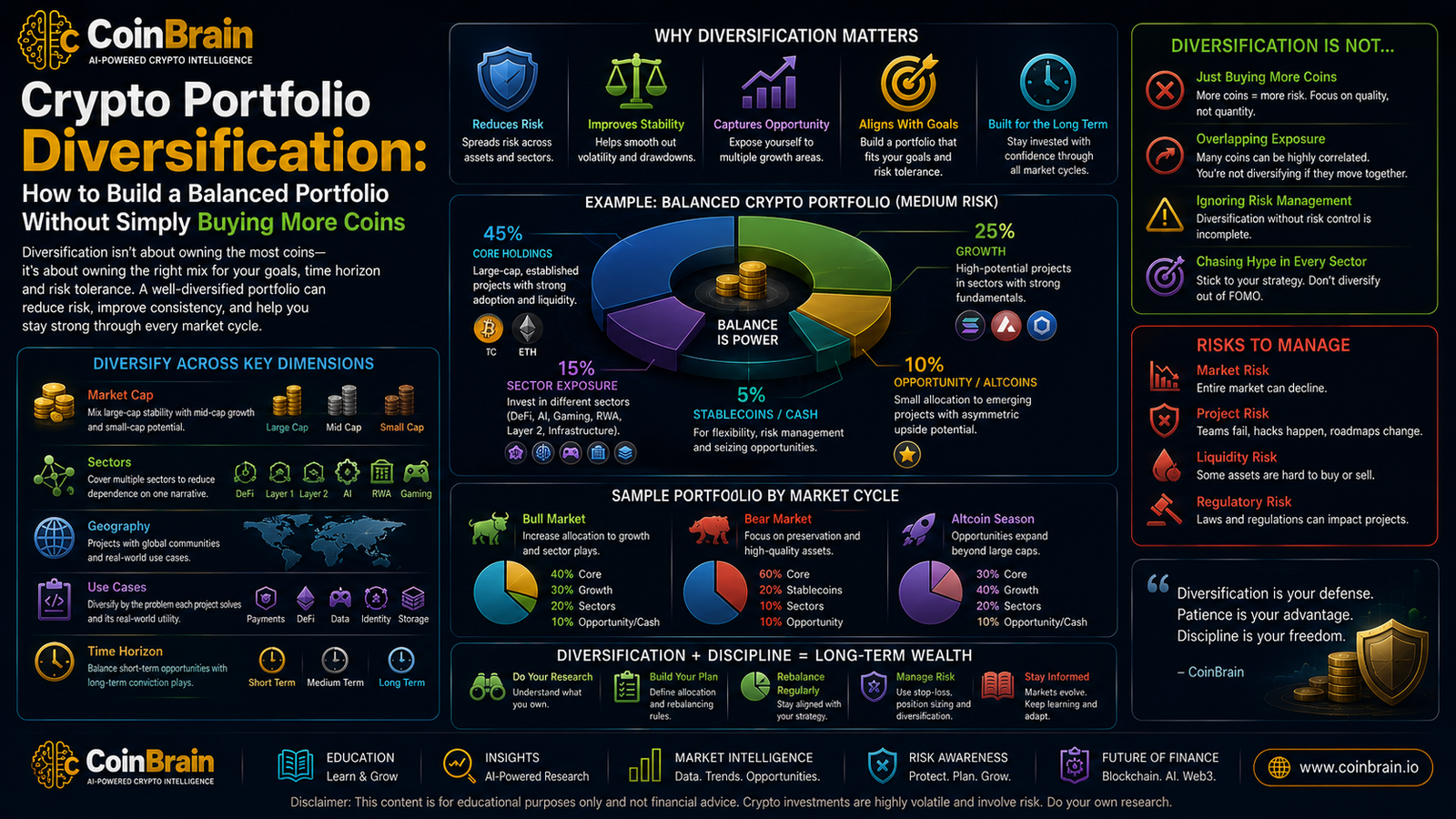

Crypto Portfolio Diversification: How to Build a Balanced Portfolio Without Simply Buying More Coins
CoinBrain Research Articles | Crypto Investing Basics — Article 10
Updated: August 2026
One of the most common pieces of investment advice is:
“Diversify your portfolio.”
But in crypto, diversification is often misunderstood.
An investor may hold:
- Bitcoin
- Ethereum
- Solana
- Avalanche
- Sui
- Chainlink
- Aave
- several AI tokens
- several DeFi tokens
and assume the portfolio is well diversified.
But if nearly all of those assets fall sharply at the same time during a broad crypto selloff, the portfolio may still contain significant concentration risk.
True diversification is not simply:
Owning more coins.
It is about spreading exposure across different:
- assets
- risk factors
- sectors
- technologies
- liquidity profiles
- investment theses
- custody arrangements
- time horizons
Diversification does not eliminate losses.
It cannot turn poor investments into good ones.
And excessive diversification can create its own problems.
The goal is not to own everything.
The goal is to avoid allowing one asset, one narrative, one protocol, one exchange, or one failure point to dominate the entire portfolio.
Educational Notice: This article is for educational and research purposes only. It does not constitute financial, investment, tax, or legal advice. Cryptocurrency investments can involve substantial volatility and the possible loss of all invested capital. Appropriate portfolio allocation depends on individual circumstances, objectives, financial position and risk tolerance.
1. Executive Summary
Portfolio diversification is the practice of spreading investment exposure across assets and risk factors so that the success or failure of one position does not determine the outcome of the entire portfolio.
In crypto, effective diversification should consider more than token count.
A diversified framework might examine:
- major digital assets
- smart-contract platforms
- infrastructure
- decentralized finance
- tokenized real-world assets
- stablecoin or cash reserves
- geographic or regulatory exposure
- custody
- liquidity
- concentration
A useful principle is:
Diversification by Risk Drivers > Diversification by Number of Tokens
For example, a portfolio containing 20 small-cap Layer-1 tokens may be less diversified than a portfolio containing:
- Bitcoin
- Ethereum
- selected infrastructure exposure
- selected DeFi exposure
- liquidity reserves
because the 20 small-cap assets may respond to the same market forces.
Diversification should work alongside:
Asset Selection + Position Sizing + Risk Management + Rebalancing
It is not a substitute for any of them.
2. Key Takeaways
1. More coins do not automatically mean more diversification
Ten highly correlated altcoins can behave like one large speculative position.
2. Diversify across investment theses
Examples:
- monetary asset
- smart-contract infrastructure
- DeFi
- tokenization
- payments
- blockchain infrastructure
3. Position size matters more than token count
A portfolio with:
70% in one token
is concentrated even if the remaining 30% is spread across 15 assets.
4. Bitcoin and altcoins carry different risk profiles
Smaller projects generally carry greater:
- execution risk
- liquidity risk
- tokenomics risk
- competitive risk
5. Stablecoins can reduce volatility but introduce other risks
They carry potential:
- issuer
- reserve
- depeg
- regulatory
- smart-contract risks
6. Diversify custody as well as assets
Holding everything on one exchange creates a single operational failure point.
7. Diversification has diminishing returns
Adding a tenth similar token may contribute very little additional risk reduction.
8. Correlation changes during crises
Assets that appear diversified during normal markets may fall together when liquidity disappears.
9. Rebalancing maintains diversification
Market movements can turn a balanced portfolio into a concentrated one.
10. Diversification should reflect conviction
Investors should understand what they own.
Owning 50 tokens that cannot be properly monitored can increase risk.
11. Crypto itself may be one risk bucket within a wider investment portfolio
A diversified crypto portfolio is not necessarily a diversified overall financial portfolio.
12. The objective is resilience
A portfolio should be able to survive being wrong about individual assets or narratives.
3. Market Overview
Why Diversification Exists
Every investment thesis contains uncertainty.
Suppose an investor believes strongly in:
Project A
Possible outcome:
Project succeeds dramatically.
But possible outcomes also include:
- competitor wins
- regulation changes
- developers leave
- technology fails
- tokenomics deteriorate
- demand never materializes
If the investor places:
100%
of capital into Project A, the portfolio depends on one thesis.
Diversification reduces this dependence.
Traditional Diversification
Traditional portfolios may spread capital across:
- equities
- bonds
- real estate
- commodities
- cash
Within equities, diversification can continue across:
- sectors
- countries
- company sizes
Crypto investors should apply the same thinking.
The Crypto Correlation Problem
Crypto assets often exhibit high correlations during major market moves.
When Bitcoin falls sharply:
- Ethereum may fall
- DeFi tokens may fall
- Layer-1 tokens may fall
- AI tokens may fall
- gaming tokens may fall
This means sector labels do not always create true independence.
Crypto often behaves as one broad:
risk-on asset ecosystem.
Bitcoin vs Altcoins
Bitcoin generally occupies a different role from most altcoins.
Its primary thesis centers on:
- digital scarcity
- monetary properties
- network security
- global liquidity
Altcoins may depend more heavily on:
- application adoption
- developer activity
- token utility
- competitive positioning
- incentives
This difference can provide some diversification within crypto.
But during severe market stress, correlations can still increase.
Diversification Beyond Crypto
A beginner should understand one critical distinction:
Diversified Crypto Portfolio
does not equal:
Diversified Investment Portfolio.
An investor with:
- 30% Bitcoin
- 20% Ethereum
- 20% altcoins
- 20% stablecoins
- 10% DeFi
still has:
100% exposure to the digital-asset ecosystem.
A broader financial portfolio may also include:
- equities
- bonds
- cash
- real estate
- other assets
depending on individual goals.
4. Technology Deep Dive
Understanding Correlation
Correlation measures how two assets move relative to one another.
It typically ranges from:
+1 to -1
+1
Assets move perfectly together.
0
No consistent relationship.
-1
Assets move perfectly opposite each other.
Suppose:
Bitcoin rises 10%.
Token X also tends to rise approximately 10%.
If this relationship is persistent, Token X provides limited diversification relative to Bitcoin.
Why Correlation Matters
Imagine:
Portfolio A
50% Bitcoin
50% Token X
If correlation is extremely high, Portfolio A may behave almost like one concentrated crypto position.
Portfolio B
50% Bitcoin
30% Ethereum
10% selected infrastructure
10% liquidity reserve
The risk structure may be more balanced, depending on actual correlations and market conditions.
Volatility
Diversification should also consider volatility.
Suppose:
Bitcoin annualized volatility:
hypothetically 60%
Small-cap token:
hypothetically 150%
A:
10%
allocation to the small-cap asset can contribute far more portfolio risk than its capital weight suggests.
Risk Contribution
Professional portfolio managers often think in terms of:
How much risk does each position contribute?
rather than:
How much money is allocated?
A simplified idea is:
Portfolio Risk Contribution ≠ Portfolio Weight Alone
Volatility and correlation matter.
Sector Diversification
Crypto can be divided into broad investment categories.
Monetary Assets
Example:
- Bitcoin
Smart-Contract Platforms
Examples:
- Ethereum
- Solana
- other Layer-1 networks
Layer-2 Infrastructure
Networks designed to scale existing ecosystems.
Oracle and Data Infrastructure
Provide external data or other services to blockchains.
Decentralized Finance
Protocols supporting:
- lending
- trading
- derivatives
Real-World Assets
Protocols and infrastructure focused on tokenization.
Payments and Stablecoin Infrastructure
Networks supporting settlement and transfers.
Decentralized Physical Infrastructure — DePIN
Projects connecting blockchain incentives with physical infrastructure.
AI and Decentralized Compute
Networks involving:
- compute
- data
- AI services
Sector diversification can reduce dependence on one specific narrative.
Chain Diversification
Suppose every token in a portfolio depends on Ethereum.
If Ethereum experiences a severe ecosystem-specific problem, the entire portfolio can be affected.
Investors may therefore evaluate exposure across multiple blockchain ecosystems.
But adding chains purely for diversification does not automatically improve portfolio quality.
Fundamentals still matter.
Custody Diversification
Portfolio risk also exists outside price movements.
Imagine:
Assets:
- Bitcoin
- Ethereum
- Solana
- Chainlink
- Aave
All held on:
Exchange X
If Exchange X fails:
Token diversification provides little protection.
This is:
Counterparty Concentration.
Diversification therefore includes:
Asset Diversification + Custody Diversification
5. Current Industry Landscape
Modern crypto markets are becoming increasingly segmented.
The ecosystem now includes:
- digital monetary assets
- smart-contract networks
- DeFi
- stablecoins
- tokenized securities
- staking
- infrastructure
- decentralized compute
- payments
This provides more potential diversification than early crypto markets.
But investors should remain cautious.
Sector Narratives
Crypto frequently experiences powerful sector rotations.
Examples across previous cycles have included:
- ICOs
- DeFi
- NFTs
- Layer 1s
- gaming
- AI
- RWAs
A portfolio concentrated entirely in the current dominant narrative can become vulnerable when capital rotates elsewhere.
Institutional Products
Traditional financial products increasingly provide exposure to:
- Bitcoin
- Ether
- broader digital-asset categories
This can allow investors to build crypto exposure through multiple structures.
Tokenized Financial Assets
Tokenization creates a particularly interesting diversification development.
Blockchain-based portfolios may increasingly contain assets whose economic exposure is not purely crypto-native.
For example:
- tokenized treasury securities
- money-market funds
- private credit
These may eventually make on-chain portfolios more economically diversified.
Stablecoins
Stablecoins can act as:
- liquidity reserves
- settlement assets
- collateral
But investors should diversify stablecoin issuer exposure where appropriate rather than treating all stablecoins as identical.
6. Institutional Activity
Institutional investors rarely construct portfolios by asking:
“How many different coins should we buy?”
They focus instead on:
- risk exposure
- liquidity
- correlations
- concentration
- custody
- regulatory status
Core-Satellite Approach
One useful traditional portfolio concept is:
Core + Satellite
The core contains larger, higher-conviction positions.
Satellite allocations target:
- growth
- specialized themes
- higher-risk opportunities
Applied conceptually to crypto:
Core
Larger, more established assets.
Satellites
Smaller allocations to:
- DeFi
- infrastructure
- RWAs
- AI
- emerging networks
This framework can prevent speculative positions from dominating the portfolio.
Institutional Position Limits
Professional portfolios frequently establish rules such as:
No single asset above X%
No single counterparty above Y%
No illiquid assets above Z%
The exact values vary.
The principle is valuable for retail investors as well.
Liquidity Tiers
Institutions may classify holdings according to liquidity.
Tier 1
Highly liquid.
Tier 2
Moderately liquid.
Tier 3
Illiquid or difficult to exit.
Portfolio managers may limit Tier 3 exposure.
Crypto investors can apply similar thinking.
Diversifying Access Infrastructure
Large investors may use multiple:
- custodians
- trading venues
- execution providers
to reduce operational concentration.
7. Market Data & Metrics
Diversification should be measured rather than assumed.
1. Position Weight
Formula:
Position Weight = Position Value ÷ Total Portfolio Value
Suppose:
Bitcoin:
$10,000
Portfolio:
$20,000
Weight:
50%
2. Largest Position
Identify the portfolio’s largest exposure.
If one asset represents:
70%
the portfolio is highly concentrated.
3. Sector Exposure
Calculate allocations by sector.
Example:
| Sector | Allocation |
|---|---|
| Bitcoin | 45% |
| Smart-Contract Platforms | 25% |
| Infrastructure | 10% |
| DeFi | 8% |
| RWA | 5% |
| Liquidity | 7% |
This reveals concentration that token count may hide.
4. Blockchain Exposure
How much depends on:
- Ethereum
- Solana
- other chains?
5. Stablecoin Exposure
How much is held in each stablecoin?
Example:
USDC — 70%
USDT — 30%
of stablecoin reserves.
6. Custodian Exposure
Calculate:
Assets Held with Provider ÷ Total Portfolio
If one provider represents:
80%
that is significant counterparty concentration.
7. Correlation
Analyze relationships among holdings.
High correlation reduces diversification benefits.
8. Volatility
Consider which positions dominate daily portfolio movements.
A small allocation to a highly volatile token may contribute substantial risk.
9. Market Capitalization Exposure
Consider allocations across:
- large cap
- mid cap
- small cap
Smaller assets generally carry greater liquidity and execution risk.
10. Liquidity
Evaluate:
- daily trading volume
- market depth
- slippage
A portfolio cannot be considered robust if significant positions cannot be exited efficiently.
11. FDV and Unlock Exposure
Suppose several portfolio assets all have:
Low Float + High FDV
Then the portfolio has concentrated:
future dilution risk.
Diversification should include tokenomics as well as sectors.
12. Portfolio Drawdown
Track maximum decline.
If diversification is working, portfolio drawdowns may be less extreme than the riskiest underlying positions.
8. Real-World Use Cases
Use Case 1 — Core Crypto Portfolio
A beginner wants long-term crypto exposure.
Instead of purchasing ten speculative tokens equally, the investor builds a larger allocation around established assets and uses smaller positions for higher-risk opportunities.
Use Case 2 — Sector Diversification
An investor believes in several long-term themes:
- Bitcoin as digital monetary infrastructure
- smart contracts
- tokenization
- DeFi
Rather than placing everything into one theme, capital is distributed among them.
Use Case 3 — Stablecoin Reserve
An investor maintains a liquidity reserve for:
- market corrections
- expenses
- rebalancing
This reduces the need to sell volatile assets during unfavorable conditions.
Use Case 4 — Custody Diversification
Long-term holdings might be divided among:
- self-custody
- regulated or reputable service providers
depending on the investor’s skills and circumstances.
The purpose is to avoid one single point of failure.
Use Case 5 — Diversification Across Time
Dollar Cost Averaging, covered in Article 09, spreads entry exposure across time.
An investor can therefore combine:
Asset Diversification
with:
Time Diversification
Use Case 6 — Rebalancing
Suppose a portfolio starts:
Bitcoin — 50%
Ethereum — 25%
Altcoins — 15%
Liquidity — 10%
After a major altcoin rally:
Bitcoin — 35%
Ethereum — 20%
Altcoins — 40%
Liquidity — 5%
The investor now has a much riskier portfolio.
Rebalancing restores the intended structure.
Use Case 7 — Narrative Risk
Suppose an investor owns:
- five AI tokens
- three decentralized-compute tokens
- two data tokens
These appear to be ten different assets.
But economically they may represent one concentrated thesis:
AI + Crypto
If that narrative weakens, the portfolio may decline broadly.
9. Risks & Challenges
Diversification can be implemented poorly.
1. Diworsification
Adding low-quality investments simply to increase the number of positions can make a portfolio worse.
This is sometimes jokingly called:
Diworsification.
2. False Diversification
Holding:
20 altcoins
that all move with Bitcoin does not eliminate market risk.
3. Over-Diversification
Suppose you own:
50 tokens
Each receives:
2%
of the portfolio.
Now you must track:
- 50 teams
- 50 tokenomics systems
- 50 unlock schedules
- 50 governance structures
Monitoring becomes difficult.
4. Concentrated Conviction
The opposite risk is holding:
80%
in one asset because conviction is high.
Conviction does not eliminate uncertainty.
5. Correlation Spikes During Crises
During normal periods:
Assets may move differently.
During crises:
everything can sell off together.
This is common across risk assets.
6. Sector Concentration
Five DeFi tokens are still primarily a DeFi bet.
7. Blockchain Concentration
Multiple tokens can all depend on the same underlying blockchain.
This creates hidden infrastructure concentration.
8. Stablecoin Concentration
Holding all liquidity in one stablecoin creates issuer concentration.
9. Custody Concentration
Holding every asset on one exchange introduces operational concentration.
10. Liquidity Concentration
A portfolio containing many illiquid small-cap assets may become difficult to exit during stress.
11. Tokenomics Concentration
Multiple high-FDV, low-float tokens can expose a portfolio to broad dilution pressure.
12. Narrative Diversification Without Fundamental Quality
Owning:
- AI
- RWA
- DeFi
- gaming
does not help if every selected project has weak fundamentals.
Diversification spreads risk.
It does not create quality.
13. Ignoring the Non-Crypto Portfolio
An investor can carefully diversify inside crypto while remaining excessively concentrated in crypto overall.
Always evaluate the broader financial picture.
10. Future Outlook: 3–5 Years
Crypto portfolio construction is likely to become significantly more sophisticated.
Broader Institutional Asset Selection
Investors may increasingly build portfolios across:
- Bitcoin
- staking assets
- DeFi infrastructure
- tokenized financial assets
- stablecoins
rather than treating crypto as one homogeneous category.
Tokenized Traditional Assets
Tokenized:
- government bonds
- money-market instruments
- funds
- credit
could allow traditional and crypto-native exposures to exist in the same blockchain-based portfolio.
This could fundamentally change diversification.
Crypto Indices
Broad digital-asset indices may become more important.
Instead of selecting individual tokens, investors may gain diversified exposure through:
index products.
This mirrors traditional equity investing.
More Professional Portfolio Analytics
Retail tools may increasingly provide:
- correlation matrices
- concentration alerts
- volatility analysis
- sector exposures
- custody exposure
- token-unlock risk
AI-Assisted Diversification
AI systems may identify hidden concentration.
For example:
“Although you own 14 tokens, 73% of portfolio risk is linked to the Ethereum ecosystem.”
or:
“Four of your six altcoin holdings face major token unlocks within the next 90 days.”
This can make portfolio risk easier to understand.
Institutional Risk Models
Professional risk concepts may increasingly become accessible to retail investors.
These include:
- volatility targeting
- risk parity
- scenario analysis
- stress testing
Stablecoins as Portfolio Infrastructure
Stablecoins may increasingly function as:
- settlement
- collateral
- liquidity reserves
rather than simply assets used between trades.
Sector-Based Crypto Investing
Future investors may think more like equity-sector investors:
Payments
RWA
DeFi
AI Infrastructure
Blockchain Security
rather than:
Which coin is going up next?
That would represent significant market maturation.
11. Investment & Business Implications
A practical crypto-diversification framework can be built systematically.
Step 1 — Start With Total Portfolio Risk
Before deciding which cryptocurrencies to own, decide:
How much of my overall investment portfolio should be in crypto?
This is the most important allocation decision.
Step 2 — Define a Core
A core portfolio might contain assets with:
- deeper liquidity
- longer operating history
- stronger network effects
The specific assets depend on the investor’s thesis.
Step 3 — Define Satellite Positions
Higher-risk investments can be placed in smaller satellite allocations.
These might include:
- emerging Layer 1s
- DeFi
- RWA
- AI
- infrastructure
The key is:
Satellite positions should not unexpectedly become the core risk of the portfolio.
Step 4 — Set Maximum Position Limits
For example:
No speculative asset > 3%
No altcoin > 10%
No single crypto asset > 50%
These are illustrations—not universal recommendations.
The principle is:
define concentration limits before emotions interfere.
Step 5 — Set Sector Limits
Example:
DeFi maximum: 15%
AI maximum: 10%
RWA maximum: 10%
This prevents one narrative from dominating.
Step 6 — Analyze Correlation
Do not assume:
different ticker = different risk.
Ask what economic factors drive each holding.
Step 7 — Include Liquidity
Maintain an amount of cash or carefully evaluated stable liquidity appropriate to your strategy.
Liquidity provides:
flexibility.
Step 8 — Diversify Custody
Ask:
What happens if this platform fails tomorrow?
If the answer is:
“I lose everything.”
custody concentration may be too high.
Step 9 — Review Tokenomics
Portfolio diversification should account for:
- FDV
- unlocks
- emissions
Avoid unknowingly building a portfolio where every asset experiences significant dilution simultaneously.
Step 10 — Rebalance
Set a review schedule.
Possible:
Quarterly
or:
Semiannually
Check whether market movements have changed portfolio structure.
Step 11 — Use New Contributions Strategically
Suppose target:
Bitcoin — 50%
Actual:
Bitcoin — 45%
Instead of selling other assets, new DCA contributions can help move the portfolio toward target weights.
Step 12 — Track Thesis Exposure
Create a simple table.
| Position | Thesis | Risk Level | Target Weight |
|---|---|---|---|
| Asset A | Monetary asset | Lower relative crypto risk | 45% |
| Asset B | Smart contracts | Medium | 25% |
| Asset C | Infrastructure | Higher | 8% |
| Asset D | RWA | Higher | 7% |
| Asset E | DeFi | Higher | 5% |
| Liquidity | Risk reserve | Lower volatility | 10% |
The purpose is not to copy these percentages.
It is to understand:
why each position exists.
A Beginner Example
Suppose Omar has decided to allocate:
$10,000
to crypto as part of a broader investment portfolio.
Instead of buying ten tokens at:
$1,000 each
he begins with risk categories.
Core Assets — 70%
$7,000
Focused on his highest-conviction, more established crypto theses.
Growth Assets — 15%
$1,500
Selected projects with higher expected growth and higher uncertainty.
Speculative Assets — 5%
$500
Positions he accepts could fail completely.
Liquidity Reserve — 10%
$1,000
Available for:
- rebalancing
- future opportunities
- reduced volatility
Now imagine a speculative token goes to zero.
Portfolio loss from that individual position may be:
1–2%
depending on the number of speculative holdings.
The investment can fail.
The portfolio survives.
This is the purpose of diversification.
Example: Fake Diversification
Another investor holds:
10 tokens
Each:
10%.
All ten are:
- small-cap
- low-liquidity
- high-FDV
- Layer-1 competitors
The portfolio looks diversified.
Economically, it is heavily concentrated in:
Small-Cap Layer-1 Speculation.
That is not meaningful diversification.
The CoinBrain Diversification Checklist
Before calling a portfolio diversified, ask:
Total Exposure
- What percentage of my total wealth is crypto?
Concentration
- What is my largest position?
Sectors
- How much is allocated to each crypto sector?
Chains
- Am I overly dependent on one ecosystem?
Market Cap
- How much is large-cap vs small-cap?
Liquidity
- Can I exit my positions?
Tokenomics
- Are multiple holdings exposed to major dilution?
Custody
- Is everything stored with one provider?
Stablecoins
- Am I dependent on one issuer?
Correlation
- Do my holdings actually behave differently?
Review
- When will I rebalance?
A portfolio that cannot answer these questions is diversified only by appearance.
Business Implications
Portfolio diversification also creates opportunities for crypto financial services.
Potential products include:
- crypto indices
- diversified funds
- automated portfolio builders
- rebalancing engines
- risk dashboards
- tokenized portfolios
- robo-advisory tools
- institutional allocation products
A future digital-asset wealth platform might ask:
Investment Objective
↓
Risk Tolerance
↓
Time Horizon
↓
Target Allocation
↓
Automated DCA
↓
Risk Monitoring
↓
Rebalancing
This is very different from today’s common exchange experience:
Top Gainers → Buy
The maturation of crypto investing will likely move toward:
portfolio management
rather than simply:
token selection.
12. Final Analysis
Diversification is often summarized as:
“Don’t put all your eggs in one basket.”
In crypto, that idea needs to go further.
It should become:
Do not put all your assets in one token.
Do not put all your tokens in one narrative.
Do not put all your narratives on one blockchain.
Do not put all your crypto with one custodian.
And:
Do not mistake a diversified crypto portfolio for a fully diversified financial life.
The objective is not to eliminate risk.
The objective is to build a portfolio capable of surviving:
- one project failure
- one narrative collapse
- one exchange failure
- one tokenomics mistake
- one badly timed investment
This requires combining the lessons from the entire CoinBrain Crypto Investing Basics series.
How to Start Investing
provides the foundation.
Spot vs Futures
explains instrument risk.
Staking
explains network participation and yield.
Yield Farming
explains DeFi capital deployment.
DeFi
explains programmable finance.
Tokenomics
explains token economics.
Market Cycles
explains changing market conditions.
Risk Management
explains capital preservation.
Dollar Cost Averaging
explains disciplined entry.
And finally:
Portfolio Diversification
brings these ideas together into portfolio construction.
The guiding principle is simple:
A good portfolio should not require every investment to be correct.
Some positions will disappoint.
Some theses will fail.
Some technologies will lose to competitors.
Diversification acknowledges that uncertainty.
It allows an investor to participate in multiple opportunities while limiting dependence on any single outcome.
The goal is not:
own more coins.
The goal is:
build a portfolio with intentional risks.
That is the difference between collecting cryptocurrencies and managing investments.
13. References & Further Reading
Investor.gov — U.S. Securities and Exchange Commission
Diversification
Investor education covering how diversification spreads investments across different assets and can reduce the consequences of individual investment failures.
Asset Allocation
Guidance explaining how allocation decisions should reflect investment horizon, financial objectives and risk tolerance.
FINRA
Asset Allocation and Diversification
Educational material covering portfolio concentration, diversification, investment categories and risk management.
CFA Institute
Portfolio Management and Diversification
Professional investment concepts covering correlation, volatility, portfolio construction, asset allocation and risk-adjusted returns.
CoinGecko
Crypto Market Data
Useful for comparing:
- market capitalization
- liquidity
- trading volume
- circulating supply
- FDV
across digital assets.
DeFiLlama
DeFi Market Analytics
Provides data covering:
- blockchain ecosystems
- TVL
- DeFi protocols
- stablecoins
- tokenized real-world assets
- protocol activity
that can assist with sector and ecosystem analysis.
Concepts for Further Study
Readers continuing beyond the fundamentals should investigate:
- asset allocation
- diversification
- correlation
- covariance
- portfolio volatility
- position sizing
- risk contribution
- portfolio concentration
- core-satellite portfolios
- portfolio rebalancing
- liquidity management
- stablecoin diversification
- counterparty diversification
- custody risk
- sector allocation
- crypto indices
- risk-adjusted returns
- Sharpe ratio
- portfolio drawdown
- scenario analysis
- stress testing
CoinBrain Crypto Investing Basics
Article 01 — How to Start Investing in Crypto
Article 02 — Spot vs Futures: Understanding the Difference Before You Trade
Article 03 — What Is Staking? How Crypto Can Earn Rewards While Securing a Blockchain
Article 04 — What Is Yield Farming? Understanding How DeFi Investors Earn Yield—and the Risks Behind It
Article 05 — What Is DeFi? Understanding Decentralized Finance and the Future of Financial Services
Article 06 — What Is Tokenomics? Understanding Supply, Demand, Utility and What Gives a Crypto Token Value
Article 07 — Understanding Crypto Market Cycles: Why Bull Markets, Bear Markets and Altcoin Seasons Happen
Article 08 — Crypto Risk Management: How to Protect Your Capital Before Chasing Returns
Article 09 — Dollar Cost Averaging: How to Invest Consistently Without Trying to Time the Crypto Market
Article 10 — Crypto Portfolio Diversification: How to Build a Balanced Portfolio Without Simply Buying More Coins
Crypto Investing Basics — Foundation Series Complete
This ten-article foundation now provides a natural bridge into more advanced CoinBrain series covering:
Blockchain Technology
Institutional Crypto
Future of Finance
Market Intelligence
Project Analysis
and:
CoinBrain Research Articles
CoinBrain Research Articles
Research. Understand. Decide.
Leave a Reply
You must be logged in to post a comment.