
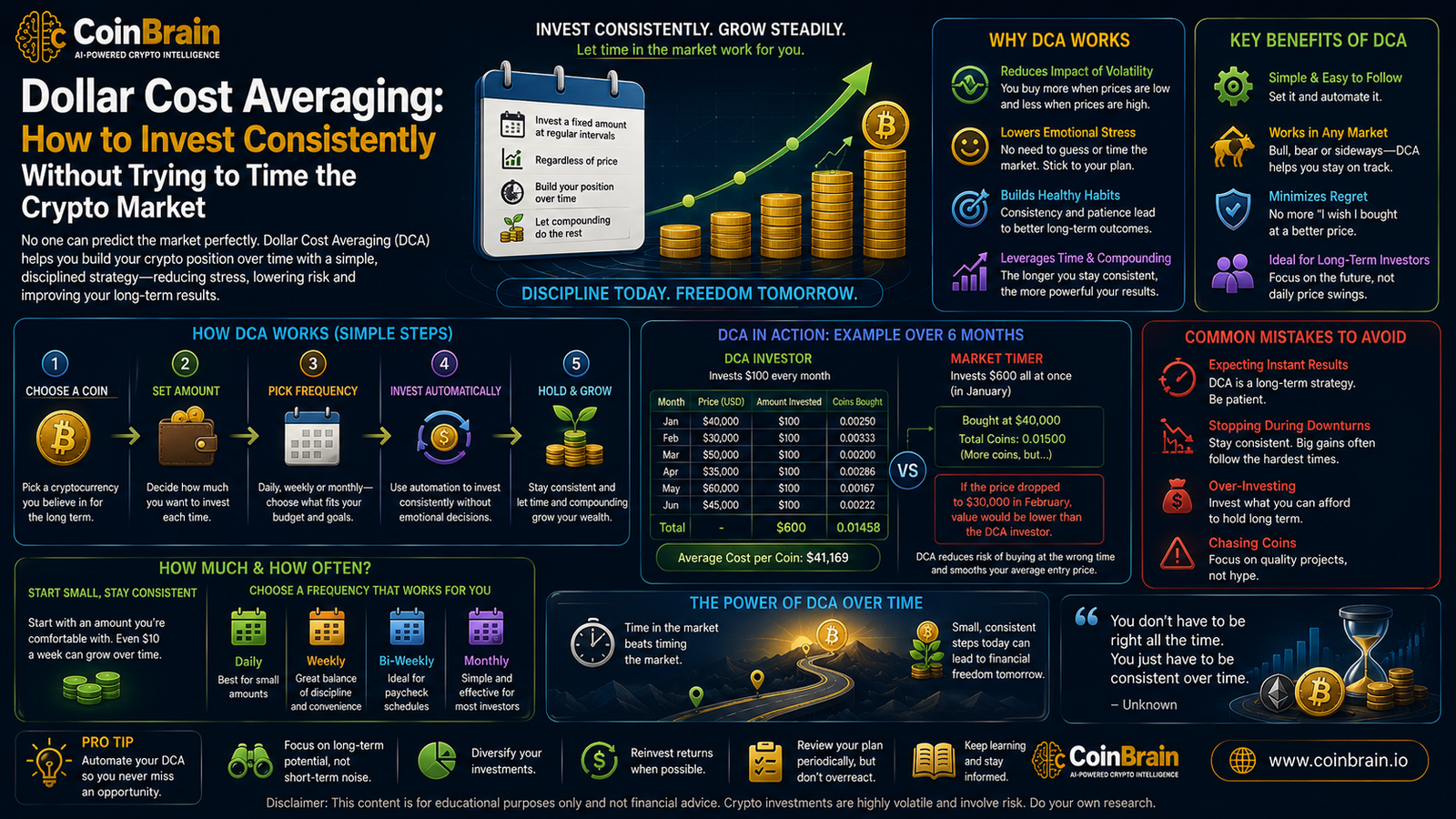

Dollar Cost Averaging: How to Invest Consistently Without Trying to Time the Crypto Market
CoinBrain Research Articles | Crypto Investing Basics — Article 09
Updated: August 2026
Imagine two investors.
The first has $12,000 available to invest in Bitcoin.
He spends weeks trying to answer one question:
“Is today the perfect time to buy?”
Bitcoin rises.
He waits for a correction.
It rises again.
He becomes afraid of missing out and eventually invests the entire amount after a large rally.
The second investor takes a different approach.
Instead of trying to predict the perfect entry price, she decides to invest:
$1,000 every month for 12 months.
Some purchases occur when Bitcoin is expensive.
Others occur after corrections.
She accepts from the beginning that she cannot consistently identify the market bottom.
This strategy is called:
Dollar Cost Averaging — DCA
Despite the name, the concept is not limited to US dollars.
An investor could invest:
- CHF 200 every month
- €500 every month
- £100 every week
The defining characteristic is not the currency.
It is the consistent investment of a predetermined amount at regular intervals regardless of short-term market movements.
DCA does not guarantee profits.
It does not prevent losses.
And it does not automatically outperform investing a lump sum.
Its primary advantage is different:
DCA reduces the investor’s dependence on making one perfectly timed entry decision.
For volatile assets such as cryptocurrency, that can be psychologically and strategically valuable.
Educational Notice: This article is for educational and research purposes only. It does not constitute financial, investment, tax, or legal advice. Dollar cost averaging does not guarantee profits or protect against losses. Cryptocurrency investments can experience substantial and prolonged declines, including complete loss of capital in individual assets.
1. Executive Summary
Dollar Cost Averaging is an investment strategy in which an investor commits a fixed amount of money to an asset at predetermined intervals, regardless of the asset’s current price.
For example:
$500 every month into Bitcoin
rather than:
$6,000 invested all at once.
When the asset price is high, the fixed contribution purchases fewer units.
When the price is low, the same contribution purchases more units.
Consider:
| Month | Bitcoin Price | Investment | BTC Purchased |
|---|---|---|---|
| January | $100,000 | $1,000 | 0.0100 |
| February | $80,000 | $1,000 | 0.0125 |
| March | $50,000 | $1,000 | 0.0200 |
| April | $75,000 | $1,000 | 0.0133 |
The investor does not need to decide:
“Is $50,000 the bottom?”
The investment plan already determines the action.
DCA can therefore reduce:
- market-timing risk
- emotional decision-making
- FOMO
- hesitation
- dependence on short-term forecasts
However, DCA cannot solve:
- poor asset selection
- excessive portfolio allocation
- bad tokenomics
- project failure
- custody risk
- permanent capital loss
The strategy determines:
when and how capital is deployed.
It does not determine:
whether the underlying investment is good.
That distinction is fundamental.
2. Key Takeaways
1. DCA means investing consistently
A predetermined amount is invested at regular intervals.
For example:
$250 every month.
2. DCA reduces dependence on market timing
The investor does not need to identify the exact bottom.
3. Lower prices automatically buy more units
When price falls, the same monetary contribution purchases more of the asset.
4. Higher prices automatically buy fewer units
This creates a disciplined accumulation mechanism.
5. DCA does not guarantee profit
If an asset declines permanently, regularly buying it can simply produce larger losses.
6. DCA works best when the underlying long-term thesis remains valid
The strategy should not become an excuse to continue buying a fundamentally broken asset.
7. DCA can reduce emotional investing
It can help prevent:
FOMO buying after rallies
and:
paralysis during corrections.
8. DCA and diversification solve different problems
DCA diversifies entry timing.
Portfolio diversification spreads asset exposure.
Both can be used together.
9. DCA and lump-sum investing are not the same
DCA spreads available capital over time.
Lump-sum investing deploys capital immediately.
Each has different tradeoffs.
10. DCA is particularly compatible with recurring income
Investors receiving monthly salaries can allocate a predetermined amount after each payday.
11. Fees matter
Very frequent small purchases can create unnecessary transaction costs depending on the platform.
12. DCA should be reviewed periodically
Automation should create discipline—not eliminate thinking.
3. Market Overview
Why Market Timing Is Difficult
Every investor would prefer to:
Buy at the Bottom
and:
Sell at the Top.
The problem is that bottoms and tops become obvious mainly in hindsight.
Consider a cryptocurrency falling from:
$100
to:
$70.
Is $70:
a bargain
or:
the beginning of a fall to $30?
Nobody knows with certainty.
Now suppose it rises from:
$70
to:
$90.
Is that:
a new bull market
or:
a temporary recovery before another decline?
Again, certainty is impossible.
The Emotional Market-Timing Cycle
Without a predefined strategy, investors frequently behave like this:
Price Falls
↓
“This looks dangerous. I’ll wait.”
↓
Price Recovers
↓
“I missed the bottom.”
↓
Price Rises Further
↓
“I don’t want to miss the rally.”
↓
FOMO Purchase
↓
Market Corrects
↓
“I bought at the wrong time.”
This is precisely the behavioral problem DCA attempts to reduce.
What DCA Changes
With a DCA plan:
Price Falls → Scheduled Purchase
Price Rises → Scheduled Purchase
Market Becomes Boring → Scheduled Purchase
The strategy replaces repeated emotional decisions with a predetermined process.
DCA Is Not Unique to Crypto
Dollar cost averaging has existed in traditional investing for decades.
Many retirement and savings systems naturally resemble DCA.
Workers receive salaries periodically and make recurring contributions into investment accounts.
Crypto simply applies the same principle to digital assets.
Why Crypto Makes DCA Attractive
Crypto markets are especially suitable for discussing DCA because they exhibit:
- high volatility
- continuous trading
- large drawdowns
- rapid sentiment changes
- difficult market timing
Instead of treating volatility entirely as an enemy, a DCA investor can use lower prices to accumulate more units with the same contribution.
But this only helps when the asset ultimately retains or increases long-term value.
4. Technology Deep Dive
How DCA Works Mathematically
Suppose an investor contributes:
$1,000 per month
for six months.
Prices are:
| Month | Asset Price | Investment | Units Purchased |
|---|---|---|---|
| 1 | $100 | $1,000 | 10.00 |
| 2 | $80 | $1,000 | 12.50 |
| 3 | $50 | $1,000 | 20.00 |
| 4 | $40 | $1,000 | 25.00 |
| 5 | $60 | $1,000 | 16.67 |
| 6 | $75 | $1,000 | 13.33 |
Total invested:
$6,000
Total units accumulated:
approximately 97.50
Average acquisition cost:
$6,000 ÷ 97.50
≈ $61.54 per unit
Notice something important.
The simple average of the six market prices is:
($100 + $80 + $50 + $40 + $60 + $75) ÷ 6
≈ $67.50
But the investor’s average cost is approximately:
$61.54
Why?
Because the fixed investment purchased more units when prices were lower.
DCA Does Not Always Lower Your Average Cost
This is important.
Suppose price rises every month:
| Month | Price |
|---|---|
| 1 | $50 |
| 2 | $60 |
| 3 | $70 |
| 4 | $80 |
| 5 | $90 |
| 6 | $100 |
In this situation, investing the entire amount at:
$50
would have produced a better outcome than spreading purchases across progressively higher prices.
Therefore:
DCA is not mathematically guaranteed to outperform lump-sum investing.
Its primary benefit is reducing timing dependence and behavioral risk.
DCA vs Lump-Sum Investing
Suppose an investor receives:
$12,000 today.
Strategy A — Lump Sum
Invest all:
$12,000 immediately.
Strategy B — DCA
Invest:
$1,000 per month for 12 months.
Which strategy wins?
It depends on what the market does afterward.
Scenario A — Market Rises Continuously
Lump sum usually benefits because more capital participates in the rise earlier.
Scenario B — Market Falls Sharply
DCA may benefit because later contributions purchase assets at lower prices.
Scenario C — Volatile Sideways Market
Results depend on the exact path of prices.
This illustrates the central tradeoff:
Lump Sum maximizes time in the market.
DCA reduces entry-timing concentration.
DCA from Income vs DCA from Existing Cash
These situations are often confused.
Investor A
Receives salary every month and invests:
$500
after payday.
This is naturally recurring investment.
The investor does not already possess all future contributions.
Investor B
Already has:
$12,000
but intentionally invests only:
$1,000 monthly.
Investor B is making an explicit market-deployment decision.
The remaining money stays uninvested while waiting.
This distinction matters when comparing DCA with lump-sum investing.
Frequency
Possible DCA schedules include:
- daily
- weekly
- biweekly
- monthly
- quarterly
There is no universally optimal frequency.
The schedule should consider:
- income timing
- transaction fees
- convenience
- investment horizon
For many long-term investors, excessively frequent purchasing adds complexity without necessarily creating meaningful advantages.
Automated DCA
Many crypto platforms allow recurring purchases.
Conceptually:
Bank Account
↓
Scheduled Transfer
↓
Exchange
↓
Automatic Purchase
↓
Crypto Position
Automation reduces the temptation to alter the strategy based on short-term emotions.
However, automated purchases should still be monitored for:
- fees
- account security
- platform risk
- portfolio allocation
5. Current Industry Landscape
DCA has become one of the most common long-term crypto accumulation strategies, particularly for Bitcoin and other established digital assets.
Its popularity reflects several characteristics of modern crypto markets.
24/7 Markets
Crypto never closes.
Trying to identify the perfect purchase moment across a continuously operating global market can become psychologically exhausting.
DCA simplifies the process.
Institutional Accessibility
Crypto exposure increasingly exists through multiple structures:
- direct spot ownership
- regulated exchange-traded products
- institutional custody
- managed investment products
This makes systematic allocation possible through both crypto-native and traditional financial infrastructure.
Bitcoin as a DCA Asset
Bitcoin is frequently associated with DCA because its investment thesis is relatively straightforward compared with many application tokens:
- fixed maximum supply
- predictable monetary issuance
- large global liquidity
- long operating history relative to other cryptocurrencies
This does not make Bitcoin risk-free.
It simply makes its long-term economic thesis easier to define than many speculative tokens.
DCA into Altcoins
DCA can also be used with altcoins.
But the risks are significantly different.
Suppose an investor systematically buys a token for three years.
If the project:
- loses developers
- loses users
- suffers major dilution
- becomes technologically obsolete
DCA does not rescue the investment.
Instead, it repeatedly allocates additional capital to a deteriorating asset.
This leads to one of the most important rules in this article:
Automate the purchase schedule—not the investment thesis.
Market Cycles
As discussed in Article 07, crypto moves through periods of:
Accumulation
↓
Expansion
↓
Euphoria
↓
Decline
↓
Capitulation
A disciplined DCA strategy can reduce the temptation to abandon investing during periods when sentiment is weakest.
But investors should still distinguish:
Market decline
from:
Project failure.
6. Institutional Activity
Institutions rarely describe their strategies simply as DCA.
But many professional investment processes use conceptually similar techniques.
These include:
- phased deployment
- systematic allocation
- scheduled rebalancing
- execution algorithms
- periodic contributions
Why Institutions Avoid Large Market Impact
Imagine a fund wants to acquire:
$500 million
of a cryptocurrency.
Purchasing everything immediately could:
- move the market
- increase execution costs
- reveal trading intentions
Instead, professional execution may divide the order across:
- time
- venues
- price levels
This is not identical to retail DCA, but the principle of avoiding one concentrated execution point is related.
Systematic Investment
Institutional investors often prefer predefined rules because rules reduce discretionary emotional decisions.
Examples include:
Allocate X% monthly
or:
Rebalance quarterly
or:
Increase allocation when portfolio weight falls below target.
The broader lesson for retail investors is valuable:
A repeatable process is often more robust than repeated prediction.
Retirement Investing
Traditional retirement investing provides perhaps the clearest institutionalized example of recurring investment.
Employees contribute regularly throughout:
- bull markets
- corrections
- recessions
- recoveries
This approach recognizes that long-term wealth building does not necessarily require predicting every market cycle.
7. Market Data & Metrics
A DCA strategy should still be measured.
Useful metrics include:
1. Total Capital Invested
Track cumulative contributions.
Example:
$500 × 24 months = $12,000
2. Total Units Accumulated
For Bitcoin:
Total BTC acquired
For Ethereum:
Total ETH acquired
This can be more informative than focusing only on short-term portfolio value.
3. Average Acquisition Cost
Formula:
Average Cost = Total Amount Invested ÷ Total Units Acquired
Example:
Total invested:
$10,000
Bitcoin accumulated:
0.125 BTC
Average cost:
$80,000 per BTC
4. Current Portfolio Value
Formula:
Units Held × Current Market Price
5. Unrealized Return
Formula:
Current Value − Total Cost
6. Portfolio Allocation
DCA can accidentally create concentration.
Suppose an investor automatically buys Bitcoin monthly while other assets remain unchanged.
Eventually Bitcoin may become:
80% of the portfolio.
The investor should evaluate whether this still matches the intended allocation.
7. Contribution Rate
How much is being invested relative to:
- income
- savings
- total portfolio
DCA should remain financially sustainable.
8. Fees
Suppose an exchange charges:
1%
per purchase.
An investor contributes:
$500 monthly.
Fee:
$5
Over:
36 months
total fees could reach:
$180
before considering spreads or withdrawal costs.
Fees deserve attention.
9. Spread
A platform may advertise:
zero commission
while embedding cost in the difference between buying and selling prices.
Evaluate:
Total Execution Cost
rather than commission alone.
10. Benchmark Comparison
An investor can compare DCA performance against:
- lump-sum investment
- Bitcoin
- broader crypto portfolio
- traditional investment benchmark
The purpose is not necessarily to outperform every benchmark.
It is to understand what the strategy is achieving.
8. Real-World Use Cases
Use Case 1 — Monthly Salary Investor
Sara earns a salary each month.
After:
- living expenses
- emergency savings
- other investments
she decides she can allocate:
CHF 300 monthly
to crypto.
Instead of attempting to predict Bitcoin’s monthly price, she purchases according to a predefined schedule.
Use Case 2 — Entering After a Large Rally
An investor becomes interested in Bitcoin after a major price increase.
He has:
$10,000
but worries about investing everything near a market high.
He decides to deploy:
$1,000 monthly
for ten months.
This reduces the consequence of one badly timed entry.
Use Case 3 — Bear Market Accumulation
Prices decline for months.
Without a plan, an investor may stop buying because sentiment is negative.
With DCA, lower prices automatically result in more units being accumulated.
Again, this only makes sense if the long-term thesis remains intact.
Use Case 4 — Combining DCA with Portfolio Allocation
Suppose monthly investment is:
$1,000
Target crypto allocation:
Bitcoin — 60%
Ethereum — 25%
Selected Growth Assets — 10%
Liquidity — 5%
Monthly contributions can follow these target weights.
Use Case 5 — DCA Plus Rebalancing
After one year:
Bitcoin performs strongly.
Portfolio becomes:
BTC — 75%
ETH — 17%
Others — 8%
Instead of selling Bitcoin immediately, an investor could temporarily direct more new contributions toward underweight allocations.
This is sometimes called:
cash-flow rebalancing.
Use Case 6 — Automated Investing
An investor schedules:
€200 every second Monday
into Bitcoin.
The purchase occurs regardless of:
- headlines
- social-media predictions
- short-term market volatility
Automation enforces discipline.
Use Case 7 — Building a Long-Term Position
Someone who believes blockchain assets will play a larger economic role over the next decade may use recurring investments to gradually build exposure rather than making one large speculative bet.
9. Risks & Challenges
DCA is simple.
It is not risk-free.
1. DCA into a Bad Asset
This is the greatest misconception.
Imagine a token falls:
$100 → $50 → $20 → $5 → $1
An investor says:
“Great. My average cost keeps falling.”
But if the project eventually becomes worthless:
average cost is irrelevant.
Repeatedly buying a failing asset is not disciplined investing.
2. Confusing Price Decline with Value
A lower price does not automatically mean better value.
Ask:
Why did the price fall?
Possible reasons include:
- broad market correction
- project exploit
- token dilution
- declining users
- regulatory action
- failed technology
The cause matters.
3. Opportunity Cost
When an investor already has capital but deploys it gradually, the uninvested portion may earn little while the market rises.
This is the central cost of DCA relative to immediate investment.
4. Excessive Fees
Daily small purchases can become expensive.
5. Over-Automation
Investors can become so committed to automation that they stop evaluating fundamentals.
A recurring investment should be reviewed.
6. Increasing Contributions During FOMO
An investor begins with:
$200 monthly.
After prices triple:
“I’ll increase it to $2,000 because crypto is obviously going higher.”
This destroys much of the behavioral discipline DCA was supposed to provide.
7. Stopping During Bear Markets
The opposite mistake occurs when:
$200 monthly
becomes:
$0
after prices decline 60%.
If the thesis remains valid, stopping only because sentiment is negative contradicts the strategy.
8. DCA Does Not Control Portfolio Size
An investor can consistently DCA too much money into crypto.
Risk management still determines:
how much total exposure is appropriate.
9. Stable Income Assumption
A monthly DCA plan must remain affordable.
If financial circumstances change, contributions should be reconsidered.
Investing should not compromise essential expenses or emergency reserves.
10. Tax Complexity
Depending on jurisdiction, recurring purchases create multiple acquisition lots with different cost bases.
Accurate records may therefore become important when assets are later sold.
10. Future Outlook: 3–5 Years
Systematic crypto investing is likely to become increasingly mainstream.
Automated Crypto Savings
Investment platforms may increasingly offer:
Salary → Automated Allocation → Diversified Portfolio
with configurable percentages.
ETF-Based Recurring Investment
Regulated crypto investment products can make recurring allocation accessible through conventional brokerage and retirement infrastructure.
AI-Assisted DCA
AI systems may help investors monitor whether recurring purchases remain aligned with:
- portfolio allocation
- risk tolerance
- market exposure
- investment thesis
The system might say:
“Your recurring purchases have increased crypto from 15% to 27% of your portfolio.”
That is useful.
But an AI should not transform disciplined DCA into constant speculative market timing.
Dynamic Contributions
Some investors may adopt rule-based variations.
For example:
Base Contribution = $500
with additional investment after predefined portfolio or valuation conditions.
This is sometimes called:
Value Averaging
or:
Dynamic DCA
depending on the methodology.
It is more complex than traditional DCA.
Tokenized Investment Portfolios
As tokenization develops, recurring investment could eventually include portfolios containing:
- Bitcoin
- tokenized bonds
- tokenized funds
- stablecoins
- other blockchain-native assets
DCA may therefore evolve from:
buying crypto regularly
into:
automated blockchain-based portfolio accumulation.
Greater Integration with Personal Finance
The strongest future DCA systems may integrate:
Income
↓
Emergency Savings
↓
Debt Management
↓
Investment Allocation
↓
Portfolio Rebalancing
rather than treating crypto as an isolated financial activity.
11. Investment & Business Implications
A disciplined DCA framework can be constructed step by step.
Step 1 — Establish Financial Capacity
Before investing, ensure money required for:
- living expenses
- emergencies
- short-term obligations
is not being placed into highly volatile assets.
Step 2 — Determine Total Crypto Allocation
Suppose total investment portfolio is:
$50,000
and an investor decides crypto should represent:
10%.
Target crypto exposure:
$5,000
DCA determines how the $5,000 is deployed.
It does not determine whether 10% is appropriate.
That comes from risk management.
Step 3 — Select the Asset
DCA should begin with an investment thesis.
Ask:
Why do I want to own this asset for several years?
For Bitcoin, the thesis might involve:
- digital scarcity
- monetary properties
- institutional adoption
For Ethereum:
- smart-contract infrastructure
- staking
- network usage
For another token, the thesis may be entirely different.
Write it down.
Step 4 — Define the Contribution
Example:
CHF 250 per month
The amount should be sustainable through both:
bull markets
and:
bear markets.
Step 5 — Choose Frequency
Possible:
Weekly
Biweekly
Monthly
For many salary-based investors:
monthly
is operationally simple.
Step 6 — Choose the Purchase Date
For example:
First working day after salary payment.
The objective is not to identify a historically magical date.
It is to create consistency.
Step 7 — Automate Carefully
Automation can remove emotion.
But maintain:
- account security
- sufficient cash
- transaction monitoring
Step 8 — Track Average Cost
Maintain records of:
- date
- amount
- price
- quantity
- fees
This supports both performance analysis and tax recordkeeping.
Step 9 — Review the Thesis
For example:
Quarterly
or:
Every Six Months
Ask:
- Is adoption progressing?
- Has technology changed?
- Has regulation materially changed?
- Has tokenomics deteriorated?
- Has the original thesis been invalidated?
Step 10 — Review Portfolio Weight
Suppose crypto target:
15%
Bull market pushes it to:
35%.
Continuing the same DCA without considering portfolio risk may no longer be appropriate.
Risk management overrides automation.
Step 11 — Define an Exit Philosophy
DCA explains how to enter.
It does not explain how to exit.
Possible strategies include:
- long-term holding
- rebalancing
- partial profit-taking
- thesis-based exit
- goal-based withdrawal
An investor should eventually define this separately.
Step 12 — Do Not Check Every Hour
One advantage of systematic investing is reducing unnecessary attention to short-term price movements.
A long-term DCA strategy combined with constant hourly portfolio checking defeats part of its psychological benefit.
A Beginner Example
Suppose Ahmed wants to build crypto exposure over five years.
Available monthly investment:
$400
He creates:
Bitcoin
$240 — 60%
Ethereum
$120 — 30%
Selected Higher-Risk Asset
$40 — 10%
Monthly contribution:
$400
Annual contribution:
$4,800
Five-year contributions, assuming unchanged amounts:
$24,000
But Ahmed does not simply run the strategy blindly for five years.
Every six months he reviews:
- investment thesis
- portfolio weights
- personal finances
- asset fundamentals
Suppose the higher-risk project fails fundamentally after two years.
Ahmed stops buying it.
That is not breaking DCA discipline.
It is recognizing that:
DCA is an execution strategy—not a substitute for investment analysis.
DCA During Different Market Conditions
Bear Market
Emotion says:
“Stop buying.”
DCA says:
“Follow the plan if the thesis remains intact.”
Early Bull Market
Emotion says:
“Invest everything now.”
DCA says:
“Follow the plan.”
Euphoria
Emotion says:
“Double the contribution!”
DCA says:
“Follow the plan and review portfolio risk.”
Crash
Emotion says:
“Sell everything.”
DCA says:
“Reassess the thesis before reacting.”
This illustrates why DCA is partly a behavioral system.
CoinBrain DCA Checklist
Before starting a recurring investment strategy, answer:
Financial Capacity
- Can I afford this contribution consistently?
- Is my emergency reserve separate?
Asset
- Why am I investing in this asset?
- Is the long-term thesis understandable?
Allocation
- What percentage of my total portfolio will crypto represent?
Amount
- How much will I invest each period?
Frequency
- Weekly, biweekly or monthly?
Costs
- What are the fees and spreads?
Custody
- Where will accumulated assets be stored?
Review
- How often will I reassess fundamentals?
Rebalancing
- What happens if crypto becomes too large a percentage of my portfolio?
Exit
- Under what circumstances will I reduce or stop the position?
If these questions have clear answers, DCA becomes a strategy rather than simply an automatic purchase.
Business Implications
Recurring investment is also commercially important for crypto platforms.
Exchanges, brokers, wallets and fintech companies can build services around:
- recurring purchases
- automated portfolio allocation
- savings plans
- automatic rebalancing
- tax reporting
- portfolio analytics
The business opportunity is larger than simply encouraging more trading.
A platform focused on long-term financial behavior could help users create:
Goals
↓
Risk Profile
↓
Target Allocation
↓
Recurring Contributions
↓
Portfolio Monitoring
↓
Rebalancing
This represents a transition from:
crypto trading platforms
toward:
digital-asset wealth-management platforms.
12. Final Analysis
Dollar Cost Averaging is powerful because it accepts an uncomfortable truth:
You probably will not consistently know the perfect time to buy.
Instead of trying to eliminate uncertainty, DCA creates a process that can operate within uncertainty.
The strategy replaces:
Prediction
with:
Consistency.
It replaces:
“Is today the bottom?”
with:
“Is my long-term investment thesis still valid?”
That is a much more useful question.
But DCA should not be romanticized.
It cannot turn:
a bad project
into:
a good investment.
It cannot protect against:
- permanent project failure
- fraud
- catastrophic token dilution
- lost private keys
- excessive portfolio concentration
DCA works best as one component of a broader framework:
Research
↓
Risk Management
↓
Asset Selection
↓
Portfolio Allocation
↓
Dollar Cost Averaging
↓
Periodic Review
↓
Rebalancing
The greatest benefit may ultimately be psychological.
Crypto markets repeatedly encourage investors to make emotional decisions.
During rallies:
“Buy before it is too late.”
During crashes:
“Sell before everything goes to zero.”
DCA creates a third response:
“Follow the process.”
For long-term investors, that discipline can be extremely valuable.
The objective is not to buy every bottom.
The objective is not to avoid every market top.
The objective is to build exposure gradually while remaining financially capable of continuing the strategy through changing market conditions.
The core principle is:
You do not need to predict every market move to build a disciplined investment portfolio.
Sometimes consistency is more valuable than prediction.
13. References & Further Reading
Investor.gov — U.S. Securities and Exchange Commission
Dollar Cost Averaging
Investor education resources describe dollar cost averaging as investing equal portions of money at regular intervals regardless of market movements.
FINRA
Investment Fundamentals
Educational resources covering long-term investing, diversification, risk tolerance and disciplined investment practices.
Vanguard
Dollar-Cost Averaging vs Lump-Sum Investing
Research and investor education comparing immediate capital deployment with gradual investment and explaining the opportunity-cost tradeoff involved in holding capital outside the market.
Fidelity
Dollar-Cost Averaging
Investor education discussing recurring investment, behavioral discipline and the limitations of systematic investing.
Bitcoin.org
Bitcoin Fundamentals
Background information on Bitcoin’s supply, network and monetary structure for investors researching the underlying asset before implementing an accumulation strategy.
Ethereum.org
Ethereum and ETH
Official educational resources explaining Ethereum, ETH utility, staking and the network’s economic architecture.
Concepts for Further Study
Readers progressing beyond the fundamentals should investigate:
- dollar cost averaging
- lump-sum investing
- market timing
- recurring investment
- average cost basis
- value averaging
- portfolio allocation
- portfolio rebalancing
- volatility
- opportunity cost
- risk tolerance
- time horizon
- compound returns
- behavioral finance
- FOMO
- loss aversion
- investment automation
- crypto custody
- investment fees
- portfolio drift
CoinBrain Crypto Investing Basics
Article 01 — How to Start Investing in Crypto
Article 02 — Spot vs Futures: Understanding the Difference Before You Trade
Article 03 — What Is Staking? How Crypto Can Earn Rewards While Securing a Blockchain
Article 04 — What Is Yield Farming? Understanding How DeFi Investors Earn Yield—and the Risks Behind It
Article 05 — What Is DeFi? Understanding Decentralized Finance and the Future of Financial Services
Article 06 — What Is Tokenomics? Understanding Supply, Demand, Utility and What Gives a Crypto Token Value
Article 07 — Understanding Crypto Market Cycles: Why Bull Markets, Bear Markets and Altcoin Seasons Happen
Article 08 — Crypto Risk Management: How to Protect Your Capital Before Chasing Returns
Article 09 — Dollar Cost Averaging: How to Invest Consistently Without Trying to Time the Crypto Market
Next Article
Article 10 — Crypto Portfolio Diversification: How to Build a Balanced Portfolio Without Simply Buying More Coins
CoinBrain Research Articles
Research. Understand. Decide.
Leave a Reply
You must be logged in to post a comment.