
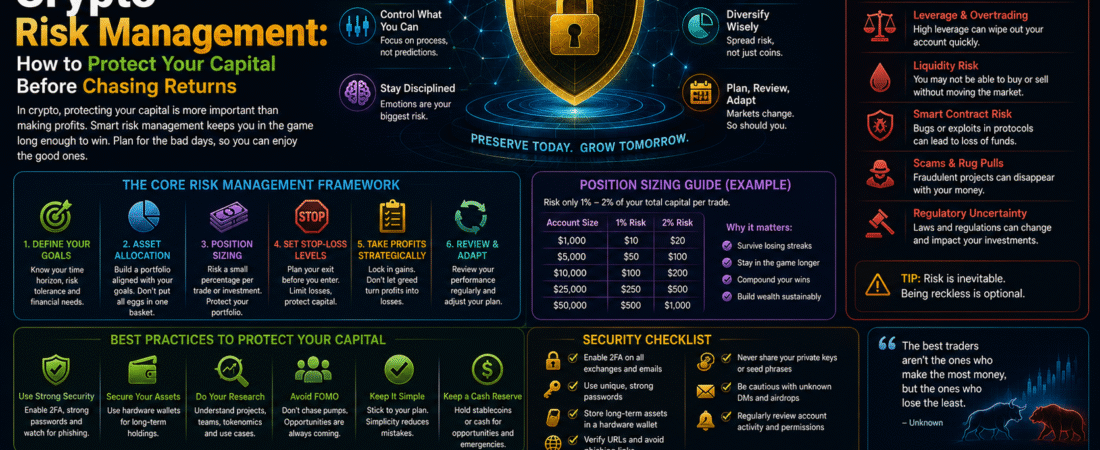

Crypto Risk Management: How to Protect Your Capital Before Chasing Returns
CoinBrain Research Articles | Crypto Investing Basics — Article 08
Updated: August 2026
Most new investors enter crypto thinking first about returns.
They ask:
Which coin can double?
Which project could 10×?
When is the next bull market?
But experienced investors often begin with a different question:
How much could I lose if I am wrong?
That distinction is the foundation of risk management.
Crypto is a highly volatile asset class.
Prices can move sharply within hours.
Projects can fail.
Smart contracts can be exploited.
Exchanges can become insolvent.
Stablecoins can lose their peg.
Leverage can trigger liquidation.
Regulations can change.
Even technically strong projects can experience devastating drawdowns.
This means that investment success is not simply about finding opportunities.
It is also about surviving mistakes.
A powerful investment idea with poor risk management can still destroy a portfolio.
A modest strategy with disciplined risk management can survive long enough to benefit from future opportunities.
The central principle is therefore simple:
Protect capital first. Pursue returns second.
Educational Notice: This article is for educational and research purposes only. It does not constitute financial, investment, tax, or legal advice. Cryptocurrency investing can result in partial or total loss of capital. Investors should consider their personal financial circumstances and risk tolerance before making investment decisions.
1. Executive Summary
Risk management is the process of identifying, measuring, limiting and monitoring the potential losses associated with an investment.
In crypto, effective risk management can include:
- limiting overall crypto exposure
- controlling individual position sizes
- avoiding excessive leverage
- diversifying across assets and risk factors
- maintaining liquidity
- securing wallets and accounts
- understanding counterparty risk
- monitoring token unlocks
- planning exits
- rebalancing portfolios
- separating long-term investments from speculative trades
The goal is not to eliminate risk.
That is impossible.
The goal is to avoid taking unnecessary, concentrated or poorly understood risk.
A useful framework is:
Risk Capacity + Risk Tolerance + Position Size + Diversification + Security + Exit Discipline
A disciplined investor should know before entering a position:
How much am I investing?
Why am I buying it?
What could make the thesis fail?
How much loss can I tolerate?
What would cause me to exit?
What percentage of my total portfolio does this represent?
These questions are more important than predicting whether a token rises tomorrow.
2. Key Takeaways
1. Capital preservation comes before return maximization
If a portfolio loses 80%, it requires a 400% gain to return to its original value.
Avoiding catastrophic losses matters enormously.
2. Position size determines risk
A bad investment representing 2% of a portfolio is manageable.
The same bad investment representing 70% of a portfolio can be devastating.
3. Diversification reduces concentration risk
Holding several assets can reduce dependence on one project.
But holding 30 highly correlated altcoins is not necessarily true diversification.
4. Leverage magnifies losses
Leverage reduces the amount of adverse market movement a position can survive.
5. Volatility and risk are related but not identical
An asset can be volatile yet fundamentally strong.
Another asset can appear stable until a structural failure occurs.
Risk analysis must go beyond price movement.
6. Liquidity matters
You need to be able to exit a position when necessary.
Illiquid assets can create losses even when quoted prices appear attractive.
7. Counterparty risk matters
If assets are held on an exchange or through another intermediary, your investment depends partly on that organization’s solvency and operational integrity.
8. Security is part of portfolio management
Wallet security, authentication and seed-phrase protection are investment risks—not merely technical concerns.
9. A high expected return does not justify unlimited position size
Even strong investment ideas can fail.
10. Risk management should be defined before emotions become intense
Plans created during panic or euphoria are often poor plans.
11. The objective is not to avoid every loss
Losses are normal.
The objective is to prevent any single mistake from becoming catastrophic.
12. Survival creates optionality
If you retain capital, you can participate in future opportunities.
If you lose everything, the opportunity set becomes irrelevant.
3. Market Overview
Why Crypto Requires Stronger Risk Management
All investing involves uncertainty.
Crypto adds several characteristics that make disciplined risk management especially important.
High Volatility
Crypto assets can experience large short-term price movements.
A major asset may fall:
10%
or:
20%
during periods that traditional investors would already consider highly volatile.
Smaller assets can move much more.
Rapid Market Cycles
Crypto market conditions can shift quickly.
A strong bull market can become a severe correction within days.
24/7 Trading
Crypto markets do not close every evening.
Trading continues:
- overnight
- on weekends
- during holidays
This means risk can change while an investor is away from the market.
High Speculation
Many assets trade largely on:
- narratives
- momentum
- social media
- expectations
rather than proven economic fundamentals.
Limited Operating History
Bitcoin itself is still relatively young compared with traditional asset classes.
Many crypto projects have existed for only a few years.
Technology Risk
Crypto investments frequently depend on:
- blockchain software
- smart contracts
- bridges
- wallets
- oracles
- validators
Failure in any of these systems can create losses.
Counterparty Risk
Investors may interact with:
- exchanges
- custodians
- stablecoin issuers
- lending platforms
Each introduces external dependencies.
Regulatory Risk
Rules around crypto assets continue evolving across jurisdictions.
This can affect:
- trading
- custody
- staking
- taxation
- token classification
- exchange access
Tokenomics Risk
Future token supply can materially affect investment outcomes.
Unlocks, inflation and emissions can create selling pressure even if project fundamentals remain unchanged.
This is why crypto risk management must operate at multiple levels.
4. Technology Deep Dive
Understanding Risk Mathematically
Risk becomes easier to manage when translated into numbers.
Suppose you have:
$100,000 total investment capital
and invest:
$5,000
into a speculative token.
If that token goes to zero:
Portfolio loss:
5%
Painful, but survivable.
Now suppose you invest:
$60,000
into the same token.
If it fails:
Portfolio loss:
60%
The investment idea is identical.
The portfolio outcome is completely different.
The difference is:
Position Size
The Mathematics of Drawdowns
This is one of the most important ideas in investing.
Suppose you begin with:
$100,000
10% Loss
Portfolio:
$90,000
Required gain to recover:
11.1%
25% Loss
Portfolio:
$75,000
Required recovery:
33.3%
50% Loss
Portfolio:
$50,000
Required recovery:
100%
75% Loss
Portfolio:
$25,000
Required recovery:
300%
80% Loss
Portfolio:
$20,000
Required recovery:
400%
Losses and required recovery returns are not symmetrical.
This is why protecting against extreme drawdowns is so important.
Position Sizing
Position sizing answers:
How much capital should I allocate to this investment?
One simple framework is to classify assets by risk.
Core Assets
Relatively established crypto assets.
Potential portfolio allocation:
larger positions.
Growth Assets
Established but higher-risk projects.
Potential allocation:
moderate positions.
Speculative Assets
Early-stage, small-cap or highly uncertain projects.
Potential allocation:
small positions.
The actual percentages depend entirely on the investor.
The principle is what matters:
Higher uncertainty should normally correspond to smaller position size.
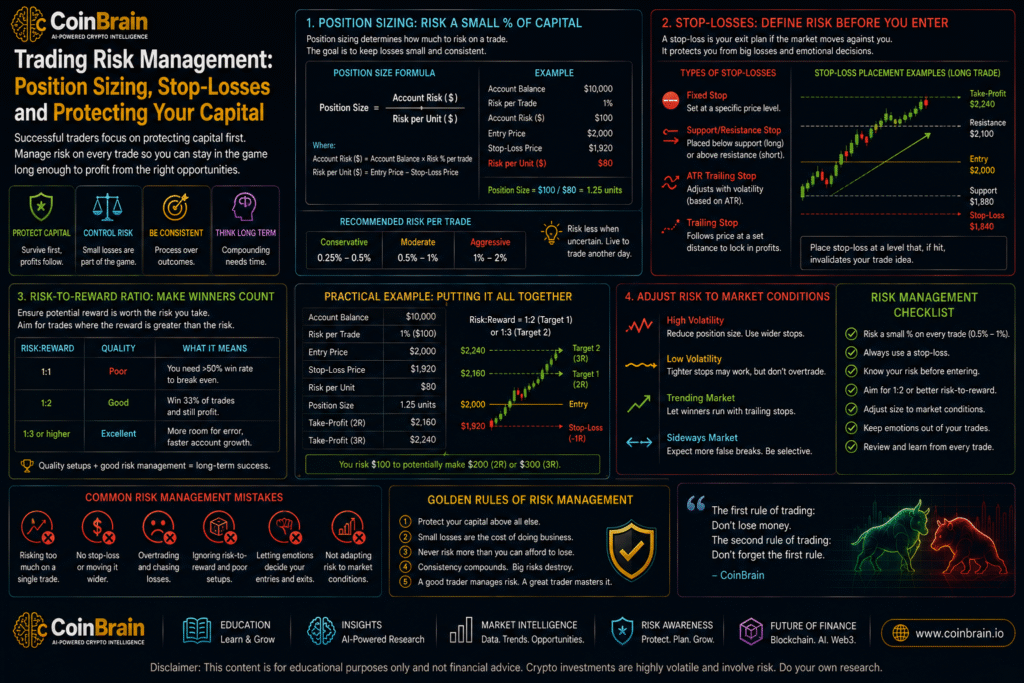
Risk Per Trade
Active traders frequently define risk before entering.
Suppose:
Portfolio:
$20,000
Maximum tolerated loss per trade:
1%
Maximum loss:
$200
If the planned entry and stop-loss imply a:
10%
potential price loss, position size might theoretically be:
$200 ÷ 10% = $2,000
This type of thinking reverses the common beginner process.
Instead of:
“I want to invest $5,000. Where should my stop be?”
the trader asks:
“I am willing to risk $200. What position size fits that risk?”
Stop-Loss Orders
A stop-loss attempts to exit a position after price reaches a predetermined level.
Example:
Buy:
$100
Stop:
$90
Maximum intended price decline:
approximately 10%
But stop-losses have limitations.
During extreme volatility:
- slippage may occur
- liquidity may disappear
- price may gap through the trigger
A stop-loss therefore manages risk but does not guarantee a precise loss amount.
Volatility-Based Positioning
A highly volatile asset generally requires smaller sizing if an investor wants to maintain similar portfolio-level risk.
Suppose:
Asset A typically moves:
2% per day
Asset B typically moves:
15% per day
Equal capital allocations do not produce equal risk.
This is why professional portfolio construction considers both:
Capital Weight
and:
Volatility.
Correlation
Diversification is effective when assets behave differently.
Suppose you hold:
- Bitcoin
- Ethereum
- Solana
- Avalanche
- Sui
You own five assets.
But during a major crypto selloff, all five may decline together.
That means diversification by token count does not necessarily equal diversification by risk.
5. Current Industry Landscape
Crypto risk management has matured substantially.
Early market participants often relied on simple buy-and-hold strategies or speculative trading.
Today’s ecosystem includes:
- institutional custodians
- derivatives markets
- portfolio analytics
- on-chain risk tools
- protocol audits
- proof-of-reserves initiatives
- professional market makers
- regulated investment products
But sophistication does not eliminate risk.
Exchange Risk
Centralized exchanges simplify access.
They can provide:
- custody
- liquidity
- trading
- fiat conversion
But investors surrender some control.
The principle:
Not Your Keys, Not Your Coins
refers to the fact that exchange-held crypto is controlled through the platform’s custody system rather than directly through the investor’s private keys.
This does not mean every investor must self-custody everything.
It means custody structure should be understood.
Self-Custody
Self-custody gives the investor greater control.
But responsibility also increases.
Risks include:
- lost private keys
- lost seed phrases
- phishing
- malicious smart-contract approvals
- physical loss of recovery backups
The risk shifts from:
Institutional Counterparty
toward:
Personal Operational Security.
DeFi Risk
DeFi introduces risks such as:
- smart-contract exploits
- liquidation
- oracle failures
- stablecoin depegging
- liquidity risk
- governance attacks
- bridge failures
These should be evaluated separately from simple token price volatility.
Stablecoin Risk
Stablecoins may appear safer because their price target is stable.
But they contain structural risks including:
- issuer risk
- reserve quality
- redemption
- smart-contract risk
- regulation
- depeg events
A portfolio holding:
50% stablecoins
is not automatically low-risk.
It depends on which stablecoins and where they are held.
Institutional Risk Controls
Professional crypto investors increasingly use frameworks familiar from traditional finance:
- position limits
- counterparty limits
- liquidity limits
- Value at Risk
- stress testing
- collateral controls
- custody segregation
- concentration limits
These tools reinforce an important principle:
Risk should be designed into the portfolio before the market moves.
6. Institutional Activity
Institutional investors generally think about crypto risk across several dimensions.
Market Risk
How much can asset prices decline?
Liquidity Risk
Can large positions be exited without moving the market?
Counterparty Risk
What happens if:
- exchange
- custodian
- broker
- stablecoin issuer
fails?
Custody Risk
Who controls the assets?
What happens if keys are compromised?
Operational Risk
Could losses arise from:
- incorrect transactions
- API failures
- system outages
- governance mistakes
Regulatory Risk
Could regulatory changes affect:
- access
- valuation
- custody
- taxation
Smart-Contract Risk
Institutional DeFi participation requires evaluation of:
- audits
- upgrade controls
- oracle dependencies
- governance
- exploit history
Why Institutions Use Derivatives
Derivatives are not only speculative instruments.
They can also reduce risk.
Suppose a fund holds:
$50 million Bitcoin
but wants to temporarily reduce market exposure.
Instead of selling Bitcoin, it might short Bitcoin futures.
Conceptually:
Long Spot Bitcoin
Short Bitcoin Futures
=
Reduced Net Bitcoin Exposure
This allows professional portfolios to adjust risk without necessarily disposing of underlying assets.
Portfolio Limits
Institutions often impose constraints such as:
No single asset > X%
No single exchange > Y%
No single stablecoin > Z%
These limits prevent one failure from becoming existential.
Retail investors can apply the same principle on a simpler scale.
7. Market Data & Metrics
Risk management requires measurement.
Important metrics include the following.
1. Portfolio Allocation
What percentage of your total portfolio is crypto?
Then ask:
What percentage of crypto is:
- Bitcoin
- Ethereum
- large-cap altcoins
- small-cap assets
- stablecoins
- DeFi positions
2. Maximum Drawdown
Maximum drawdown measures the largest decline from portfolio peak to subsequent low.
Formula:
Maximum Drawdown = (Trough − Peak) ÷ Peak
Example:
Peak:
$100,000
Low:
$60,000
Drawdown:
-40%
Understanding historical drawdowns helps investors evaluate whether their portfolio risk is realistic.
3. Volatility
Volatility measures the magnitude of price fluctuations.
Higher volatility generally means:
greater uncertainty of short-term outcomes.
4. Correlation
Correlation measures how closely assets move together.
If all portfolio assets have high positive correlation, diversification benefits are limited.
5. Liquidity
Useful measures include:
- daily trading volume
- order-book depth
- bid-ask spread
- slippage
6. Open Interest
High derivative open interest can indicate substantial leverage.
It becomes especially important when combined with extreme market sentiment.
7. Funding Rates
Extreme funding rates can indicate crowded positioning.
They can signal potential leverage risk.
8. Token Unlocks
Upcoming unlocks can introduce additional supply.
Monitor:
- quantity
- date
- recipient
- percentage of circulating supply
9. Stablecoin Exposure
Know:
- which stablecoin
- who issues it
- where it is deposited
- whether additional protocol risk exists
10. Counterparty Exposure
Calculate:
How much of my portfolio depends on one platform?
If 80% of assets sit on one exchange, that is concentration risk regardless of token diversification.
11. Smart-Contract Exposure
A portfolio may appear diversified across multiple tokens while all are deposited into the same DeFi protocol.
That protocol becomes a single point of failure.
12. Portfolio Concentration
A useful measure is simply:
Largest Position ÷ Total Portfolio
If one position represents:
65%
of the portfolio, its risk dominates everything else.
8. Real-World Use Cases
Risk management applies to nearly every crypto-investment decision.
Use Case 1 — Position Sizing
An investor believes strongly in a new Layer-1 token.
Instead of allocating:
50%
of the portfolio, the investor allocates:
5%.
If the project succeeds, the position can still contribute positively.
If it fails, the portfolio survives.
Use Case 2 — Diversification
Instead of holding:
100% one altcoin
an investor might diversify across:
- major assets
- growth assets
- speculative assets
- liquidity reserves
The objective is not simply to own more tokens.
It is to avoid dependence on one thesis.
Use Case 3 — Counterparty Diversification
An investor may distribute assets across:
- self-custody
- regulated exchange
- institutional custodian
rather than concentrating everything in one location.
Each method has tradeoffs.
Use Case 4 — Rebalancing
Suppose:
Bitcoin rises 100%.
Altcoins rise 200%.
A portfolio originally designed as:
60% BTC
25% ETH
15% Altcoins
might become heavily concentrated in altcoins.
Rebalancing restores the intended risk profile.
Use Case 5 — Stablecoin Reserves
Maintaining some liquidity can allow an investor to:
- meet expenses
- avoid forced selling
- buy during corrections
But stablecoin reserves themselves still require risk analysis.
Use Case 6 — Avoiding Excessive Leverage
A long-term investor can hold a volatile asset through temporary declines.
A highly leveraged trader may be liquidated first.
Avoiding unnecessary leverage increases portfolio survival probability.
Use Case 7 — Security Management
An investor uses:
- hardware wallets
- strong authentication
- separate email accounts
- transaction verification
This is risk management just as much as portfolio diversification.
9. Risks & Challenges
Risk management itself contains several common mistakes.
1. Overconfidence
One of the biggest risks is believing:
“I have done enough research. This project cannot fail.”
Every investment can fail.
Position sizing should reflect this.
2. Excessive Concentration
A portfolio may outperform dramatically when its largest position rises.
It can also collapse when that position fails.
3. False Diversification
Owning 20 speculative altcoins can create the illusion of diversification.
During market stress, they may all decline simultaneously.
4. Over-Diversification
The opposite can also occur.
Holding 100 tiny positions makes:
- monitoring difficult
- conviction unclear
- portfolio impact negligible
Diversification should be purposeful.
5. Leverage
Leverage converts normal volatility into liquidation risk.
For beginners, this deserves particular caution.
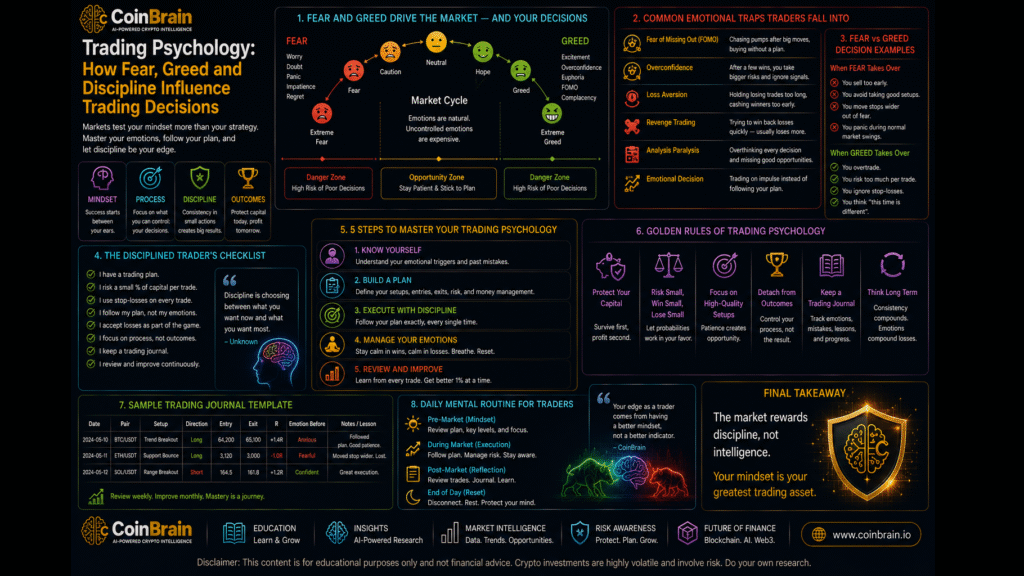
6. Emotional Position Sizing
Investors often increase positions after prices rise because confidence has increased.
This can produce:
larger position + worse entry price
at exactly the wrong time.
7. Revenge Trading
After losing money, some traders increase risk trying to recover quickly.
This often compounds losses.
8. Averaging Down Without Reassessment
Buying more after a decline can be reasonable.
But only if the thesis remains valid.
Ask:
Is the asset cheaper?
or:
Is the investment broken?
These are very different situations.
9. Ignoring Liquidity
Small tokens may display attractive prices but have insufficient market depth.
Selling can become difficult.
10. Ignoring Tax Obligations
Frequent trading can create tax consequences.
Poor tax planning can create unexpected liabilities.
11. Poor Security
A perfectly diversified portfolio is worthless if the wallet is compromised.
12. Yield Chasing
Investors may move assets into increasingly risky DeFi protocols to gain an additional:
2% or 5% APY
while introducing the possibility of a:
100% loss
This is a poor risk/reward trade unless the additional risk is understood.
13. Changing the Plan During Panic
Risk frameworks work best when designed before the crisis.
Do not invent risk rules when markets are collapsing.
10. Future Outlook: 3–5 Years
Crypto risk management is likely to become substantially more sophisticated.
Institutional-Grade Custody Will Expand
Investors will increasingly expect:
- segregated custody
- insurance structures
- audit trails
- institutional controls
Risk Analytics Will Become More Accessible
Retail investors may gain tools that previously belonged mainly to professional institutions.
Potential analytics include:
- portfolio stress testing
- volatility analysis
- correlation analysis
- smart-contract risk scores
- protocol concentration
On-Chain Transparency Will Improve Risk Analysis
Blockchain data can allow investors to observe:
- collateral
- liquidations
- treasury activity
- token movements
- protocol reserves
This creates analytical possibilities not available in many traditional markets.
AI Will Assist Portfolio Risk Monitoring
AI systems may increasingly help investors identify:
- excessive concentration
- unusual on-chain activity
- token unlocks
- smart-contract incidents
- portfolio drift
AI can support decision-making.
It should not replace judgment.
Regulation Will Raise Standards
More regulated crypto products may introduce stronger:
- custody requirements
- disclosures
- operational controls
- risk management
This could make institutional participation easier.
DeFi Risk Management Will Mature
Protocols will likely improve:
- oracle resilience
- collateral frameworks
- liquidation systems
- audits
- governance
But smart-contract risk will never become zero.
Portfolio Construction Will Become More Professional
As crypto matures, investors may increasingly evaluate assets using:
Expected Return
relative to:
Volatility + Liquidity + Correlation + Fundamental Risk
rather than simply ranking tokens by potential upside.
11. Investment & Business Implications
A practical crypto risk-management framework can be built step by step.
Step 1 — Protect Your Financial Foundation
Do not invest money required for:
- rent
- food
- debt payments
- emergency expenses
High-risk investing should not compromise basic financial security.
Step 2 — Define Total Crypto Allocation
Before choosing tokens, ask:
How much of my total investment capital should be in crypto?
Possible allocations vary enormously by investor circumstances.
The important point is defining a maximum intentionally.
Step 3 — Separate Crypto Into Risk Buckets
One example:
Core
More established assets.
Growth
Higher-growth but higher-risk projects.
Speculative
Early-stage or high-risk positions.
Liquidity
Cash or carefully selected stable reserves.
This makes risk easier to visualize.
Step 4 — Set Maximum Position Sizes
For example, an investor might decide:
No speculative asset > 3%
No altcoin > 10%
No individual position > 40%
The specific numbers depend on the investor.
The value comes from having predefined limits.
Step 5 — Define the Thesis
For every major position, record:
Why am I buying this?
What must happen for the thesis to succeed?
What could prove it wrong?
Step 6 — Define the Exit Conditions
Possible exit reasons include:
- thesis invalidated
- security incident
- regulatory change
- tokenomics deterioration
- valuation becomes extreme
- portfolio becomes overly concentrated
Step 7 — Avoid Unnecessary Leverage
Ask:
Does leverage improve the investment thesis?
Usually it does not.
It simply increases position sensitivity.
Step 8 — Diversify Custody
Do not allow one operational failure to control your entire portfolio.
Consider the tradeoffs among:
- self-custody
- exchange custody
- professional custody
Step 9 — Rebalance Periodically
Suppose your target is:
BTC 50%
ETH 25%
Altcoins 15%
Liquidity 10%
If market movements change this materially, rebalance according to your strategy.
Step 10 — Keep a Risk Reserve
Maintaining liquidity has two benefits.
Defensive
You avoid selling investments simply because you suddenly need cash.
Offensive
You retain capital for future opportunities.
Step 11 — Track Portfolio-Level Risk
Do not analyze positions independently.
Ask:
What happens if crypto falls 50%?
What happens if one exchange fails?
What happens if my largest stablecoin depegs?
What happens if my largest DeFi protocol is exploited?
This is:
Scenario Analysis
Step 12 — Stress Test the Portfolio
Imagine:
Bitcoin:
-40%
Ethereum:
-50%
Large altcoins:
-65%
Small altcoins:
-85%
Could you tolerate the portfolio outcome?
If not, the current portfolio may be riskier than you think.
A Beginner Example
Suppose Fatima has:
$20,000
available for long-term investment.
She decides that:
20%
of her investment capital can be allocated to crypto.
Crypto allocation:
$4,000
She divides it:
Bitcoin
$2,000 — 50%
Ethereum
$1,000 — 25%
Selected Growth Assets
$600 — 15%
Liquidity Reserve
$400 — 10%
Now suppose one growth asset fails completely.
If it represented:
$200
of her total portfolio, the loss is painful but manageable.
If Fatima had invested the entire:
$20,000
into that asset, the outcome would be catastrophic.
The key insight is:
Risk management can matter more than asset selection.
The CoinBrain Risk Checklist
Before making an investment, ask:
Capital
- Can I afford to lose this amount?
Position
- What percentage of my portfolio is this?
Thesis
- Why am I buying it?
Failure
- What could go wrong?
Liquidity
- Can I exit?
Tokenomics
- Are major unlocks coming?
Custody
- Who controls the assets?
Leverage
- Am I borrowing?
Security
- Is my wallet/account protected?
Exit
- What would make me sell?
If you cannot answer these questions, the position may be too large or insufficiently researched.
Business Implications
Risk management is also critical for crypto businesses.
Companies should manage:
- treasury exposure
- stablecoin concentration
- exchange exposure
- smart-contract exposure
- cybersecurity
- operational reserves
A company that earns revenue in crypto but pays expenses in fiat can also face significant treasury risk.
Suppose payroll is:
$1 million per month
and the company holds six months of expenses entirely in a volatile token.
A 50% market decline can suddenly reduce the reserve to:
three months.
Treasury risk management therefore becomes essential.
12. Final Analysis
Crypto investing rewards optimism.
Risk management rewards humility.
Both are necessary.
An investor must believe:
There are opportunities worth pursuing.
But also accept:
I can be wrong.
The second statement is what makes risk management possible.
The most dangerous portfolio is not necessarily the one containing the worst asset.
It is the one that cannot survive being wrong.
That is why disciplined investors focus on:
Position Size
Diversification
Liquidity
Security
Custody
Leverage
Exit Rules
before maximizing potential returns.
One investment may fail.
One exchange may fail.
One blockchain may lose relevance.
One smart contract may be exploited.
One regulatory event may change an investment thesis.
None of these events should automatically destroy an entire portfolio.
The goal should therefore be:
No single mistake should determine your financial future.
Risk management also changes how investors respond emotionally.
Without a plan:
Price Falls → Fear → Panic Selling
With a plan:
Price Falls → Reassess Thesis → Follow Predefined Risk Framework
Without a plan:
Price Rises → FOMO → Increase Position
With a plan:
Price Rises → Check Allocation → Rebalance if Needed
This is the difference between:
reacting to markets
and:
managing a portfolio.
The most important lesson of this article is simple:
Returns determine how fast your wealth can grow.
Risk determines whether you remain invested long enough for growth to matter.
In crypto, survival is a strategy.
13. References & Further Reading
U.S. Securities and Exchange Commission — Investor.gov
Diversification
General investor education explaining how diversification can reduce exposure to individual investments and help manage portfolio risk.
Asset Allocation
Educational guidance on balancing investments according to risk tolerance, goals and time horizon.
Crypto Asset Investor Alerts
SEC investor materials frequently emphasize volatility, fraud, platform risk, custody risk and the possibility of substantial or complete investment losses.
FINRA
Understanding Investment Risk
Investor education covering market risk, liquidity risk, concentration risk and other common forms of investment exposure.
CFTC
Virtual Currency Risk Guidance
Educational materials covering crypto volatility, leverage, fraud and derivatives-related risks.
CoinBrain Topics for Further Study
Readers progressing beyond the fundamentals should investigate:
- portfolio allocation
- position sizing
- diversification
- correlation
- volatility
- maximum drawdown
- liquidity risk
- counterparty risk
- custody risk
- smart-contract risk
- stablecoin risk
- leverage
- liquidation
- rebalancing
- stop-loss orders
- scenario analysis
- stress testing
- risk-adjusted returns
- portfolio concentration
- operational security
CoinBrain Crypto Investing Basics
Article 01 — How to Start Investing in Crypto
Article 02 — Spot vs Futures: Understanding the Difference Before You Trade
Article 03 — What Is Staking? How Crypto Can Earn Rewards While Securing a Blockchain
Article 04 — What Is Yield Farming? Understanding How DeFi Investors Earn Yield—and the Risks Behind It
Article 05 — What Is DeFi? Understanding Decentralized Finance and the Future of Financial Services
Article 06 — What Is Tokenomics? Understanding Supply, Demand, Utility and What Gives a Crypto Token Value
Article 07 — Understanding Crypto Market Cycles: Why Bull Markets, Bear Markets and Altcoin Seasons Happen
Article 08 — Crypto Risk Management: How to Protect Your Capital Before Chasing Returns
Next Article
Article 09 — Dollar Cost Averaging: How to Invest Consistently Without Trying to Time the Crypto Market
CoinBrain Research Articles
Research. Understand. Decide.
Leave a Reply
You must be logged in to post a comment.