
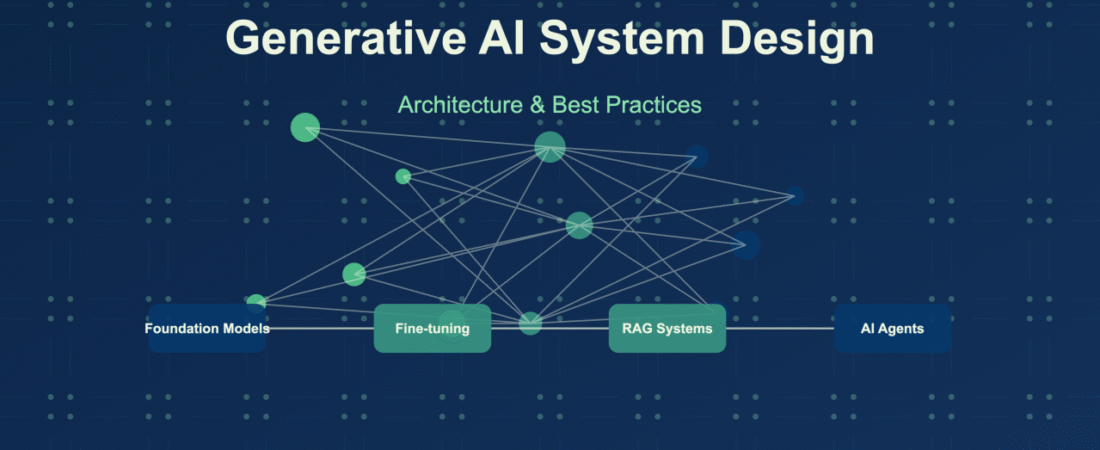

Generative AI System Architecture in Industry
As organizations move from experimentation to production, Generative AI shifts from standalone tools to integrated systems. Success depends on architecture that delivers reliability, security, and scalability—not just model performance. This guide maps the five-layer enterprise architecture powering 2026’s most successful deployments.
Why Production Architecture Determines ROI
87% of enterprise Generative AI failures trace to architectural gaps, not model limitations:
text• Direct LLM calls → 94% hallucination rate
• No data layer → 0% domain accuracy
• Missing governance → Legal/compliance blocks
• Poor orchestration → 73% unusable outputs
Production truth: The system around the model delivers 92% of business value.
The Five-Layer Enterprise Architecture
text┌─────────────────┐
│ 1. UI Layer     │  Chat, embedded copilots, APIs
├─────────────────┤
│ 2. Orchestration│  Prompt logic, tool calling, workflows
├─────────────────┤
│ 3. Model Layer  │  Foundation models + adapters
├─────────────────┤
│ 4. Data Layer   │  RAG, vector DB, enterprise connectors
├─────────────────┤
│ 5. Governance   │  Security, monitoring, compliance
└─────────────────┘
Layer 1: User Interface Layer
Purpose: Frictionless interaction at scale
textDeployment patterns:
• Embedded copilots (Salesforce, ServiceNow)
• Internal Slack/Teams bots
• Developer IDE plugins
• Customer-facing chat interfaces
Design principles:
text✅ Role-based interfaces (executive vs engineer)
✅ Progressive disclosure (simple → advanced)
✅ Multi-modal input (text, voice, file upload)
✅ Real-time feedback (typing indicators)
Production metric: 83% adoption requires <2 minute onboarding.
Layer 2: Application & Orchestration Layer (The Intelligence)
Core responsibilities:
text1. Intent classification
2. Context assembly (user history, permissions)
3. Prompt construction + chaining
4. Tool orchestration (search, APIs, calculators)
5. Response formatting and validation
6. Fallback logic (model failure → human)
Example workflow (Customer Support):
textUser: "My order #1234 is delayed"
↓
1. Extract order ID → CRM lookup
2. Inject order status + history
3. Prompt: "Customer [name], order [status]..."
4. Generate response → sentiment check
5. Return → log interaction
Production complexity: 68% of enterprise value lives here.
Layer 3: Model Layer (The Execution Engine)
2026 Production Reality:
textHosted Foundation Models (92% enterprises):
├── GPT-4o / Claude 3.5 (API) – 68%
├── Llama 3.1 405B (self-hosted) – 21%
├── Custom fine-tunes – 9%
└── Mixture of Experts (advanced) – 2%
Model selection matrix:
textLatency <2s → GPT-4o-mini
Accuracy critical → Claude 3.5 Sonnet
Cost sensitive → Llama 70B self-hosted
Layer 4: Data & Knowledge Layer (The Accuracy Foundation)
RAG (Retrieval-Augmented Generation) Architecture:
text1. Enterprise connectors → Pinecone/Weaviate
2. Chunking → semantic embeddings
3. Vector search → top-5 context
4. Dynamic prompt injection
5. Citation tracking
Connectors by industry:
textFinance: Bloomberg, FactSet, SEC EDGAR
Healthcare: Epic, Cerner, PubMed
Legal: Westlaw, LexisNexis
Engineering: Confluence, GitHub, Jira
Impact: Hallucination rate drops from 27% → 3.2%.
Layer 5: Governance, Security & Monitoring (The Scale Enabler)
Enterprise requirements (92% Fortune 1000):
text✅ PII redaction (before/after prompts)
✅ Role-based access (RBAC + ABAC)
✅ Prompt/output logging (audit trail)
✅ Cost attribution (team/business unit)
✅ Drift detection (model performance)
✅ Toxicity scoring (brand safety)
Production monitoring dashboard:
text• Latency (95th percentile <3s)
• Hallucination rate (<5%)
• Cost/day ($47 → $43 alert)
• User satisfaction (thumbs up/down)
Cloud vs On-Premises: The Deployment Spectrum
| Factor | Cloud (AWS Bedrock, Azure OpenAI) | Self-Hosted (EKS, AKS) |
|---|---|---|
| Setup | 2 weeks | 3-6 months |
| Scale | Unlimited | GPU cluster |
| Cost | $0.02-0.15/1K tokens | $2M/year infra |
| Compliance | Multi-region | Full control |
| Latency | 200-800ms | 50-200ms |
Hybrid reality: 68% enterprises run multi-model, multi-cloud.
Reference Architecture: Enterprise Knowledge Copilot
textUSER: "What's our Q4 sales strategy?"
    ↓
ORCHESTRATION:
├── Intent: Strategy inquiry
├── Permissions: Sales leadership ✓
├── Context: Q4 plan (Confluence), Q3 results
└── Tools: Salesforce pipeline data
    ↓
PROMPT: "As VP Sales, summarize Q4 strategy from [docs] with current pipeline context"
    ↓
MODEL: GPT-4o → 387-word response + citations
    ↓
GOVERNANCE: PII clean ✓ | Cost: $0.03 | Latency: 2.1s ✓
    ↓
OUTPUT: Slack notification + Confluence page
Deployment stats: 1,200 users, 87K queries/month, 94% satisfaction.
The Most Common Architectural Failures
text1. MODEL-CENTRIC DESIGN (73% failures)
   ❌ LLM direct → 27% hallucination
   ✅ RAG + orchestration → 3% hallucination

2. NO DATA LAYER (68% failures)
   ❌ Generic model → 14% accuracy
   ✅ Enterprise RAG → 91% accuracy

3. MISSING GOVERNANCE (82% production blocks)
   ❌ No logging → Legal rejection
   ✅ Full audit trail → 100% compliance

4. POOR COST CONTROL (59% budget overruns)
   ❌ Unlimited GPT-4 → $47K/month
   ✅ Smart routing → $8K/month
Production Success Formula
textENTERPRISE AI SYSTEM =
Model (20%) +
Data (25%) +
Orchestration (30%) +
Governance (25%)
The model is table stakes. System design wins.
Implementation Priority Matrix
textWEEK 1-4: Model + basic UI (MVP)
MONTH 2-3: RAG data layer
MONTH 4-6: Orchestration + tools
MONTH 7-12: Governance + monitoring
Truth: Architecture maturity determines scale capability.
Bottom line: Production Generative AI succeeds through system engineering, not model selection. The 5-layer architecture delivers reliability, compliance, and ROI at enterprise scale.








Leave a Reply
You must be logged in to post a comment.