
Latest posts
-
The Future of Generative AI

Generative AI is still early. The next breakthroughs will come from better reasoning, memory, efficiency, alignment, and autonomous systems—not just larger models. The future belongs to engineers and researchers who build what doesn’t exist yet. #GenerativeAI #AIResearch #FutureOfAI #Innovation
-
Multimodal and Agentic Generative AI Systems
The future of Generative AI is multimodal and agentic. AI systems are evolving from passive responders to autonomous agents that can plan, use tools, and act toward goals. This shift unlocks powerful new applications—and new responsibilities. #GenerativeAI #AgenticAI #MultimodalAI…
-
Advanced Generative AI Implementation and System Optimization

Training models is only half the challenge—most Generative AI cost and complexity lives in inference and optimization. Techniques like quantization, distributed execution, and tiered model strategies define production-grade AI systems. Engineering discipline is the real differentiator. #GenerativeAI #AIEngineering #ModelOptimization…
-
Inside Large Generative Models
Transformer models power modern Generative AI through self-attention, embeddings, and scale. Understanding how these systems work internally is essential for engineers, researchers, and architects building next-generation AI solutions. Innovation starts with deep technical clarity. #GenerativeAI #Transformers #AIEngineering #MachineLearning
-
Generative AI in Production – Challenges, Risks, and Proven Solutions
Most Generative AI failures don’t happen in demos—they happen in production. Hallucinations, cost overruns, security risks, and model drift are systemic challenges that require architectural and operational solutions. Production-ready AI is an engineering discipline. #GenerativeAI #AIInProduction #EnterpriseAI #AIGovernance
-
Fine-Tuning, RAG, and Enterprise Adaptation of Generative AI

Enterprise Generative AI is not about training massive models—it’s about adaptation. Fine-tuning adjusts behavior, while RAG injects real-time enterprise knowledge to reduce hallucinations and improve trust. Most production systems rely on RAG as their backbone. #GenerativeAI #RAG #EnterpriseAI #AIEngineering
-
Advanced Prompt Engineering and Optimization

Prompts are not questions—they are engineered interfaces. Advanced prompt engineering determines accuracy, cost, and reliability of Generative AI in enterprise environments. Treat prompts as code, not experimentation. #PromptEngineering #GenerativeAI #EnterpriseAI #AIArchitecture
-
RAG Implementation Patterns & LLMOps Production Guide
RAG Implementation Patterns & LLMOps Production Guide Retrieval-Augmented Generation (RAG) and LLMOps represent the production engineering backbone of enterprise Generative AI. RAG reduces hallucinations from 27% to 3.2% while enabling domain-specific accuracy. LLMOps ensures 99.7% uptime across millions of…
-
Generative AI System Architecture in Industry
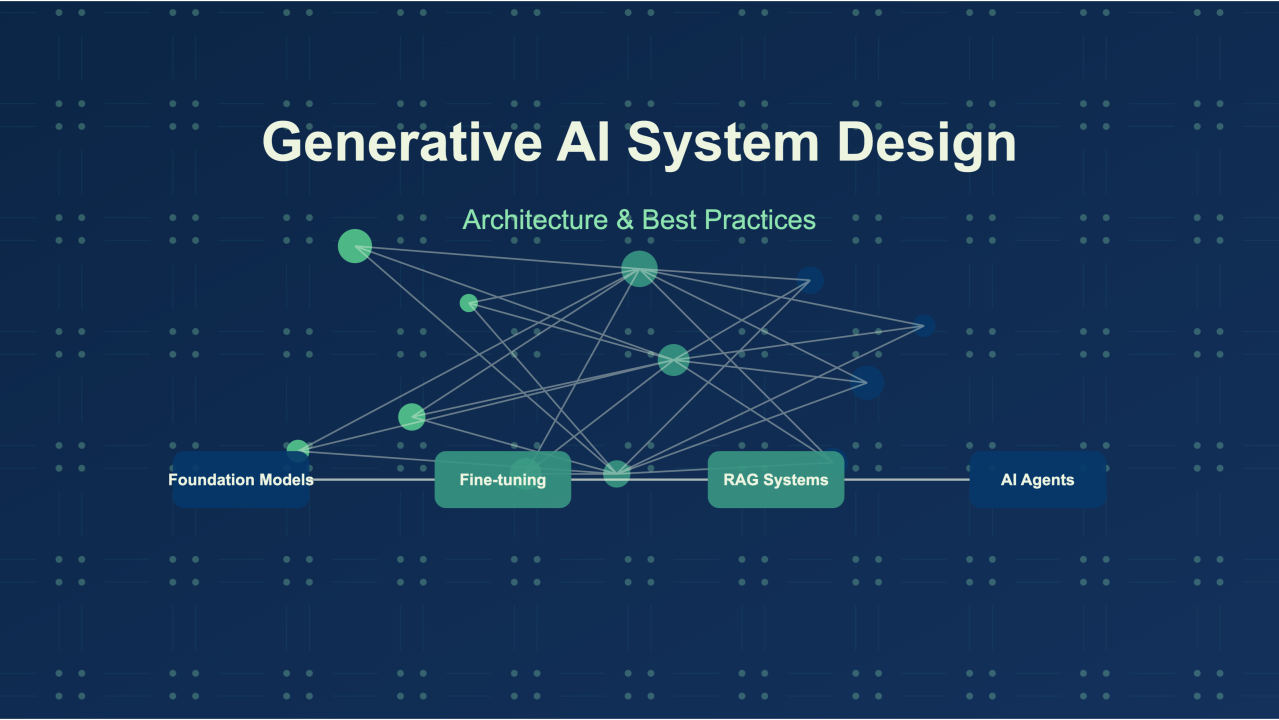
In enterprise environments, Generative AI is not a model—it’s a system. Success depends on architecture: orchestration, data integration, governance, and monitoring. Organizations that design AI systems properly scale faster, safer, and more cost-effectively. #GenerativeAI #EnterpriseAI #SystemArchitecture #AIEngineering
-
Where Generative AI Is Used Today

Generative AI is no longer experimental—it’s operational. From marketing and software development to healthcare and finance, organizations are using AI as a copilot to scale productivity and knowledge. Understanding current use cases is the first step toward successful adoption.…