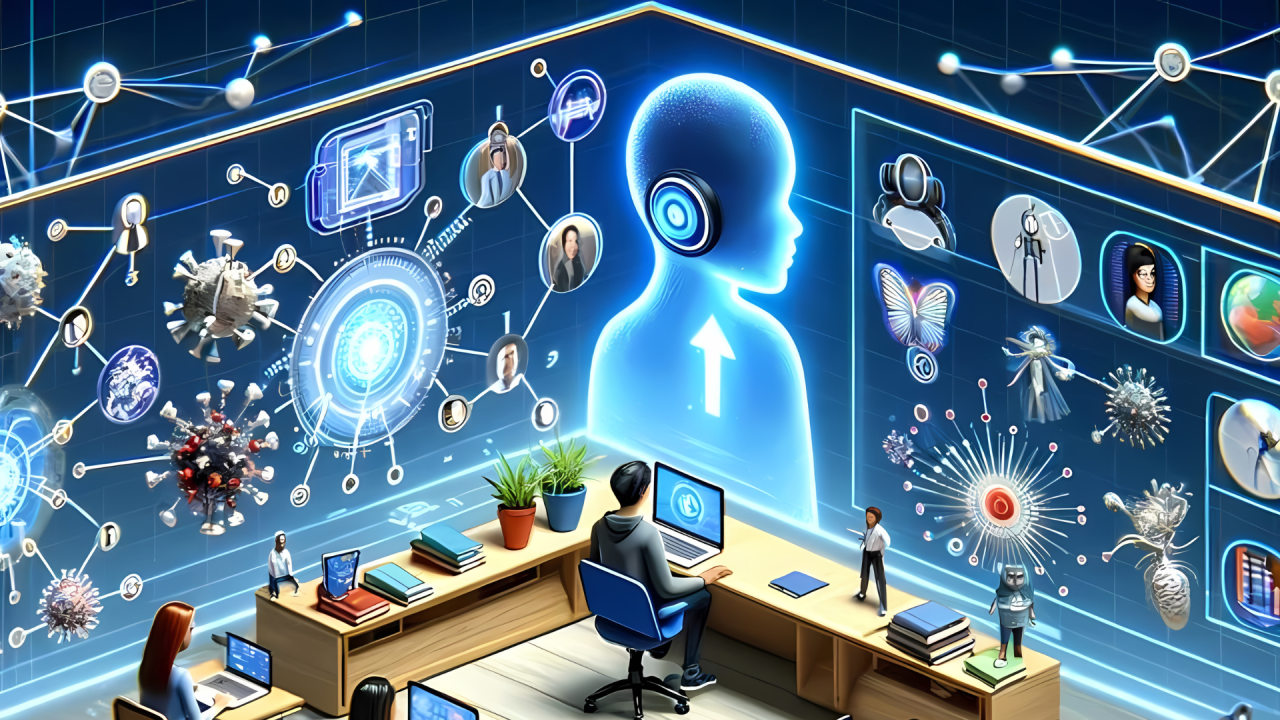

Market Demand: Personalized learning, assessment automation, hybrid learning
Sample Projects:
- AI-Powered Lecture Summarizer (Whisper + GPT)
- Quiz Generator from PDFs and Video Lectures
- Adaptive Learning Path Engine (based on learning style + progress)
- Real-Time Doubt Solving Tutor Chatbot with Math Solver API
✅ Skills Mapped: NLP, OCR, Speech-to-Text, Adaptive algorithms
AI for education and digital learning is one of the fastest-growing AI segments, driven by demand for personalized learning, hybrid classrooms, and assessment automation. Below is a detailed, project-focused blog that ties your sample ideas into market demand, technology, and operations.
AI in Education: Market and Opportunity
AI in education is scaling rapidly as schools, universities, and corporate training providers adopt tools for personalization, analytics, and automation. Global AI-in-education markets are projected to grow from a few billion USD mid‑2020s to several tens or even hundreds of billions by the early 2030s, with strong demand in personalized learning and adaptive platforms.
Key demand drivers:
- Personalized learning paths for diverse learners.
- Assessment automation and formative feedback at scale.
- Hybrid and online learning models needing AI support for engagement and support.
Your proposed projects align well with the core capabilities the market expects: NLP, speech‑to‑text, adaptive algorithms, and real‑time tutoring.
Project 1: AI-Powered Lecture Summarizer
Goal: Turn long lectures (video or audio) into concise, structured summaries with key points, definitions, and action items.
Tech Stack and Architecture
- Input: Lecture audio/video file or URL.
- Core technologies:
- Speech-to-text: OpenAI Whisper or similar for accurate transcription, including accents and noisy environments.
- NLP/LLM: GPT-like model for summarization, key topics extraction, and Q&A generation.
- Pipeline:
- Ingest audio/video → run Whisper → generate timestamped transcript.
- Clean transcript (remove filler words, noise, repetitions).
- Chunk transcript into segments and pass to LLM for:
- Bullet-point summary per segment.
- Global summary, key terms, and definitions.
- Optionally generate:
- Auto-generated quiz questions.
- “Cheat sheet” or flashcards.
Operational Flow (High-Level)
- Student uploads lecture or LMS passes recording.
- Backend processes asynchronously; user notified when summary is ready.
- UI displays:
- Summary sections.
- Link back to timestamps.
- Download as PDF/Notes.
- Optional integration with LMS (LTI) for one-click “Summarize this lecture”.
Market Usage
Lecture summarizers are increasingly used in universities, MOOCs, and corporate training to reduce cognitive load and help learners review faster. Reviews highlight benefits like time savings and improved retention for students who cannot rewatch full-length lectures.
Project 2: Quiz Generator from PDFs and Video Lectures
Goal: Automatically generate formative assessments (MCQs, short answer, flashcards) from course material.
Tech and Workflow
- Inputs: PDFs (slides, textbooks), lecture transcripts.
- Core technologies:
- OCR / PDF parsing to extract structured text.
- NLP/LLM for question generation and distractor creation.
- Pipeline:
- Extract text from PDF or use transcript from the summarizer.
- Segment content by topic/heading.
- For each segment, LLM generates:
- MCQs with 1 correct + N distractors.
- True/false questions.
- Short answer prompts.
- Optional difficulty labeling (easy/medium/hard) based on concept complexity.
Operational Flow
- Instructor uploads content → selects course, topic, difficulty, number of questions.
- System processes in background; instructor reviews and edits the bank.
- Export to:
- LMS quizzes.
- Print/pdf for offline use.
- Track which questions are used and how students perform to refine future generations.
Market Usage
AI-driven assessment and quiz generation support formative assessment at scale and are part of many adaptive learning and tutoring platforms. Studies show that intelligent tutoring and automated assessments can improve learning gains when combined with instructor guidance and regular usage.
Project 3: Adaptive Learning Path Engine
Goal: Dynamically personalize the learning path for each learner based on performance, behavior, and preferences.
Core Technology Concepts
- Knowledge tracing: Algorithms estimate learners’ mastery of micro‑skills (concepts) after each interaction.
- Adaptive sequencing: Recommender logic selects the next best activity to optimize learning efficiency.
- Data sources: Quiz scores, time-on-task, clickstream, self‑reported confidence, learning style preferences.
Architecture
- Backend engine:
- Student model: stores current mastery level per concept (0–1).
- Content model: tags each resource with concepts, difficulty, modality (video, text, practice).
- Policy: mapping from state → next activity.
- Algorithms:
- Simple: rule-based paths (if score < threshold → remedial node).
- Advanced: Bayesian knowledge tracing or deep knowledge tracing for skill mastery, RL-inspired recommenders.
Operational Flow
- Learner logs in → takes diagnostic quiz or initial activities.
- Engine estimates baseline mastery profile.
- For each step:
- Engine selects next content based on gaps, preferences, and constraints (e.g., time).
- Learner completes task; results logged.
- Model updates mastery estimates and re-evaluates path.
- Teacher view:
- Dashboard showing mastery, risk flags, and recommended interventions.
Market Usage
Adaptive pathway engines are now central to many K‑12 and higher‑ed platforms, shortening time to competency and giving teachers granular insights. Some vendors report sizable time savings and increased growth when learners meet usage targets.
Project 4: Real-Time Doubt-Solving Tutor Chatbot
Goal: Offer students an on-demand assistant to ask questions, get explanations, and solve math or coding problems.
Tech Stack
- NLP/LLM: Core conversational engine for explanations and Q&A.
- Math solver API: For symbolic math, equation solving, and step-by-step solutions.
- RAG (Retrieval-Augmented Generation): To ground answers in course-specific content (slides, notes, textbooks).
Operation Flow
- Student opens chat widget in LMS or app.
- Types a question or uploads a screenshot of a problem (optional OCR for math).
- Pipeline:
- Detect subject (math, physics, programming).
- Retrieve relevant content chunks from course materials.
- Call math solver if equation/problem-focused.
- Use LLM to:
- Combine retrieved content + solver output.
- Generate a guided, step-by-step explanation appropriate to the student’s level.
- Safety/guardrails:
- Encourage understanding, not just giving final answers.
- Offer hints first, then full solutions.
Market Usage
AI tutors and virtual teaching assistants are being deployed in K‑12, higher ed, and professional training as scalable support outside classroom hours. Research indicates positive but nuanced learning gains, especially when tools are integrated with teacher workflows and used regularly.
Skills and Technologies Mapped
These projects collectively touch a broad, industry‑relevant skill set:
- NLP: Summarization, question generation, conversational tutoring.
- Speech-to-Text: Whisper-based lecture transcription and multimodal processing.
- OCR and Document Understanding: Parsing PDFs and images for quiz generation and tutoring.
- Adaptive Algorithms: Knowledge tracing, recommendation, and policy design for learning paths.
RAG and Data Engineering: Integrating content repositories, embeddings, and LLMs for grounded answers.
For a portfolio or product roadmap, these four projects cover the core pillars of AI in digital learning: content understanding, assessment, personalization, and tutoring—right where current market growth and demand are strongest.




Leave a Reply
You must be logged in to post a comment.