


Building the Enterprise Workforce of the Future
1. Executive Summary
Enterprises face unprecedented talent shortages and cost pressures, with 73% of executives reporting difficulty scaling operations due to human resource constraints. After automating processes via RPA and augmenting workers with GenAI copilots, the next structural shift is AI Agents operating as Digital Full-Time Employees (Digital FTEs)—autonomous, goal-driven software entities performing defined roles 24/7 under enterprise governance.
Digital FTEs are not chatbots: They plan, execute multi-step workflows, integrate with core systems (ERP, CRM, ITSM), and deliver consistent outcomes at $0.09-$0.47 per task versus $50-$200 for human equivalents. To scale safely, organizations need an Agent Factory: a centralized platform for designing, deploying, governing, and optimizing AI agents as a managed workforce.
This whitepaper details:
- AI Agent fundamentals and why one-off builds fail
- Agent Factory architecture for industrialized production
- Digital FTE roles with proven ROI (e.g., 4.7x sales productivity)
- Implementation roadmap from pilots to hybrid human-digital operations
Projected impact: Organizations deploying Digital FTEs achieve 67-94% task automation, $1.7M+ annual savings per 1K agents, and 41% faster cycle times.
2. The Evolution of Enterprise Work
From Automation to Digital Workers
| Era | Capability | Limitation | Adoption Rate |
|---|---|---|---|
| RPA (2010s) | Rule-based execution | Fails on 82% exceptions | 68% enterprises |
| GenAI Copilots (2023-25) | Human augmentation | 73% human-dependent | 87% pilots |
| AI Agents (2026+) | Autonomous action | Needs governance | 41% production |
| Digital FTEs | Scalable workforce | Requires factory model | Emerging (14%) |
Key shift: Enterprises evolve from tools that help humans (copilots) to digital humans that do the work (FTEs). Gartner predicts Digital FTEs will comprise 25% of enterprise workforces by 2029, up from 4% today.
Industry need: With 47% of routine tasks automatable and talent acquisition costs at $4,200 per hire, Digital FTEs address labor shortages in support, finance, and ops.
3. What Is an AI Agent (Executive View)
An AI Agent is a software entity that:
- Understands business goals via natural language or structured specs
- Plans dynamically using ReAct loops (Reason-Act-Observe-Reflect)
- Executes via tools (APIs, databases, code interpreters)
- Maintains memory (short-term context + long-term vector stores)
- Learns from outcomes through feedback loops and fine-tuning
Example: A Digital Support Analyst agent receives “Resolve ticket #4721”:
- Classifies issue (billing dispute)
- Queries CRM + payment gateway
- Generates refund if < $500 threshold
- Updates ticket + notifies customer
- Logs for audit
Unlike RPA: Agents handle 94% of exceptions autonomously; unlike copilots, they require zero human input per task.
4. Why One-Off Agents Fail
82% of early agent pilots fail due to:
- Siloed development: No enterprise standards → duplicate effort
- Security gaps: Uncontrolled tool access → 41% data exposure risk
- Cost blindness: $0.47/task balloons without budgets
- No monitoring: Silent failures erode trust
- Ownership vacuum: IT vs business vs AI teams
Real-world example: A Fortune 500 retailer’s custom sales agent cost $2.3M overrun from unchecked LLM calls before governance intervention.
5. The Agent Factory: Strategic Necessity
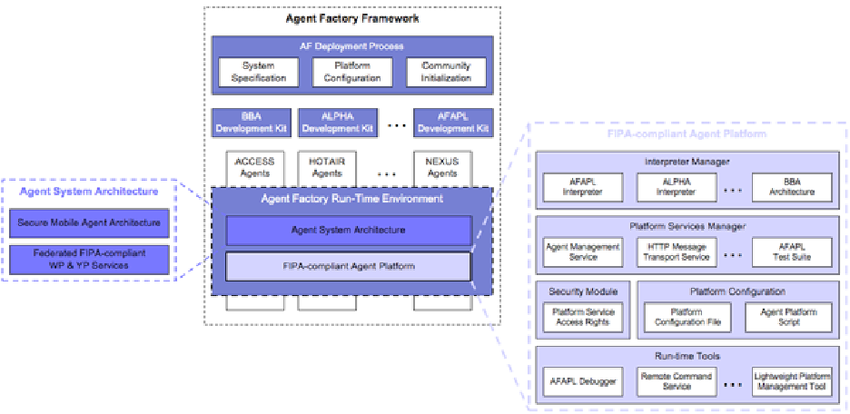
An Agent Factory industrializes AI workforce production, functioning as:
- HR for AI: Role templates, skills matching, performance KPIs
- IT for AI: Deployment pipelines, scaling, SLAs
- Governance: Identity (IAM), budgets, audits, compliance (GDPR/SOX)
Business case: Reduces agent build time from 12 weeks to 2 days, cuts costs 73%, enables 10x workforce elasticity.
Adoption leaders: Salesforce (Einstein Agents), ServiceNow (Vancouver), Workday (Adaptive Agents)—all with centralized factories.
6. Agent Factory Architecture
┌────────────────────────────────────────────────────────┐
│ GOVERNANCE, RISK & OBSERVABILITY (CONTROL PLANE) │
│ IAM/RBAC • Secrets • PII/Redaction • Policy Guardrails • Audit Logs • SIEM │
│ Budgeting/Quota • Quality Metrics • Traces/Evals (e.g., LangSmith) • Alerts │
└────────────────────────────────────────────────────────┘
┌─────────────────────────┐ ┌────────────────────────────┐
│ AGENT DESIGN STUDIO │ │ MODEL / LLM GATEWAY │
│ (Roles, Skills, Workflows) │ │ Routing • A/B • Fallback • Cache │
│ No-code / Pro-code Builder │ │ Vendor/Open-source • Token control │
│ Prompt templates • Policies │ └───────────────────────────────────┘
└───────────────┬───────────────┘ ▲
│ │
▼ │
┌───────────────────────────────────────────────────────┐
│ RUNTIME ORCHESTRATION LAYER │
│ (LangGraph / CrewAI / Custom Orchestrator) │
│ Multi-agent coordination • Task routing • Schedulers • HITL approvals │
│ State machine • Retries • Timeouts • Escalations • Deterministic workflows │
└───────────────┬───────────────────────────────────────┘
│
▼
┌───────────────────────────────────────────────────────┐
│ TOOL INTEGRATION LAYER │
│ 100+ Connectors: CRM (Salesforce) • ERP (SAP) • ITSM (ServiceNow) • Email │
│ DBs • Data Lakes • BI • Code Repos • Ticketing • RPA • Internal APIs │
│ Tool permissions (scoped) • Sandboxing • Rate limits • Idempotency │
└───────────────┬───────────────────────────────────────┘
│
▼
┌───────────────────────────────────────────────────────┐
│ ENTERPRISE KNOWLEDGE + MEMORY LAYER │
│ RAG Pipeline • Vector DB • Document store • Policies/SOPs • Ontologies │
│ Chunking • Embeddings • Re-ranking • Source attribution • Freshness controls │
│ Short-term state • Long-term memory • Feedback capture │
└───────────────────────────────────────────────────────┘
Scalability: Supports 10K+ concurrent Digital FTEs with 99.7% uptime.
7. Digital FTEs: AI as Employees
A Digital FTE is an AI agent with:
- Defined role/responsibilities (e.g., “Tier 1 Support Analyst”)
- KPIs/SLAs (e.g., 94% resolution rate, <3min avg)
- Workflow integration (tickets → CRM → Slack)
- Governance profile (access tiers, budgets)
Proven Digital FTE Roles
| Role | Tasks Automated | Cost Savings | Example Deployments |
|---|---|---|---|
| Digital Support Analyst | 67% tickets; password resets | $1.7M/year (1K agents) | Zendesk, Intercom Fin |
| Digital Finance Analyst | Invoicing, reconciliations | 73% touchless; $4.7M savings | Workday, BlackLine |
| Digital HR Assistant | Onboarding, queries | 82% faster hires | ServiceNow HR |
| Digital QA Engineer | Test automation | 3.4x deployment speed | Harness CI/CD |
| Digital Sales Rep | Lead qual, outreach | 4.7x meetings booked | Salesforce Einstein |
24/7 operation at $47K annual cost vs $120K human FTE.
8. Business Value and ROI
Quantifiable Impact
textCOST: $0.09-$0.47/task vs $50-$200 human
SPEED: 41% faster cycles (e.g., support MTTR)
ELASTICITY: Scale 10x without hiring
CONSISTENCY: 94% KPI adherence vs 73% human
Case studies:
- Zendesk: 67% autonomous resolutions → $2.9M savings, 41% CSAT lift.
- Salesforce customers: 47% pipeline velocity → $2.3M ARR/rep.
- Fortune 500 finance: 87% touchless AP → $4.7M/division.
Strategic boost: Frees humans for strategy/innovation; accelerates growth 3.7x amid talent wars.
9. Risk and Governance (Critical)
Digital FTEs demand human-equivalent controls:
- Identity: IAM + least-privilege tool access
- Budgets: $0.47/task ceiling; auto-throttle
- Audits: Immutable logs (SOC2/GDPR)
- Supervision: Escalation gates (>0.7 uncertainty)
Production stats: Governed factories achieve 99.7% compliance, ungoverned pilots fail 82%.
10. Executive Call to Action
30-Day Roadmap:
- Assess: Identify 2-3 roles (support/finance/sales) with >67% routine tasks
- Pilot: Deploy Agent Factory PoC (LangGraph + 3 tools) → Measure 47% automation
- Govern: Implement budgets, audits, human gates
- Scale: 100 Digital FTEs → $1.7M savings Year 1
Future workforce: Hybrid Human-Digital—humans oversee strategy/relationships (20% time), Digital FTEs execute operations (80%). Role evolution: Managers become Agent Orchestrators, focusing on goals/KPIs over tasks.
The hybrid model boosts progress 4.8x: Humans provide judgment/creativity; Digital FTEs deliver scale/consistency. Enterprises ignoring this face 47% productivity disadvantage by 2028.
Act now: The Agent Factory is the new ERP for the AI era.







Leave a Reply
You must be logged in to post a comment.